2 More Than 3 Times A Number Is 17

monithon
Mar 18, 2026 · 7 min read
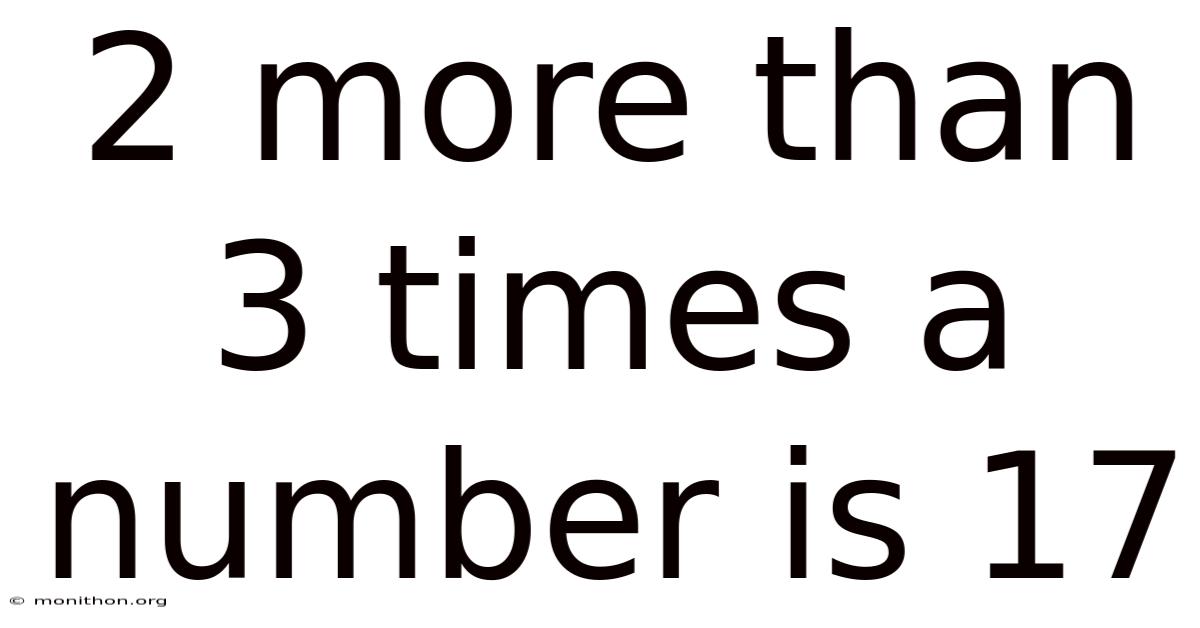
Table of Contents
Unlocking the Mystery: Solving "2 More Than 3 Times a Number is 17"
At first glance, the statement "2 more than 3 times a number is 17" sounds like a simple riddle or a cryptic clue. Yet, it is the very essence of algebra, the mathematical language we use to describe relationships and solve for unknowns. This phrase is not just a puzzle; it is a linear equation waiting to be decoded. For many students and lifelong learners, translating words into a mathematical equation is the first and most crucial hurdle. Mastering this skill unlocks the door to everything from calculating personal finances to understanding scientific formulas. This article will guide you through the precise, logical steps to transform that verbal statement into a solved answer, building a rock-solid foundation for all future math success. By the end, you will not only know the solution but also understand the powerful, universal principles behind it.
The Critical First Step: Translating Words into an Equation
The bridge between a word problem and its solution is the algebraic equation. We must carefully dissect the English sentence to identify its mathematical components.
- "a number": This is our unknown, the value we need to find. In algebra, we represent an unknown number with a variable, most commonly the letter x. So, "a number" becomes x.
- "3 times a number": The word "times" explicitly means multiplication. Therefore, "3 times a number" translates directly to 3x.
- "2 more than": This phrase indicates addition. It means we take the quantity that comes before it ("3 times a number" or 3x) and add 2 to it. So, "2 more than 3 times a number" becomes 3x + 2.
- "is": In mathematical terms, the word "is" always means equals (=). It is the balance point of the equation.
- "17": This is the known quantity on the other side of the equals sign.
Putting it all together, the sentence "2 more than 3 times a number is 17" transforms into the clean, solvable equation: 3x + 2 = 17
This translation is the most important part of the process. A single misinterpretation—for example, reading "2 more than" as 2x + 3—will lead to a completely wrong answer. Always parse the sentence piece by piece.
The Systematic Solution: A Four-Step Method to Find x
With the equation 3x + 2 = 17 in hand, we now apply the fundamental rules of algebra to isolate the variable x. The goal is to perform operations that undo what has been done to x, maintaining perfect balance on both sides of the equals sign at every single step. Think of the equation as a perfectly balanced scale; whatever you do to one side, you must do to the other.
Step 1: Identify the Operations Attached to the Variable. Look at the left side, 3x + 2. The variable x has two operations performed on it in order: first, it is multiplied by 3, and then 2 is added to that result. To isolate x, we must reverse these operations in the reverse order (following the reverse PEMDAS/BODMAS rule).
Step 2: Undo the Addition/Subtraction (The outermost operation). The last operation done to x was adding 2. The inverse (opposite) of addition is subtraction. So, we subtract 2 from both sides of the equation to cancel out the +2.
- 3x + 2 – 2 = 17 – 2
- This simplifies to: 3x = 15
- Why? On the left, +2 and –2 cancel each other out, leaving just 3x. On the right, 17 – 2 equals 15. The scale remains balanced.
Step 3: Undo the Multiplication/Division. Now, x is being multiplied by 3. The inverse of multiplication is division. To undo multiplying by 3, we divide both sides by 3.
- (3x) ÷ 3 = 15 ÷ 3
- This simplifies to: x = 5
- Why? On the left, 3x ÷ 3 simplifies to 1x, or just x. On the right, 15 ÷ 3 equals 5.
Step 4: Verify and Interpret the Solution. We have found x = 5. But a solution is not complete until it is checked. Substitute 5 back into the original equation to verify:
- Original: 3x + 2 = 17
- Substitute: 3(5) +
2 = 17
- Calculate: 15 + 2 = 17
- Result: 17 = 17 ✓
The equation is true, confirming our solution is correct. The number we were looking for is 5.
Beyond the Numbers: The Power of This Method
This problem is a simple example, but the method is universal. The four-step process—translate, identify operations, reverse them in order, and verify—applies to all linear equations, no matter how complex they appear. Whether the problem involves money, distance, time, or any other real-world quantity, the algebraic steps remain the same.
Mastering this process builds more than just math skills; it develops logical thinking and problem-solving abilities. It teaches you to break down a complex situation into manageable parts, to work systematically, and to always check your work. These are invaluable skills in academics, careers, and everyday life.
The beauty of algebra is that it provides a universal language for solving problems. By learning to translate words into equations and then solving them with a clear, methodical approach, you gain a powerful tool for understanding and interacting with the world. So, the next time you encounter a problem that seems like a confusing mix of words and numbers, remember this process. Translate it, isolate the variable, and solve it—one balanced step at a time.
Applying the Method to Real-World Scenarios
The four-step process isn’t confined to abstract equations—it’s a tool for solving tangible problems. For instance, imagine a scenario where you’re planning a road trip. If a car rental costs $30 per day plus a $20 insurance fee, and your total budget is $110, you can model this as 30x + 20 = 110, where x represents the number of days. Using the same method:
- Translate: Identify the operations (multiplication and addition).
- Reverse Operations: Subtract 20 first, then divide by 30.
- Solve: x = (110 − 20) ÷ 30 = 3 days.
- Verify: 30(3) + 20 = 110 ✓.
This approach scales to more complex situations, like calculating discounts, interest rates, or even scientific formulas. The key is translating the problem into an equation, then systematically isolating the variable.
Common Pitfalls and How to Avoid Them
Even with a clear method, mistakes can occur. A frequent error is reversing operations in the wrong order—for example, dividing before subtracting in the original equation. This would lead to x = (17 ÷ 3) − 2 ≈ 3.67, which fails verification. Another trap is arithmetic errors during simplification. Double-checking each step—especially during verification—is critical.
The Role of Practice
Mastery of this method comes with repetition. Start with simple equations, then gradually introduce variables on both sides (e.g., 2x + 5 = x + 10) or fractional coefficients. Over time, the process becomes intuitive. Tools like algebra tiles or digital solvers can aid visualization, but the core principle remains: reverse operations methodically.
A Lifelong Skill
Beyond academics, this systematic thinking translates to everyday decisions. Whether budgeting expenses, analyzing data, or troubleshooting a problem, breaking it into steps, identifying key variables, and reversing assumptions fosters clarity. Algebra trains the mind to approach chaos with structure—a skill invaluable in any field.
Conclusion
The equation 3x + 2 = 17 may seem trivial, but it encapsulates a powerful philosophy: problems are solvable when approached with logic and patience. By translating real-world challenges into mathematical language and applying a reverse-step-by-step strategy, we unlock solutions that might otherwise seem elusive. Algebra isn’t just about finding x; it’s about cultivating a mindset that turns complexity into clarity. As you encounter new problems, remember this process: translate, isolate, reverse, verify. With it, you’re not just solving equations—you’re building a toolkit for lifelong problem-solving. The next time you face an unknown, start by asking, What operation is being done last? The answer will guide you to the solution.
Latest Posts
Latest Posts
-
How Many Centimeters Are In 2 M
Mar 18, 2026
-
What Quantum Numbers Specify These Subshells
Mar 18, 2026
-
4 Divided By 1 3 As A Fraction
Mar 18, 2026
-
Without Red Marrow Bones Would Not Be Able To
Mar 18, 2026
-
How Many Hours Until 9 Am
Mar 18, 2026
Related Post
Thank you for visiting our website which covers about 2 More Than 3 Times A Number Is 17 . We hope the information provided has been useful to you. Feel free to contact us if you have any questions or need further assistance. See you next time and don't miss to bookmark.
