2 More Than 3 Times A Number X Is 17

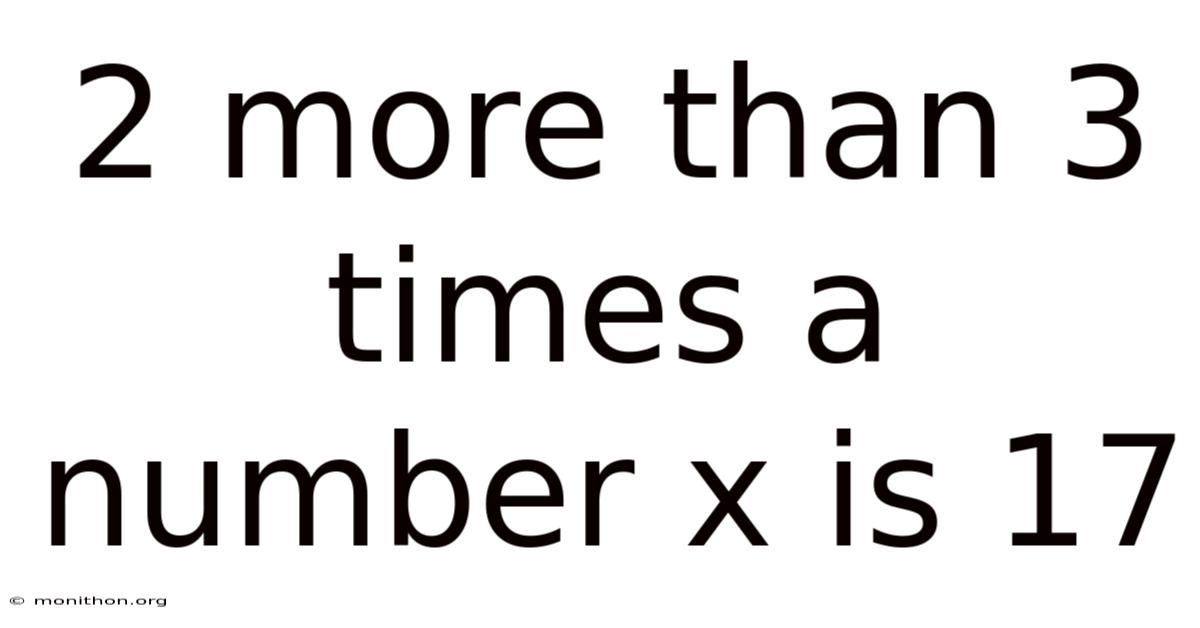
Finding the Value of x in the Equation "2 More Than 3 Times a Number x is 17"
When we encounter word problems in mathematics, it's important to translate the words into a mathematical equation that we can solve. The phrase "2 more than 3 times a number x is 17" may sound tricky at first, but breaking it down step by step makes it much easier to understand and solve. In this article, we will explore how to translate this statement into an equation, solve for the unknown number x, and understand the logic behind each step.
Understanding the Problem Statement The statement "2 more than 3 times a number x is 17" can be broken into parts to help us build the correct equation. Let's look at each part:
"3 times a number x" means we multiply x by 3, which gives us 3x. "2 more than" means we add 2 to whatever comes after it, so we add 2 to 3x. "Is 17" tells us that the result of the previous calculation equals 17.
By putting all these parts together, we get the equation: 3x + 2 = 17.
Setting Up the Equation Now that we have translated the words into a mathematical expression, we can set up the equation: 3x + 2 = 17 This equation is what we need to solve to find the value of x.
Solving the Equation Step by Step To solve for x, we need to isolate it on one side of the equation. Here's how we do it:
Step 1: Subtract 2 from both sides of the equation to remove the constant term on the left side. 3x + 2 - 2 = 17 - 2 This simplifies to: 3x = 15
Step 2: Divide both sides by 3 to isolate x. 3x / 3 = 15 / 3 This simplifies to: x = 5
Therefore, the value of x that satisfies the equation "2 more than 3 times a number x is 17" is 5.
Checking the Solution To make sure our solution is correct, we can substitute x = 5 back into the original statement:
3 times 5 is 15. 2 more than 15 is 17.
This matches the original statement, so our solution is correct.
Understanding the Logic Behind the Solution The process of solving this equation involves basic algebraic operations: addition, subtraction, and division. By following the order of operations and isolating the variable, we can find the value of x. This method is not only useful for this particular problem but also forms the foundation for solving more complex equations in algebra.
Applications and Importance Understanding how to translate word problems into equations and solve them is a fundamental skill in mathematics. It is used in various fields such as science, engineering, economics, and everyday problem-solving. Being able to break down a problem into manageable steps and solve it logically is a valuable skill that extends beyond the classroom.
Conclusion In this article, we have learned how to solve the equation "2 more than 3 times a number x is 17" by translating the words into a mathematical expression, setting up the equation, and solving it step by step. The solution, x = 5, satisfies the original statement. This process highlights the importance of understanding algebraic concepts and applying logical steps to solve problems. With practice, solving such equations becomes easier and more intuitive, paving the way for tackling more advanced mathematical challenges.
Expanding on Algebraic Thinking
While this example focuses on a linear equation with a single variable, the principles demonstrated are scalable. More complex word problems often involve multiple variables and operations. The key remains the same: careful translation of language into mathematical symbols. Consider a scenario like, “The length of a rectangle is 5 more than twice its width. If the perimeter is 34, find the length and width.” This requires assigning variables to both length (l) and width (w), formulating two equations based on the given information (l = 2w + 5 and 2l + 2w = 34), and then employing techniques like substitution or elimination to solve for both unknowns.
Furthermore, recognizing patterns and utilizing properties of equality are crucial. For instance, the distributive property (a(b+c) = ab + ac) frequently appears when dealing with expressions in parentheses. Similarly, understanding inverse operations – addition and subtraction, multiplication and division – is paramount for isolating variables. A common mistake students make is performing the same operation on only one side of the equation, disrupting the balance and leading to an incorrect solution. Maintaining equality throughout the solving process is non-negotiable.
Beyond simple equations, these skills are foundational for understanding functions, graphing, and ultimately, calculus. The ability to model real-world situations mathematically allows for prediction, optimization, and a deeper understanding of the world around us. For example, calculating loan payments, determining optimal production levels, or predicting population growth all rely on the principles of translating word problems into equations and solving them effectively.
In conclusion, mastering the art of translating word problems into algebraic equations isn’t merely about finding the correct numerical answer. It’s about developing a powerful problem-solving mindset, honing logical reasoning skills, and building a strong foundation for future mathematical endeavors. The ability to deconstruct a complex situation, represent it symbolically, and manipulate those symbols to arrive at a solution is a skill that transcends mathematics and proves invaluable in countless aspects of life.
Latest Posts
Latest Posts
-
Aqueous Sodium Carbonate Cobalt Ii Nitrate
Mar 20, 2026
-
Find The Acceleration When The Velocity Is 0
Mar 20, 2026
-
Find The Missing Values In The Following Table
Mar 20, 2026
-
Finding Acceleration From Velocity And Distance
Mar 20, 2026
-
What Is The Decimal Of 80
Mar 20, 2026
