20x 5y 15 Solve For Y

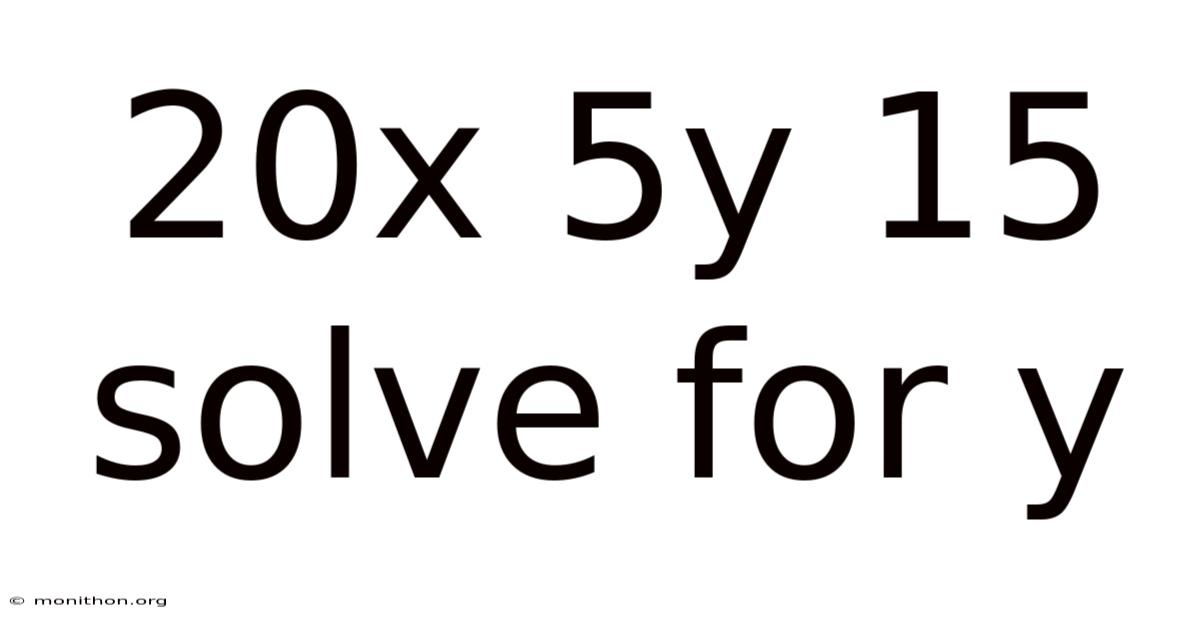
To solve the equation (20x + 5y = 15) for (y), we isolate the variable (y) through a series of algebraic steps. This process involves basic arithmetic operations to rearrange the equation, ensuring (y) stands alone on one side. The goal is to express (y) in terms of (x), providing a clear relationship between the two variables. Below, we detail the method, explain the underlying principles, and address common questions.
Steps to Solve for y
-
Subtract 20x from both sides: The first step is to eliminate the (20x) term from the left side of the equation. This is done by subtracting (20x) from both sides, maintaining balance. [ 20x + 5y - 20x = 15 - 20x ] Simplifying, we get: [ 5y = 15 - 20x ]
-
Divide both sides by 5: The next step is to eliminate the coefficient 5 multiplying (y). This is achieved by dividing both sides of the equation by 5. [ \frac{5y}{5} = \frac{15 - 20x}{5} ] Simplifying further: [ y = \frac{15}{5} - \frac{20x}{5} ] [ y = 3 - 4x ]
The Result Therefore, the solution to (20x + 5y = 15) for (y) is: [ y = 3 - 4x ] This equation represents a linear relationship where (y) decreases by 4 units for every 1-unit increase in (x). It defines (y) explicitly in terms of (x), allowing you to calculate (y) for any given (x).
Scientific Explanation Algebraically, solving for a specific variable involves applying inverse operations to both sides of the equation. The inverse of addition is subtraction, and the inverse of multiplication is division. Here, subtracting (20x) removes its influence, and dividing by 5 eliminates the coefficient of (y). This systematic approach ensures the equation remains balanced while isolating the desired variable. The resulting expression (y = 3 - 4x) is the explicit form of the linear equation, clearly showing how (y) depends on (x).
FAQ
- What does it mean to solve for y? It means rearranging the equation so that y is by itself on one side, expressed solely in terms of x (or other variables).
- Can I solve for x instead? Yes! You can isolate x by subtracting 5y and then dividing by 20: (x = \frac{3 - y}{4}).
- Is this solution unique? For any given x, there is exactly one corresponding y that satisfies the equation, confirming it's a function.
- Why do we perform the same operation on both sides? To maintain the equation's balance and equality. Whatever you do to one side, you must do to the other.
- What if the equation had different coefficients? The process remains the same: subtract or add terms to move other variables/constants, then divide by the coefficient of the target variable.
Conclusion Solving (20x + 5y = 15) for (y) yields the linear equation (y = 3 - 4x). This demonstrates a fundamental algebraic technique: isolating a variable to understand its relationship with others. Mastering these steps builds a strong foundation for tackling more complex equations and real-world problems involving linear relationships.
To verify the solution, substitute the expression for(y) back into the original equation and confirm that both sides remain equal for any chosen value of (x). For instance, let (x = 2). Then (y = 3 - 4(2) = -5). Plugging these into (20x + 5y) gives (20(2) + 5(-5) = 40 - 25 = 15), which matches the right‑hand side. This consistency holds for all real numbers, reinforcing that the derived formula correctly captures the relationship between the variables.
Graphically, the equation (y = 3 - 4x) is a straight line with a slope of (-4) and a y‑intercept at ((0, 3)). The negative slope indicates that as (x) increases, (y) falls at a constant rate, which aligns with the algebraic interpretation that each unit increase in (x) reduces (y) by four units. Plotting a few points—such as ((-1, 7)), ((0, 3)), ((1, -1)), and ((2, -5))—and connecting them yields the same line, providing a visual check of the algebraic manipulation.
In practical contexts, linear equations like this model scenarios where one quantity changes at a steady rate relative to another. For example, if (x) represents the number of hours a machine operates and (y) denotes the remaining units of a resource, the equation could describe a consumption rate of four units per hour, starting with an initial supply of three units. Solving for (y) allows operators to predict resource levels at any given time, facilitating scheduling and maintenance decisions.
When dealing with systems of linear equations, isolating one variable—as we did here—often serves as the first step in substitution methods. By expressing (y) explicitly in terms of (x), we can substitute this expression into a second equation to solve for (x) directly, then back‑substitute to find (y). This technique extends seamlessly to higher‑dimensional problems, underscoring the importance of mastering basic variable isolation.
Finally, recognizing equivalent forms of the same relationship enhances flexibility. The expression (y = 3 - 4x) can be rewritten as (4x + y = 3) or (x = \frac{3 - y}{4}), each highlighting a different perspective. Choosing the most convenient form depends on the specific problem at hand, whether it involves graphing, substitution, or interpreting coefficients.
Conclusion
By systematically applying inverse operations, we isolated (y) in the equation (20x + 5y = 15) to obtain (y = 3 - 4x). This result not only satisfies the original equation for every real (x) but also reveals a clear linear trend with a slope of (-4) and an intercept of (3). Verifying through substitution, visualizing on a graph, and considering real‑world applications all reinforce the correctness and utility of the solution. Mastering such algebraic manipulation lays a solid groundwork for tackling more intricate equations and for translating mathematical relationships into practical insights.
Beyond the basic isolation of (y), the equation (20x+5y=15) illustrates several broader algebraic principles that become valuable when the problem scales up. One useful perspective is to view the equation as a dot product: the vector (\langle20,5\rangle) dot (\langle x,y\rangle) equals 15. This geometric view emphasizes that all solution pairs ((x,y)) lie on a line orthogonal to the coefficient vector, reinforcing why the slope is (-\frac{20}{5}=-4). Recognizing this orthogonality can speed up the process of sketching the line without computing individual points.
Another extension involves treating the equation as a constraint in optimization. Suppose we wish to minimize a cost function (C = ax^2 + by^2) subject to (20x+5y=15). Using Lagrange multipliers, we set (\nabla C = \lambda \nabla(20x+5y)) and solve the resulting system, which again reduces to substituting (y = 3-4x) into the cost function. This demonstrates how the isolated expression serves as a building block for more advanced techniques such as constrained optimization or linear programming.
In data analysis, the same linear relationship appears when fitting a simple linear regression model with a single predictor. If we collect observations ((x_i, y_i)) that truly follow (y = 3-4x) plus random noise, the least‑squares estimates of the slope and intercept will converge to (-4) and (3) as the sample size grows. Thus, the ability to isolate and interpret the slope provides immediate insight into the underlying generative process, a skill that translates directly to interpreting regression output in fields ranging from epidemiology to finance.
Finally, consider the equation’s role in modular arithmetic. Working modulo 5, the term (5y) vanishes, leaving (20x \equiv 15 \pmod{5}), which simplifies to (0 \equiv 0). This tells us that any integer (x) yields a corresponding integer (y) that satisfies the original equation, highlighting the infinite nature of the solution set. Such observations are useful when solving Diophantine equations or when designing algorithms that rely on linear congruences.
Conclusion
The straightforward step of isolating (y) in (20x+5y=15) opens the door to a variety of mathematical tools—from geometric interpretations and optimization techniques to statistical modeling and modular reasoning. By mastering this foundational manipulation, learners gain a versatile lens through which they can view and solve more complex problems, reinforcing the idea that elementary algebraic skill is a gateway to deeper quantitative understanding.
Latest Posts
Latest Posts
-
3 3 4 Cups Divided By 2
Mar 20, 2026
-
How Many Grams Are In 50 Ml
Mar 20, 2026
-
Where Can A Chemical System Be Found
Mar 20, 2026
-
What Is The Value Of 8
Mar 20, 2026
-
What Classifies A War As A World War
Mar 20, 2026
