3 More Than The Product Of 2 And X

monithon
Mar 16, 2026 · 7 min read
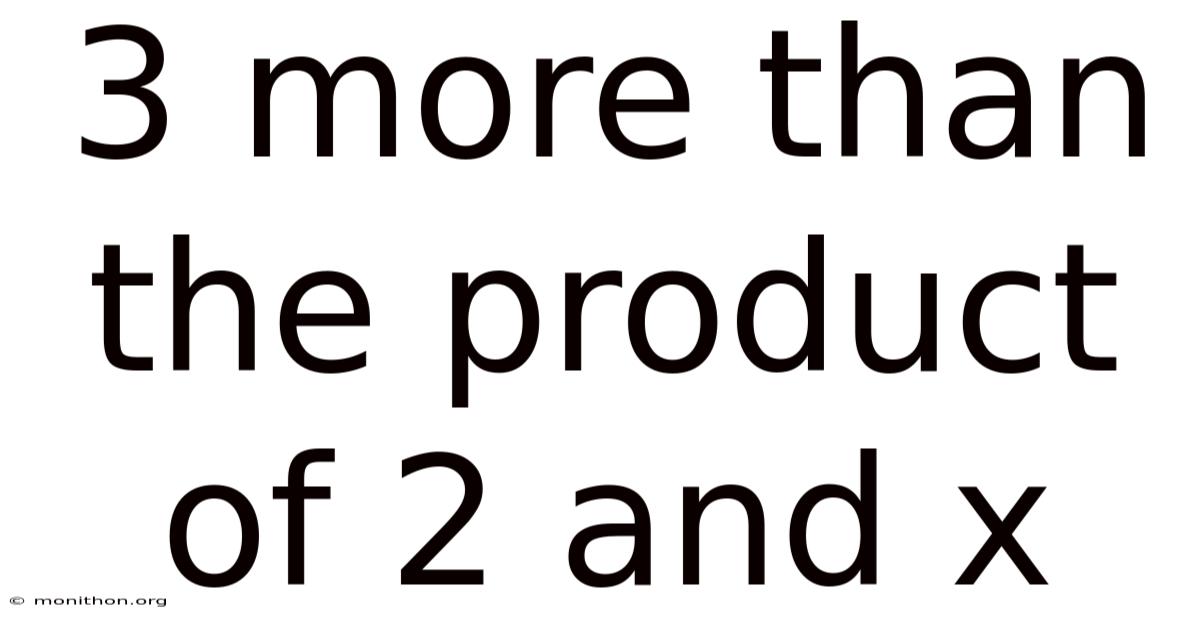
Table of Contents
Understanding "3 More Than the Product of 2 and x": A Fundamental Algebraic Expression
The phrase "3 more than the product of 2 and x" is a classic example of how everyday language is translated into the precise, symbolic language of algebra. Mastering this translation is a critical first step in building a strong foundation for all future mathematics, from solving simple equations to modeling complex real-world phenomena. This expression is not just an abstract string of symbols; it is a powerful tool for describing relationships, predicting outcomes, and solving problems. At its core, "3 more than the product of 2 and x" translates directly to the algebraic expression 2x + 3. This article will deconstruct this phrase piece by piece, explore its meaning, visualize it, and demonstrate its surprising utility across numerous practical scenarios.
Breaking Down the Phrase: A Word-by-Word Analysis
To translate any verbal phrase into algebra, we must identify the key operational words and the order in which they imply operations should be performed. The phrase follows a very specific logical sequence.
- "the product of 2 and x": The word "product" is the mathematical term for the result of multiplication. Therefore, this part of the phrase instructs us to multiply the number 2 by the variable x. In algebra, we write this as 2x. The convention is to write the numerical coefficient (2) before the variable (x), and we omit the multiplication sign for clarity.
- "3 more than...": The phrase "more than" is a comparative phrase that signals addition. It indicates that we are taking the quantity described before the phrase ("the product of 2 and x") and adding something to it. Crucially, "3 more than [something]" means [something] + 3, not 3 + [something]. While addition is commutative (order doesn't matter for the final sum), the phrasing follows a specific mental sequence: start with the base amount and then add the extra amount.
- Combining the Parts: Putting it all together, we start with the product (2x) and then add 3 to it. This gives us the final, standard algebraic expression: 2x + 3.
It is vital to understand that the expression 2x + 3 is not an equation (it does not contain an equals sign). It is an expression—a combination of numbers, variables, and operations that represents a single numerical value for any given value of x. Its value changes depending on what number we substitute for the variable x.
Translating to Algebra: The Standard Form and Its Components
The expression 2x + 3 is written in a standard form that reveals its internal structure. This structure is fundamental to understanding more complex polynomials later.
- Terms: The expression has two distinct terms: 2x and 3. Terms are separated by addition (+) or subtraction (-) signs.
- Variable Term: The term 2x is called the variable term because it contains the variable x. The number 2 is the coefficient—it tells us how many times the variable is multiplied. Here, the coefficient is 2.
- Constant Term: The term 3 is the constant term. It is a fixed number that does not change, regardless of the value of x.
- Like Terms: In this simple expression, the two terms are unlike terms (one contains a variable, the other does not). They cannot be combined further. This principle becomes essential when simplifying more complex expressions.
A common mistake is to misinterpret the order and write 2(x + 3). This would mean "2 times the quantity of (x plus 3)," which translates to the phrase "twice the sum of x and 3" or "2 times (x increased by 3)." The parentheses change the order of operations entirely. Our original phrase, "3 more than the product," dictates that the multiplication by 2 happens first, and then we add 3. Therefore, 2x + 3 is correct, and 2(x + 3) is incorrect for this specific wording.
Visualizing the Expression: A Number Line and Area Model
Abstract symbols become more tangible with visualization. Consider the expression 2x + 3 for a moment.
- Number Line Interpretation: Imagine a number line. Start at 0. The term 2x means you move a distance that is twice the value of x from zero. If x is positive, you move to the right; if x is negative, you move to the left. Then, from that new position, you add 3, which means you move 3 units to the right. Your final position on the number line represents the value of 2x + 3.
- Area Model (for positive x): Picture a rectangle. Its length is 2 units. Its width is x units. The area of this rectangle is 2 * x = 2x. Now, imagine attaching a smaller rectangle or a strip to one side of this larger rectangle. This added strip has an area of 3 square units (e.g., a 1x3 or 3x1 rectangle). The total area of this new, combined shape is 2x + 3. This model beautifully illustrates that the expression represents a total composed of two distinct parts: a variable part (2x) and a fixed part (3).
Real-World Applications: Where This Expression Lives
The power of algebra lies in its application. The expression 2x + 3 can model countless situations. Let's explore a few.
- Cost Calculation: You are buying tickets. There is a flat $3 processing fee for the entire order. Each ticket costs $2. If you buy x tickets, your total cost is 2x + 3 dollars.
- Distance and Speed: A cyclist travels at a constant speed of 2 meters per second for x seconds, covering a distance of 2x meters. After that, they walk an additional 3 meters. The total distance traveled is 2x + 3 meters.
- Age Problems: Currently, Maria is 3 years older than twice her younger brother's age. If her brother's age is x years, then Maria's age is 2x + 3 years.
- Recipe Scaling:
If a base recipe for x servings requires 2x cups of flour, but you always add an extra 3 cups to ensure a crispy topping, your total flour usage is 2x + 3 cups.
Conclusion
Mastering the translation from verbal phrases to algebraic expressions like 2x + 3 is more than an academic exercise; it is the cultivation of precise mathematical literacy. The distinction between 2x + 3 and 2(x + 3) underscores a fundamental principle: the order of operations is not arbitrary but is dictated by the logical sequence described in words. Visual models, from number lines to area diagrams, transform abstract symbols into concrete, manipulable concepts, bridging the gap between symbolic manipulation and intuitive understanding. Finally, recognizing these patterns in real-world contexts—from calculating costs and distances to scaling recipes—demonstrates algebra's power as a universal language for modeling relationships. By rigorously practicing this translation, students build the essential skill of converting complex, word-based problems into solable mathematical forms, a competency that forms the bedrock for all future success in mathematics and its applications.
This ability to deconstruct and reconstruct relationships through expressions like 2x + 3 is the gateway to functional thinking. It moves us from solving static equations to understanding dynamic systems where one quantity depends on another. Whether predicting the total cost of a scalable service, modeling the growth of a plant that has an initial height plus a variable growth rate, or calculating a utility bill with a fixed base charge plus a variable usage rate, the pattern of a constant plus a multiple of a variable is ubiquitous. Recognizing this pattern allows one to bypass laborious step-by-step calculations and engage directly with the underlying structure of a problem.
Ultimately, the journey from a verbal description to the compact elegance of 2x + 3 is a exercise in clarity and precision. It demands that we identify what is known, what is unknown, and how they relate. This disciplined approach to parsing information is invaluable far beyond the mathematics classroom. It trains the mind to look for the fixed and the variable, the independent and the dependent, in any complex scenario—from personal finance and scientific data to logistical planning and algorithmic design. By mastering this fundamental translation, we do not merely learn algebra; we acquire a foundational tool for structured, logical reasoning about the quantitative world.
Latest Posts
Latest Posts
-
3 4 Divided By 1 1 2
Mar 16, 2026
-
What Process Never Occurs In Interphase
Mar 16, 2026
-
What Is The Formula For Copper Ii Chloride
Mar 16, 2026
-
How Many Ml Is 4 Liters
Mar 16, 2026
-
Add Multiple Gradients To Same Object Illustrator
Mar 16, 2026
Related Post
Thank you for visiting our website which covers about 3 More Than The Product Of 2 And X . We hope the information provided has been useful to you. Feel free to contact us if you have any questions or need further assistance. See you next time and don't miss to bookmark.
