5 Less Than A Number Is 15

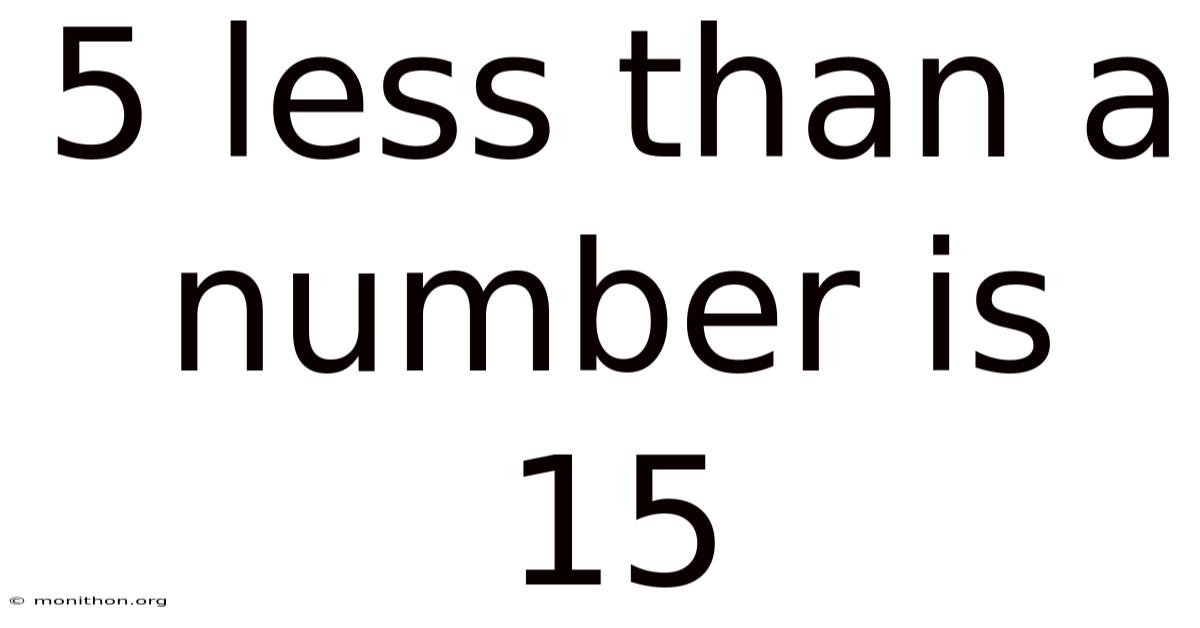
5 less than a number is 15 is a simple yet powerful statement that introduces the core idea of translating everyday language into algebraic equations. At first glance, the phrase may look like a riddle, but it actually describes a linear relationship that can be solved with basic algebra. Understanding how to move from words to symbols is a foundational skill that helps students tackle more complex problems in mathematics, science, and everyday decision‑making. In this article we will break down the meaning of the sentence, show how to turn it into an equation, solve it step by step, verify the answer, and explore where similar reasoning appears in real life.
Introduction
When we hear “5 less than a number is 15,” we are being told that if we take an unknown quantity and subtract five from it, the result equals fifteen. The unknown quantity is what we call a variable—often represented by the letter (x). The goal is to find the value of (x) that makes the statement true. This type of problem belongs to the family of one‑step linear equations, which are the building blocks for all higher‑level algebra.
Understanding the Phrase
Breaking Down the Language
- “A number” → the unknown value we are looking for.
- “5 less than” → indicates subtraction of five from that unknown value.
- “Is 15” → tells us the result of the subtraction equals fifteen.
Notice the order: “5 less than a number” means we start with the number and then take away five, not the other way around. If we reversed the phrase to “a number less than 5,” the meaning would change completely.
Translating Words to Symbols
Using the variable (x) for the unknown number, the phrase becomes:
[ x - 5 = 15 ]
This equation states that when five is subtracted from (x), the outcome is fifteen.
Step‑by‑Step Solution
Solving a one‑step equation involves isolating the variable on one side of the equals sign. Here’s how we do it:
-
Write the original equation
[ x - 5 = 15 ] -
Add 5 to both sides to cancel the (-5) on the left.
[ x - 5 + 5 = 15 + 5 ] -
Simplify each side.
[ x = 20 ]
The variable (x) is now alone, and we have determined that the number satisfying the original statement is 20.
Checking the Solution
A good habit in algebra is to substitute the found value back into the original wording to ensure it makes sense.
- Start with the number we found: 20.
- Take 5 less than 20: (20 - 5 = 15).
- The result is indeed 15, which matches the condition given in the problem.
Since the check confirms the answer, we can be confident that (x = 20) is correct.
Real‑World Applications
Although the example looks abstract, the same reasoning appears in many everyday situations:
| Situation | How the phrase appears | Equation | Solution |
|---|---|---|---|
| Shopping discount | A coupon gives you $5 off, and you end up paying $15. What was the original price? | (p - 5 = 15) | (p = 20) dollars |
| Cooking recipe | You need to remove 5 grams of salt from a mixture to reach 15 grams. How much salt did you start with? | (s - 5 = 15) | (s = 20) grams |
| Travel distance | After driving 5 miles less than planned, you have traveled 15 miles. What was the planned distance? | (d - 5 = 15) | (d = 20) miles |
In each case, the phrase “5 less than a number is 15” models a scenario where a known reduction leads to a known outcome, and we need to recover the original amount.
Common Mistakes and How to Avoid Them
-
Reversing the subtraction
- Mistake: Writing (5 - x = 15) (thinking “5 less than” means subtract the number from 5).
- Fix: Remember that “less than” always refers to subtracting the stated amount from the unknown, not the other way around.
-
Forgetting to perform the same operation on both sides
- Mistake: Adding 5 only to the left side, resulting in (x = 15).
- Fix: Whatever you do to one side of the equation must be done to the other to keep the equality true.
-
Misreading the phrase as “5 less than a number equals 15” and then solving for 5
- Mistake: Solving for the constant instead of the variable.
- Fix: Identify the variable first (the unknown number) and treat all known numbers as constants.
Practicing with similar phrases—such as “7 more than a number is 12” or “three times a number decreased by 4 equals 11”—helps reinforce the correct translation process.
Practice Problems
Try translating and solving each of the following on your own before checking the answers.
- 8 less than a number is 22.
- 4 less than twice a number is 10.
- A number decreased by 6 equals 9.
Answers
- (x - 8 = 22 ;\rightarrow; x = 30) 2. Let the number be (x). “Twice a number” is (2x). Then (2x - 4 = 10 ;\rightarrow; 2x = 14 ;\rightarrow; x = 7).
- (x - 6 = 9 ;\rightarrow; x = 15).
Working through these examples builds confidence in recognizing the structure of the language and applying the inverse operation correctly.
Frequently Asked Questions
Q: Why do we add 5 to both sides instead of subtracting it?
Answer: We add 5 to both sides because the equation (x-5=15) represents a value that is 5 less than the unknown. To isolate the unknown, we must undo that subtraction. Adding 5 cancels the “‑5” on the left side, leaving just (x). If we were to subtract 5 instead, we would be making the left side even smaller, moving us farther from the solution.
Extending the Idea: “More than,” “Twice,” and “Three Times”
The same systematic approach works for any linear relationship, not just “less than.”
- “More than” translates to addition: “3 more than a number is 12” → (x+3=12).
- “Twice a number” translates to multiplication: “Twice a number decreased by 4 equals 10” → (2x-4=10).
- “Three times a number plus 2 equals 20” → (3x+2=20).
In each case, identify the operation that connects the unknown to the known numbers, then perform the inverse operation on both sides to isolate the variable.
Real‑World Modeling: From Word Problems to Equations
- Read the problem carefully. Highlight phrases that indicate operations (e.g., less than, more than, together, split). 2. Assign a variable to the unknown quantity.
- Translate the phrase into an algebraic expression using the chosen variable.
- Set the expression equal to the given result.
- Solve by performing inverse operations, always keeping the equation balanced.
- Check the solution by substituting it back into the original word problem.
Example: A store sells notebooks for $3 each. After buying some notebooks and paying a $5 shipping fee, a customer’s total bill is $23. How many notebooks were purchased?
- Let (n) = number of notebooks.
- Cost of notebooks = (3n).
- Total cost = (3n + 5 = 23). - Subtract 5: (3n = 18).
- Divide by 3: (n = 6).
- Check: (3 \times 6 + 5 = 23) ✔️
Quick Reference Cheat Sheet
| Phrase | Algebraic Form | Inverse Operation |
|---|---|---|
| “k less than a number” | (x - k) | Add (k) |
| “k more than a number” | (x + k) | Subtract (k) |
| “k times a number” | (kx) | Divide by (k) |
| “A number divided by k” | (\frac{x}{k}) | Multiply by (k) |
| “k increased by a number” | (k + x) | Subtract (k) |
| “k decreased by a number” | (k - x) | Add (x) (solve for (x)) |
Keep this table handy; it’s a fast way to convert everyday language into solvable equations.
Conclusion
Understanding how everyday language maps onto algebraic expressions is a foundational skill that unlocks a wide range of problem‑solving abilities. By systematically identifying the unknown, translating relational phrases into equations, and then applying inverse operations, you can confidently tackle everything from simple “5 less than a number is 15” scenarios to more complex real‑world word problems. Practice regularly, watch for common pitfalls, and always verify your answers—soon the translation process will feel as natural as reading the sentence itself.
Latest Posts
Latest Posts
-
How To Find Y Intercept Of A Function
Mar 19, 2026
-
Ax By C Solve For B
Mar 19, 2026
-
How Many Ounces Is 5 Lbs
Mar 19, 2026
-
How Many Colorado Rivers Are There
Mar 19, 2026
-
In Which Part Of The Cell Does Transcription Occur
Mar 19, 2026
