6 Less Than The Product Of 4 And X

monithon
Mar 12, 2026 · 9 min read
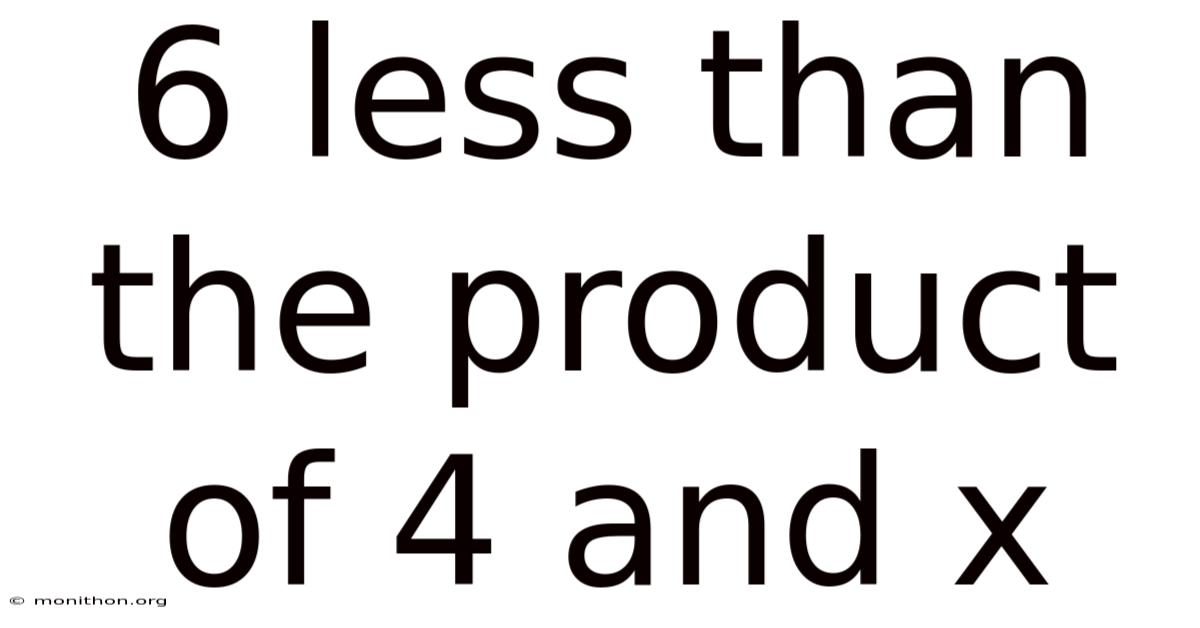
Table of Contents
6 less than the product of 4 and x is a common verbal phrase that appears in algebra textbooks, word problems, and standardized tests. Understanding how to translate this phrase into a mathematical expression—and how to work with that expression—is a foundational skill for students learning algebra, as well as for anyone who needs to model real‑world situations with equations. In this article we will break down the meaning of the phrase, show step‑by‑step how to convert it into an algebraic form, explore how to solve equations that involve it, discuss practical applications, highlight typical mistakes, and provide practice problems to reinforce the concepts.
Understanding the Phrase
The phrase “6 less than the product of 4 and x” can be dissected into three parts:
- The product of 4 and x – multiplication of the number 4 and the variable (x).
- 6 less than – subtract 6 from whatever quantity precedes it.
- The order of operations – the subtraction is applied after the product is formed.
Putting these together yields the algebraic expression
[\boxed{4x - 6} ]
It is crucial to note that “6 less than …” does not mean (6 - 4x); the subtraction always follows the quantity mentioned after “than”. This subtle point is a frequent source of error, especially for beginners.
Translating Verbal Phrases to Algebraic Expressions
Step‑by‑Step Procedure
| Step | Action | Example with “6 less than the product of 4 and x” |
|---|---|---|
| 1 | Identify the core operation mentioned first (here, “product”). | Product → multiplication. |
| 2 | Write the operation using the given numbers/variables. | (4 \times x) or (4x). |
| 3 | Look for the modifier (“less than”, “more than”, “increased by”, etc.). | “6 less than” → subtract 6. |
| 4 | Apply the modifier to the result from step 2, keeping the correct order. | (4x - 6). |
| 5 | Simplify if possible (none needed here). | Final expression: (4x - 6). |
Similar Phrases for Comparison
- “4 more than twice a number” → (2x + 4)
- “Three less than five times x” → (5x - 3)
- “The quotient of x and 7, increased by 2” → (\frac{x}{7} + 2)
Recognizing the pattern helps students quickly convert any verbal description into a symbolic form.
Solving Equations Involving (4x - 6)
Once the expression is formed, it often appears inside an equation or inequality. Below are typical scenarios and the methods to solve them.
1. Simple Linear Equation
Problem: Find (x) if (4x - 6 = 10).
Solution:
[ \begin{aligned} 4x - 6 &= 10 \ 4x &= 10 + 6 \quad (\text{add 6 to both sides})\ 4x &= 16 \ x &= \frac{16}{4} = 4\end{aligned} ]
Answer: (x = 4).
2. Equation with Variables on Both Sides
Problem: Solve (4x - 6 = 2x + 8).
Solution:
[\begin{aligned} 4x - 6 &= 2x + 8 \ 4x - 2x &= 8 + 6 \quad (\text{subtract }2x\text{, add }6)\ 2x &= 14 \ x &= \frac{14}{2} = 7 \end{aligned} ]
Answer: (x = 7).
3. Inequality
Problem: Determine the values of (x) for which (4x - 6 > 14).
Solution:
[ \begin{aligned} 4x - 6 &> 14 \ 4x &> 20 \ x &> 5 \end{aligned} ]
Answer: (x > 5).
4. Word Problem Application
Problem: A rectangle’s length is 4 times its width ((x)). If the perimeter is 6 units less than twice the length, find the width.
Translation:
- Length = (4x)
- Twice the length = (2(4x) = 8x)
- 6 less than that = (8x - 6)
- Perimeter of a rectangle = (2(\text{length} + \text{width}) = 2(4x + x) = 2(5x) = 10x)
Set the perimeter equal to the expression:
[ 10x = 8x - 6 ]
Solve:
[ \begin{aligned} 10x - 8x &= -6 \ 2x &= -6 \ x &= -3 \end{aligned} ]
A negative width is not physically meaningful, indicating that the original condition cannot be satisfied for a real rectangle. This illustrates how algebra can reveal inconsistencies in a problem statement.
Real‑World Applications
The expression (4x - 6) appears in many practical contexts:
| Situation | How (4x - 6) Models It |
|---|---|
| Cost Calculation | A product costs $4 each, and there is a fixed discount of $6. Total cost for (x) items: (4x - 6). |
| Distance‑Time Problems | A vehicle travels at 4 m/s, but starts 6 seconds behind the origin. Position after (x) seconds: (4x - 6) meters. |
| Scoring Systems | In a game, each correct answer earns 4 points, but a penalty of 6 points is applied for each incorrect attempt. Net score after (x) correct answers (assuming no incorrect attempts): (4x - 6). |
| Programming Loops | A loop increments a counter by 4 each iteration, starting at –6. Counter value after (x) iterations: (4x - 6). |
Recognizing the structure lets practitioners quickly set up formulas, make predictions, and troubleshoot models.
Common Mistakes and How to Avoid Them
| Mistake | Why It Happens | Correct Approach |
|---|---|---|
| Writing (6 - 4x) instead of (4x - 6) | Misinterpreting “less than” |
| Mistake | Why It Happens | Correct Approach |
|---|---|---|
| Writing (6 - 4x) instead of (4x - 6) | Misinterpreting “less than” phrases or reversing subtraction order. | Remember: “6 less than (4x)” means (4x - 6), not (6 - 4x). Always translate phrases literally. |
| Forgetting to reverse the inequality sign when multiplying/dividing by a negative | Overlooking the rule for inequalities. | When multiplying or dividing an inequality by a negative number, flip the inequality symbol (e.g., (>) becomes (<)). |
| Dropping parentheses prematurely in word problems | Losing track of operations applied to entire expressions. | Keep parentheses intact until you’ve correctly distributed or combined terms. For example, (2(\text{length} + \text{width})) must be expanded as (2 \times \text{length} + 2 \times \text{width}). |
| Assuming a negative solution is always invalid | Not considering context. | In pure algebra, negative solutions are valid. In word problems, assess whether the quantity can logically be negative (e.g., width, count). If not, the problem may have no feasible solution, as seen in the rectangle example. |
Verifying Solutions
A critical step often overlooked is checking whether a solution satisfies the original equation or inequality. This catches arithmetic errors and ensures contextual validity.
Example: For (4x - 6 = 10) with solution (x = 4):
Substitute: (4(4) - 6 = 16 - 6 = 10) ✓
Example: For the inequality (4x - 6 > 14) with solution (x > 5):
Test (x = 6): (4(6) - 6 = 24 - 6 = 18 > 14) ✓
Test (x = 5): (4(5) - 6 = 20 - 6 = 14 \not> 14) (boundary not included) ✓
Contextual Check: In the rectangle problem, (x = -3) yields length (4(-3) = -12) and perimeter (10(-3) = -30), both nonsensical for physical dimensions. Thus, no valid width exists under the given conditions.
Extending to More Complex Scenarios
The pattern (4x - 6) can appear within larger expressions or systems.
System of Equations:
[
\begin{cases}
4x - 6 = y \
2x + y = 10
\end{cases}
]
Substitute (y) from the first equation into the second:
(2x + (4x - 6) = 10 \Rightarrow 6x - 6 = 10 \Rightarrow 6x = 16 \Rightarrow x = \frac{8}{3}), then (y = 4(\frac{8}{3}) - 6 = \frac{32}{3} - \frac{18}{3} = \frac{14}{3}).
Quadratic Extension:
If (4x - 6) is set equal to (x^2):
(x^2 = 4x - 6 \Rightarrow x^2 - 4x + 6 = 0).
The discriminant ((-4)^2 - 4(1)(6) = 16 - 24 = -8) indicates no real solutions, showing how the same linear expression can lead to different solution types when equated to nonlinear terms.
Conclusion
The expression (4x - 6) serves as a versatile tool for modeling linear relationships, from simple equations to real-world scenarios involving costs, motion, and scoring. Mastery of solving such expressions—through careful translation, systematic manipulation, and rigorous verification—builds foundational algebraic fluency. Recognizing common pitfalls, such as sign errors or misapplied operations, strengthens problem-solving accuracy. Moreover, understanding the contextual meaning of solutions, especially when negative or non-integer values arise, bridges abstract mathematics to practical interpretation. By internalizing these strategies, learners can confidently adapt the pattern (ax + b) to diverse mathematical and applied challenges,
The principles underlying expressions like (4x - 6) underscore a broader truth in mathematics: precision and adaptability are paramount. Whether solving for a variable in isolation or embedding it within complex systems, the methodologies—translation, manipulation, verification—form a universal framework. This framework not only resolves immediate problems but also cultivates a mindset for approaching unfamiliar challenges. For instance, the quadratic extension of (4x - 6) into (x^2 - 4x + 6 = 0) illustrates
The principles underlying expressions like (4x - 6) underscore a broader truth in mathematics: precision and adaptability are paramount. Whether solving for a variable in isolation or embedding it within complex systems, the methodologies—translation, manipulation, verification—form a universal framework. This framework not only resolves immediate problems but also cultivates a mindset for approaching unfamiliar challenges. For instance, the quadratic extension of (4x - 6) into (x^2 - 4x + 6 = 0) illustrates how linear expressions can intersect with nonlinear relationships, revealing the depth of algebraic exploration possible even within seemingly simple structures. Such explorations teach learners to anticipate diverse outcomes—whether real solutions, complex roots, or no solutions at all—and to interpret these results within their respective contexts.
Beyond academic exercises, the ability to dissect and apply expressions like (4x - 6) reflects a critical skill in real-world problem-solving. From optimizing costs and designing physical systems to analyzing data trends, the same principles of algebraic manipulation and contextual validation apply. This adaptability ensures that mathematical tools remain relevant across disciplines, empowering individuals to model and solve practical problems with confidence.
Ultimately, mastering expressions of the form (ax + b) is not merely about finding numerical answers; it is about developing a rigorous, flexible approach to mathematics. It fosters an appreciation for the interplay between abstract reasoning and practical application, preparing learners to tackle increasingly complex challenges. As mathematics evolves, the foundational techniques demonstrated here continue to serve as reliable tools, bridging the gap between theoretical understanding and real-world innovation. In this way, expressions like (4x - 6) are more than just equations—they are gateways to deeper mathematical literacy and creative problem-solving.
Latest Posts
Latest Posts
-
Twice The Difference Of 9 And A Number
Mar 12, 2026
-
60 Grams Equals How Many Milliliters
Mar 12, 2026
-
What Is One Half Of Two Thirds
Mar 12, 2026
-
Re Write The Quadratic Function Below In Standard Form
Mar 12, 2026
-
How Long Is The Act Exam
Mar 12, 2026
Related Post
Thank you for visiting our website which covers about 6 Less Than The Product Of 4 And X . We hope the information provided has been useful to you. Feel free to contact us if you have any questions or need further assistance. See you next time and don't miss to bookmark.
