8 To The Power Of 1/3

monithon
Mar 14, 2026 · 7 min read
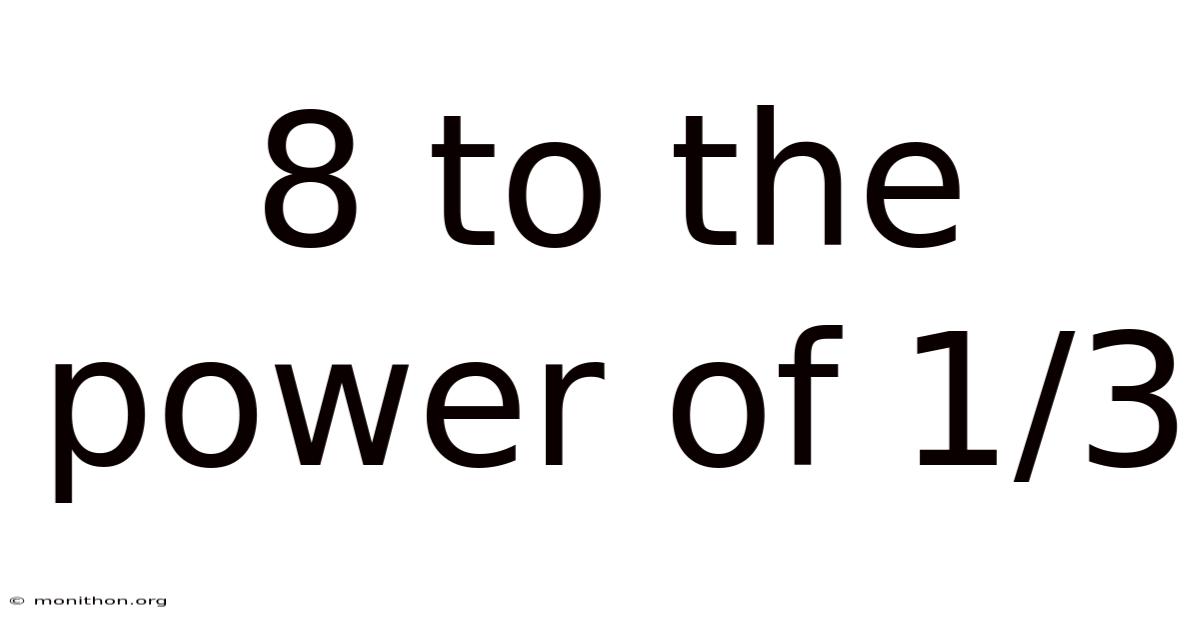
Table of Contents
Understanding 8 to the Power of 1/3: A Deep Dive into Exponents and Roots
When we encounter expressions like 8 to the power of 1/3, it can seem confusing at first. What does it even mean to raise a number to a fractional exponent? How does this relate to roots, and why is this concept important in mathematics? In this article, we will explore the meaning of 8^(1/3), break down the mathematical principles behind it, and uncover its practical applications. Whether you’re a student grappling with exponents or a curious learner seeking to expand your knowledge, this guide will demystify the concept and show how it connects to broader mathematical ideas.
What Does 8^(1/3) Mean?
The expression 8^(1/3) is a way of writing the cube root of 8. In mathematics, a fractional exponent like 1/3 represents a root. Specifically, the denominator of the fraction (3 in this case) indicates the type of root, while the numerator (1 here) tells us the power to which the root is raised. So, 8^(1/3) is equivalent to the cube root of 8, written as ∛8.
To understand this, let’s first recall what a cube root is. The cube root of a number is a value that, when multiplied by itself three times, gives the original number. For example:
- ∛8 = 2 because 2 × 2 × 2 = 8.
- Similarly, ∛27 = 3 because 3 × 3 × 3 = 27.
This means that 8^(1/3) simplifies to 2. But how do we arrive at this conclusion systematically? Let’s break it down step by step.
Breaking Down the Exponent: From Fractions to Roots
Exponents are a way to express repeated multiplication. For instance, 8^2 means 8 × 8, and 8^3 means 8 × 8 × 8. However, fractional exponents introduce a new layer of complexity. The general rule for fractional exponents is:
a^(m/n) = (n√a)^m, where n√a is the nth root of a, and m is the power to which that root is raised.
Applying this to 8^(1/3):
- Here, m = 1 and **n =
Applying the rule, 8^(1/3) = (∛8)^1 = ∛8. Since the cube root of 8 is 2, the expression simplifies directly to 2. This process reveals a powerful symmetry: a fractional exponent with a numerator of 1 simply converts the denominator into a root. However, the true utility of this notation becomes apparent when the numerator is greater than 1. For instance, 8^(2/3) means we first find the cube root of 8 (which is 2) and then square the result, yielding 2² = 4. This unified framework allows us to handle roots and powers within a single, consistent system of exponents, eliminating the need to switch between separate notations like radicals and powers.
This concept extends far beyond perfect cubes. Consider 27^(1/3), which is 3, or 125^(1/3), which is 5. For numbers that are not perfect cubes, such as 10^(1/3), the result is an irrational number approximately equal to 2.154. The fractional exponent notation provides a precise and compact way to represent such values, which is essential in algebra, calculus, and scientific computations. In solving equations, this notation is indispensable. For example, to solve x³ = 8, we rewrite it as x = 8^(1/3), immediately identifying the real solution. Similarly, equations like x^(3/2) = 27 can be tackled by raising both sides to the reciprocal power (2/3), a maneuver made intuitive by the rules of fractional exponents.
The implications ripple into higher mathematics and applied sciences. In geometry, cube roots arise when relating the volume of a cube to its side length. In physics, they appear in formulas involving density, pressure, and scaling laws. In finance, fractional exponents are used in compound interest calculations when growth periods are subdivided. Even in computer graphics, root calculations help with perspective and dimension scaling. Mastering 8^(1/3) is therefore not an isolated trick but a gateway to understanding a fundamental language of mathematics—one that bridges arithmetic, algebra, and beyond. It exemplifies how a single, elegant rule can unify seemingly disparate operations, providing both conceptual clarity and practical efficiency.
Conclusion
Understanding 8^(1/3) illuminates the deep connection between exponents and roots, showcasing the coherence of mathematical notation. What begins as a simple calculation—finding that the cube root of 8 is 2—opens the door to a versatile tool for expressing and manipulating powers and roots in a unified system. This fractional exponent rule is more than a computational convenience; it is a foundational concept that empowers problem-solving across algebra, calculus, and the sciences. By grasping this principle, learners gain not only a specific answer but also a key to unlocking broader mathematical fluency, where complex operations become intuitive extensions of basic ideas.
Conclusion
Understanding 8^(1/3) illuminates the deep connection between exponents and roots, showcasing the coherence of mathematical notation. What begins as a simple calculation—finding that the cube root of 8 is 2—opens the door to a versatile tool for expressing and manipulating powers and roots in a unified system. This fractional exponent rule is more than a computational convenience; it is a foundational concept that empowers problem-solving across algebra, calculus, and the sciences. By grasping this principle, learners gain not only a specific answer but also a key to unlocking broader mathematical fluency, where complex operations become intuitive extensions of basic ideas.
Ultimately, the power of representing roots as fractional exponents lies in its ability to simplify complex mathematical expressions and provide a consistent framework for various operations. It fosters a deeper understanding of mathematical relationships and equips individuals with a powerful tool for tackling challenges in diverse fields. The seemingly simple example of 8^(1/3) serves as a brilliant illustration of how a unified notation can streamline mathematics, making it more accessible and ultimately, more powerful. It's a cornerstone of mathematical literacy, paving the way for a more nuanced and comprehensive understanding of the mathematical world.
This principle extends seamlessly into more advanced territories. When students encounter logarithms, they recognize that the logarithm of a number is, in essence, the exponent to which a base must be raised—a direct echo of the relationship between (8^{1/3}) and its result. In calculus, the derivative of (x^{1/3}) is derived using the same power rule that governs integer exponents, demonstrating the rule’s robustness even when the exponent is a fraction. The notation does not merely offer a shortcut; it enforces a consistent logic that persists through differentiation, integration, and the solution of differential equations, where expressions like (t^{3/2}) appear routinely in physics and engineering models.
Moreover, this unified view dismantles the artificial barrier between "finding a root" and "raising to a power." Operations that once required separate procedural knowledge—such as calculating a square root versus squaring a number—are revealed as two sides of the same coin. This reduction in cognitive load is profound: it means that the rules for manipulating expressions, such as ((a^m)^n = a^{mn}) or (a^m \cdot a^n = a^{m+n}), apply universally. One need not memorize a new set of rules for roots; the existing exponent laws suffice. This economy of thought is a hallmark of elegant mathematical design, where a single framework explains a vast landscape of phenomena.
Ultimately, the power of representing roots as fractional exponents lies in its ability to simplify complex mathematical expressions and provide a consistent framework for various operations. It fosters a deeper understanding of mathematical relationships and equips individuals with a powerful tool for tackling challenges in diverse fields. The seemingly simple example of 8^(1/3) serves as a brilliant illustration of how a unified notation can streamline mathematics, making it more accessible and ultimately, more powerful. It's a cornerstone of mathematical literacy, paving the way for a more nuanced and comprehensive understanding of the mathematical world.
Latest Posts
Latest Posts
-
Relationship Between Temperature And Kinetic Energy
Mar 14, 2026
-
Is Chromatin In Plant And Animal Cells
Mar 14, 2026
-
Which Of The Following Cavities Are Separated By The Diaphragm
Mar 14, 2026
-
Factor As The Product Of Two Binomials
Mar 14, 2026
-
How To Write A Good Hook For An Essay
Mar 14, 2026
Related Post
Thank you for visiting our website which covers about 8 To The Power Of 1/3 . We hope the information provided has been useful to you. Feel free to contact us if you have any questions or need further assistance. See you next time and don't miss to bookmark.
