Cos X Sin X Tan X

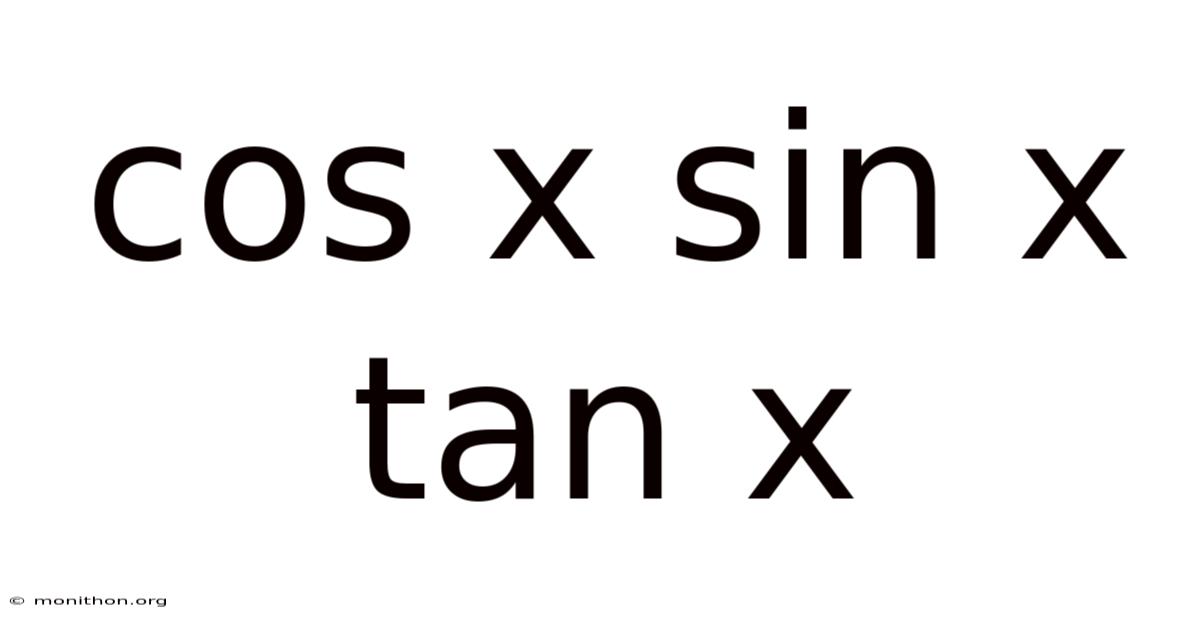
The product of cosine, sine, and tangent functions—specifically cos x sin x tan x—might appear complex at first glance, but it reveals a surprisingly elegant simplification. This fundamental trigonometric identity is crucial for solving equations, simplifying expressions, and understanding wave behaviors. Let's break down the steps, explore the underlying mathematics, and clarify common questions surrounding this expression.
Step 1: Understanding the Components Before simplifying, recognize the core definitions:
- cos x: The ratio of the adjacent side to the hypotenuse in a right-angled triangle with angle x.
- sin x: The ratio of the opposite side to the hypotenuse.
- tan x: The ratio of the opposite side to the adjacent side. Crucially, tan x = sin x / cos x. The expression cos x sin x tan x combines these three functions into a single product.
Step 2: Applying the Tangent Identity The key to simplification lies in substituting the definition of tangent: cos x sin x tan x = cos x sin x * (sin x / cos x) This step replaces tan x with its equivalent ratio.
Step 3: Simplifying the Expression Now, observe the terms: cos x sin x * (sin x / cos x) = (cos x / cos x) * (sin x * sin x) The cos x in the numerator and denominator cancel out: = 1 * (sin² x) = sin² x The final, simplified form of cos x sin x tan x is sin² x.
Scientific Explanation: Why This Works The cancellation of the cos x terms is mathematically sound. Dividing a number by itself always yields one (cos x / cos x = 1). This fundamental property of division underpins the simplification. The result, sin² x, is the square of the sine function. This identity is a specific case of the broader trigonometric product-to-sum identities and highlights the inherent relationships between the primary trig functions. It demonstrates how combining functions can yield a simpler, equivalent expression, which is invaluable for algebraic manipulation and calculus applications.
FAQ
- Q: Is this identity always true?
- A: Yes, cos x sin x tan x = sin² x holds for all values of x where the original expression is defined (i.e., where cos x ≠ 0, since tan x would be undefined otherwise).
- Q: What's the practical use of this identity?
- A: It simplifies complex trigonometric expressions, aids in solving equations (like finding sin²x given other information), and is foundational in calculus (e.g., integration techniques involving powers of trig functions).
- Q: Can I write it as (sin x)(sin x)?
- A: Yes, sin² x is simply a concise way to write (sin x) * (sin x).
- Q: What if I have cos x sin x tan x + something else?
- A: The identity still applies to the product segment cos x sin x tan x, simplifying it to sin² x within the larger expression.
- Q: Is there a similar identity for other combinations?
- A: Absolutely. Exploring identities like sin x cos x tan x (which also simplifies to sin² x) or cos² x tan x (simplifying to sin² x) reveals the consistent interplay between these core trig functions.
Conclusion The seemingly intricate product cos x sin x tan x elegantly collapses into the simple expression sin² x. This transformation, achieved through the substitution tan x = sin x / cos x and the cancellation of the cos x terms, underscores the profound interconnectedness of trigonometric functions. Mastering this identity empowers you to navigate more complex trigonometric landscapes with greater ease, whether you're tackling algebraic problems, calculus integrals, or physics applications involving waves and oscillations. Recognizing such fundamental simplifications is a cornerstone of mathematical fluency and problem-solving efficiency.
This simplification isn't just a neat trick; it’s a gateway to understanding deeper trigonometric relationships. It illustrates how different representations of the same mathematical concept can be equivalent, offering flexibility in problem-solving. The ability to manipulate trigonometric expressions through identities like this is crucial for success in advanced mathematics, physics, engineering, and various scientific fields. It’s a testament to the power of algebraic manipulation within the framework of trigonometry, and a valuable tool to build a strong foundation for further exploration of these essential mathematical concepts. Therefore, solidifying your understanding of this identity and its underlying principles will undoubtedly enhance your mathematical toolkit and problem-solving capabilities.
Latest Posts
Latest Posts
-
A Cyclist Rides Into The Country
Mar 22, 2026
-
How Many Diploids Do Humans Have
Mar 22, 2026
-
How Many Inches Is 5 4 Ft
Mar 22, 2026
-
What Determines The Chemical Properties Of An Atom
Mar 22, 2026
-
4 To The Square Root Of 3
Mar 22, 2026
