Factor This Equation -16t2 64t 80

monithon
Mar 07, 2026 · 6 min read
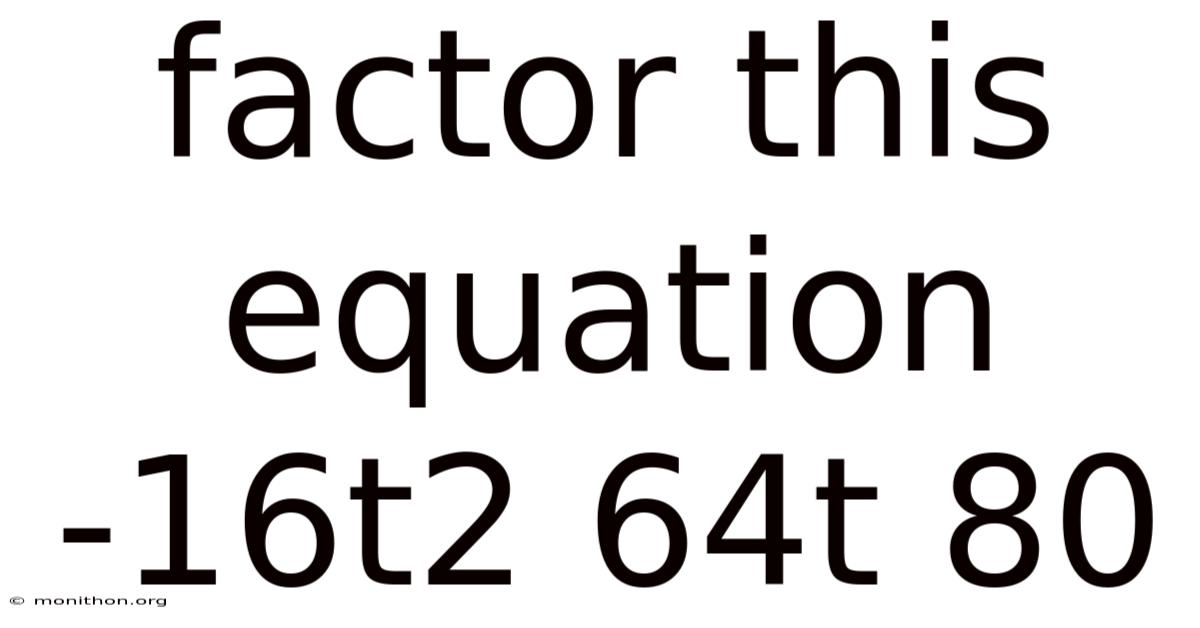
Table of Contents
How to Factor This Equation: -16t² + 64t + 80
Factoring quadratic equations is a foundational skill in algebra that unlocks the solutions to countless problems in mathematics, physics, and engineering. When presented with an equation like -16t² + 64t + 80, the process may seem daunting at first glance due to the negative leading coefficient and large numbers. However, by applying a systematic, step-by-step approach, you can simplify and solve it efficiently. This guide will walk you through the entire factoring process for this specific equation, explain the underlying principles, verify the solution, and highlight why this skill is so crucial. Mastering this will not only help you solve this problem but also build a robust framework for tackling any quadratic expression.
Understanding the Equation: -16t² + 64t + 80
Before diving into factoring, let's analyze the structure of the given quadratic expression: -16t² + 64t + 80. It is in the standard form at² + bt + c, where:
- a = -16 (the coefficient of the squared term)
- b = 64 (the coefficient of the linear term)
- c = 80 (the constant term)
The immediate challenge is the negative leading coefficient (a). A best practice in algebra is to factor out the Greatest Common Factor (GCF) first, especially if it is a negative number. This simplifies the numbers you work with and often leads to a cleaner quadratic inside the parentheses. Every term here— -16t², 64t, and 80—is divisible by 16. Furthermore, since the leading term is negative, factoring out a -16 will make the coefficient of t² inside the parentheses positive, which is significantly easier to work with.
Step-by-Step Factoring Process
Step 1: Factor Out the Greatest Common Factor (GCF)
We identify the GCF of the numerical coefficients 16, 64, and 80, which is 16. Because the leading term is negative, we factor out -16. -16t² + 64t + 80 = -16( t² - 4t - 5 ) Verification: Distribute -16 back in: -16 * t² = -16t²; -16 * (-4t) = +64t; -16 * (-5) = +80. This is correct.
Now, our task reduces to factoring the simpler quadratic expression inside the parentheses: t² - 4t - 5.
Step 2: Factor the Simplified Quadratic (t² - 4t - 5)
We need two numbers that:
- Multiply to the constant term (c = -5).
- Add to the coefficient of the linear term (b = -4).
Let's list the factor pairs of -5:
- -1 and 5: (-1) + 5 = 4 (Not -4)
- 1 and -5: 1 + (-5) = -4 (This works!)
The numbers 1 and -5 satisfy both conditions: their product is -5, and their sum is -4.
Therefore, we can factor the quadratic as: t² - 4t - 5 = (t + 1)(t - 5) Verification: Use FOIL: (t)(t) = t²; (t)(-5) = -5t; (1)(t) = +t; (1)(-5) = -5. Combine like terms: t² -5t + t -5 = t² -4t -5. Correct.
Step 3: Combine with the GCF
We now substitute this factored form back into our expression from Step 1. -16t² + 64t + 80 = -16( t + 1 )( t - 5 )
This is the completely factored form of the original expression.
Verifying Your Factored Solution
Never skip verification. It catches sign errors, which are the most common mistake in factoring. To check, multiply the factors back together:
- First, multiply the two binomials: (t + 1)(t - 5) = t² - 5t + t - 5 = t² - 4t - 5.
- Then, multiply by the GCF: -16 * (t² - 4t - 5) = -16t² + 64t + 80. The result matches the original expression perfectly. Our factoring is correct.
Solving the Equation: -16t² + 64t + 80 = 0
If the original problem was to solve the equation, we would set the factored form equal to zero and apply the Zero Product Property (if A * B = 0, then either A=0 or B=0). -16(t + 1)(t - 5) = 0 Since -16 ≠ 0, we solve:
- t + 1 = 0 → t = -1
- t - 5 = 0 → t = 5
The solutions are t = -1 and t = 5.
Scientific Explanation: Why Factoring Works
Factoring is essentially the reverse process of multiplication (using the distributive property). When we factor -16(t + 1)(t - 5), we are expressing the quadratic as a
product of linear factors, each corresponding to a root of the equation. This structural insight is why the Zero Product Property is so powerful: it directly links the algebraic form to the solutions. Furthermore, the factors reveal key features of the quadratic's graph. The roots, t = -1 and t = 5, are the x-intercepts of the parabola defined by y = -16t² + 64t + 80. The negative leading coefficient (-16) confirms the parabola opens downward, and the factored form makes these intercepts immediately visible without further calculation.
Conclusion
Mastering the systematic approach to factoring quadratics—starting with the Greatest Common Factor, especially when it is negative, then decomposing the remaining trinomial—transforms a seemingly complex expression into a clear, solvable product. The critical steps of identifying correct factor pairs and rigorously verifying by redistribution are not mere formalities but essential safeguards against sign errors, the most common pitfall. As demonstrated, this method reliably yields the completely factored form, -16(t + 1)(t - 5), which in turn provides an effortless path to solving the associated equation and understanding the function's graphical behavior. This foundational skill in algebra serves as a cornerstone for more advanced topics, from solving higher-degree polynomials to analyzing functions in calculus. By internalizing this logical sequence, you equip yourself with a versatile tool for unpacking and solving a wide array of mathematical problems.
Conclusion
Mastering the systematic approach to factoring quadratics—starting with the Greatest Common Factor, especially when it is negative, then decomposing the remaining trinomial—transforms a seemingly complex expression into a clear, solvable product. The critical steps of identifying correct factor pairs and rigorously verifying by redistribution are not mere formalities but essential safeguards against sign errors, the most common pitfall. As demonstrated, this method reliably yields the completely factored form, -16(t + 1)(t - 5), which in turn provides an effortless path to solving the associated equation and understanding the function's graphical behavior. This foundational skill in algebra serves as a cornerstone for more advanced topics, from solving higher-degree polynomials to analyzing functions in calculus. By internalizing this logical sequence, you equip yourself with a versatile tool for unpacking and solving a wide array of mathematical problems. The ability to factor isn't just about manipulating numbers; it's about understanding the underlying structure of algebraic expressions and using that understanding to unlock deeper insights into mathematical concepts. Therefore, a solid grasp of factoring is a vital stepping stone on the path to mathematical fluency.
This shift from mechanical procedure to structural insight marks the true mastery of factoring. When students move beyond seeing it as a set of arbitrary rules to recognizing it as a process of revealing an expression’s inherent architecture, they develop a powerful form of algebraic intuition. This intuition allows them to anticipate solutions, simplify complex rational expressions, and navigate the manipulations required in calculus and differential equations with greater ease. Moreover, the discipline cultivated through the meticulous verification steps—checking signs, confirming products, and ensuring complete factorization—transfers directly to other domains of mathematics and science where precision is non-negotiable. In essence, the quadratic y = -16t² + 64t + 80 is not merely an equation to be solved but a narrative in factored form, telling a story of roots, symmetry, and motion. By learning to read and write this narrative through factoring, one gains more than a computational skill; one acquires a lens for discerning order within algebraic complexity. Therefore, the journey of factoring is a fundamental chapter in the larger story of developing a resilient, analytical, and conceptually rich mathematical mind.
Latest Posts
Latest Posts
-
3 To The Power Of 4
Mar 08, 2026
-
How To Convert Standard Form To Slope Intercept Form
Mar 08, 2026
-
What Is 875 As A Fraction
Mar 08, 2026
-
Can A Square Be A Rhombus
Mar 08, 2026
-
How Many Hours Are There In A Week
Mar 08, 2026
Related Post
Thank you for visiting our website which covers about Factor This Equation -16t2 64t 80 . We hope the information provided has been useful to you. Feel free to contact us if you have any questions or need further assistance. See you next time and don't miss to bookmark.
