Fifteen More Than Half A Number Is 9

monithon
Mar 14, 2026 · 7 min read
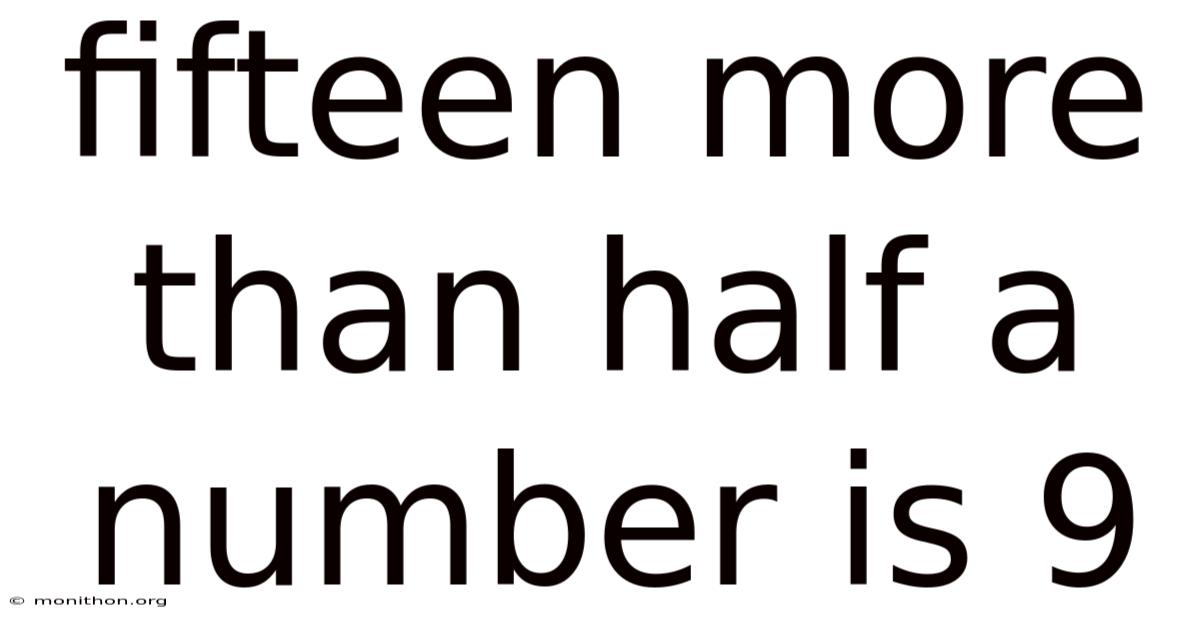
Table of Contents
Fifteen More Than Half a Number is 9: A Step-by-Step Algebraic Breakdown
At first glance, the statement “fifteen more than half a number is 9” reads like a simple riddle. Yet, it encapsulates the fundamental power of algebra: the ability to translate everyday language into a precise mathematical statement and solve for the unknown. This deceptively simple phrase is a classic linear equation in one variable, and mastering its translation and solution builds a critical foundation for all higher mathematics. The answer, which may initially seem counterintuitive, reveals a key lesson about the nature of numbers and operations. This article will dissect this problem completely, transforming confusion into clarity through systematic reasoning, practical steps, and a deeper exploration of the concepts involved.
Translating Words into an Algebraic Equation
The first and most crucial step in solving any word problem is accurate translation. We must convert the verbal phrase into a symbolic mathematical equation. Let’s proceed phrase by phrase.
- “A number”: This is our unknown quantity. In algebra, we represent an unknown with a variable, most commonly
x. So, “a number” =x. - “Half a number”: This means we take our unknown number
xand divide it by 2. In mathematical notation, this isx/2or(1/2)x. - “Fifteen more than…”: The phrase “more than” is a direct indicator of addition. It signifies that we are adding 15 to the quantity that follows. Therefore, “fifteen more than half a number” translates to
(x/2) + 15. - “…is 9”: The word “is” functions as the equals sign (=). It establishes that the expression on the left is equal to the value on the right.
Combining these components, the complete algebraic equation is: (x/2) + 15 = 9
This equation is our roadmap. It states that if you take a number, halve it, and then add fifteen, the result is nine.
The Step-by-Step Solution Process
Solving for x requires us to isolate the variable on one side of the equation. We do this by performing inverse operations in the reverse order of operations (PEMDAS/BODAMS). Since the expression (x/2) + 15 involves addition and division, we will undo the addition first and then the division.
Step 1: Undo the Addition.
The equation is (x/2) + 15 = 9. The last operation performed on x was adding 15. To undo this, we subtract 15 from both sides of the equation. This maintains the equality.
(x/2) + 15 - 15 = 9 - 15
This simplifies to:
x/2 = -6
Step 2: Undo the Division.
We now have x/2 = -6. The operation applied to x is division by 2. To undo this, we multiply both sides by 2.
(x/2) * 2 = -6 * 2
This simplifies to:
x = -12
Step 3: Verify the Solution.
A solution is only correct if it satisfies the original problem statement. Let’s plug x = -12 back into the original phrase: “fifteen more than half a number is 9.”
- Half of -12 is -6.
- Fifteen more than -6 is -6 + 15 = 9. The statement holds true. Therefore, the number is -12.
The Surprise of the Negative Solution and Its Meaning
Many students initially expect a positive answer. The phrase “fifteen more than” intuitively suggests a larger, positive result. Finding that the original number must be negative is a pivotal learning moment. It forces us to confront the logic of the equation: to end up at a relatively small positive number (9) after adding a large positive number (15), you must have started from a negative value. Think of it in terms of a bank account: if you start with a debt (negative balance) and deposit $15, you might only end up with $9 in your account. Your starting balance was negative.
This highlights a core principle: the operations defined by the words dictate the sign of the solution, not our intuitive assumptions. The algebraic process is objective; it follows the rules of arithmetic without prejudice.
Deeper Conceptual Understanding: Why This Works
The solution process relies on two fundamental algebraic properties:
- The Addition Property of Equality: If
a = b, thena + c = b + c. We used this to subtract 15 from both sides. This property ensures the equation remains balanced, just like a scale. - The Multiplication Property of Equality: If
a = b, thena * c = b * c(forc ≠ 0). We used this to multiply both sides by 2. This property allows us to “clear” the fraction.
Understanding why these properties work is as important as knowing how to apply them. They are the logical rules that preserve truth within the system of algebra. Every step we take is justified by one of these properties, making our solution rigorous and verifiable.
Common Pitfalls and How to Avoid Them
- Misinterpreting “more than”: The phrase “15 more than half a number” means
(half a number) + 15. A common error is to write15 + x/2, which is mathematically identical due to the commutative property of addition, but sometimes leads to confusion when the order is reversed in more complex problems. The key is that “more than” attaches the addition to the preceding phrase (“
The Surpriseof the Negative Solution and Its Meaning (Continued)
This experience underscores a crucial lesson: algebraic solutions often defy initial intuition. Our brains are wired to expect positive results from positive operations, especially when phrases like "more than" suggest an increase. However, the algebraic process is objective and rule-bound. It doesn't care about our expectations; it follows the logic of the equation. The sign of the solution is dictated entirely by the arithmetic operations defined by the words in the problem statement.
Further Conceptual Understanding: The Role of Operations and Properties
The power of the solution lies not just in finding the number, but in understanding why the steps work. The process relies fundamentally on two immutable properties of equality:
- The Addition Property of Equality: If
a = b, thena + c = b + cfor any numberc. This allows us to "undo" addition by subtracting the same value from both sides. In our case, subtracting 15 from both sides isolates the term containing the variable. - The Multiplication Property of Equality: If
a = b, thena * c = b * cfor any non-zero numberc. This allows us to "undo" division by multiplying both sides by the reciprocal (the multiplicative inverse). Here, multiplying by 2 cleared the fractionx/2.
These properties are the bedrock of algebra. They ensure that any operation performed equally on both sides of a true equation preserves its truth. Understanding why these properties hold (they are logical consequences of the definition of equality) empowers students to apply them confidently and correctly in more complex situations.
Addressing the Common Pitfall: "More Than" vs. "Less Than"
The confusion surrounding "more than" is a frequent stumbling block. Students might write 15 + x/2 instead of x/2 + 15. While mathematically equivalent due to the commutative property of addition, this reversal can sometimes obscure the structure of the problem, especially when combined with other operations or when translating word problems into equations becomes more intricate. The key is to carefully parse the language: "more than" always attaches the addition to the preceding quantity. In "half a number more than 15," the "more than" modifies "half a number," meaning we add 15 to the result of "half a number." The phrase "fifteen more than half a number" explicitly states the order: take half the number, then add fifteen.
The Value of Verification: Beyond the Answer
The final step – verification – is arguably the most critical. Plugging the solution back into the original statement is non-negotiable. It serves multiple purposes:
- Confirms Correctness: It definitively proves whether the solution satisfies the equation.
- Checks for Errors: If the verification fails, it signals an error in the solving process (e.g., arithmetic mistake, incorrect application of a property).
- Deepens Understanding: Seeing the solution work within the original context reinforces the connection between the abstract equation and the concrete problem it represents. It validates the algebraic journey.
In this case, verifying x = -12 yields (-12)/2 + 15 = -6 + 15 = 9, perfectly matching the given result. This successful verification solidifies our confidence in the solution and the process.
Conclusion
The journey to solve "fifteen more than half a number is 9" reveals more than just the number -12. It illuminates the disciplined nature of algebra: a system governed by logical rules and properties of equality, independent of our initial expectations. The negative solution, initially surprising, is a powerful reminder that mathematical truth often lies beyond intuition.
Latest Posts
Latest Posts
-
What Is The Decimal Of 1 12
Mar 14, 2026
-
Do Commas Go Inside Or Outside Quotation Marks
Mar 14, 2026
-
15 Percent As A Fraction In Simplest Form
Mar 14, 2026
-
Write 63 As The Product Of Prime Factors
Mar 14, 2026
-
Which Of The Following Is Equal To The Expression Below
Mar 14, 2026
Related Post
Thank you for visiting our website which covers about Fifteen More Than Half A Number Is 9 . We hope the information provided has been useful to you. Feel free to contact us if you have any questions or need further assistance. See you next time and don't miss to bookmark.
