Five Less Than Four Times A Number

monithon
Mar 10, 2026 · 6 min read
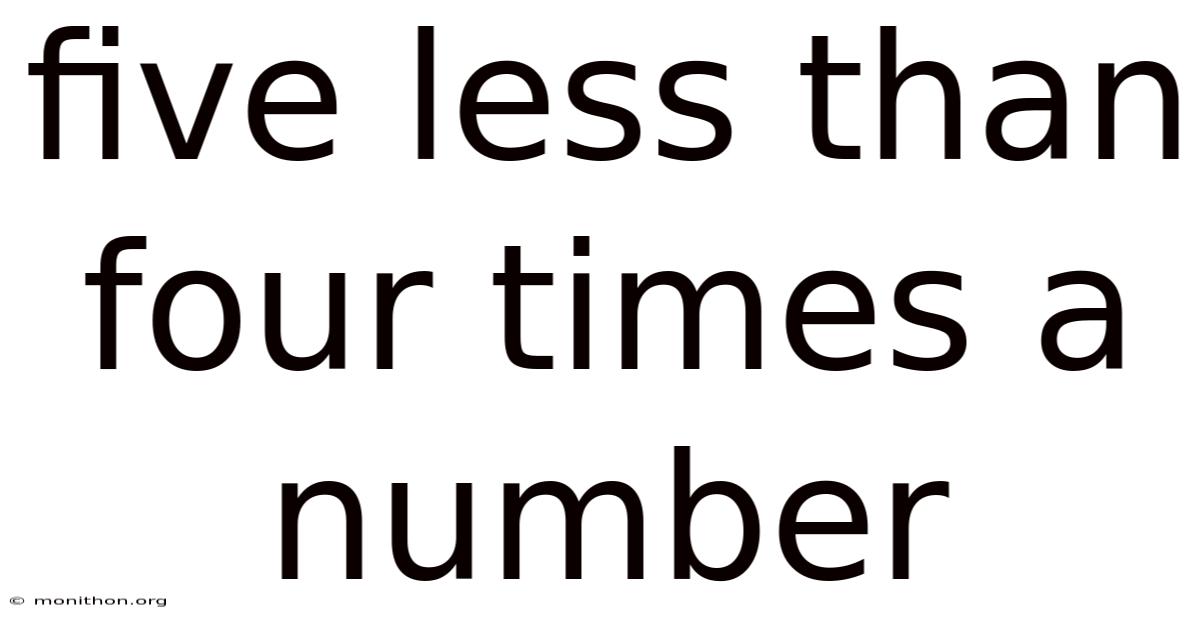
Table of Contents
Five less than four times a number is a foundational algebraic expression that appears in many word problems and real‑life scenarios; understanding how to translate and manipulate it builds essential problem‑solving skills. This article breaks down the phrase, shows step‑by‑step methods for working with it, explains the underlying mathematical ideas, and answers common questions that learners often encounter.
Understanding the Phrase
The wording “five less than four times a number” describes a specific combination of operations.
- Four times a number means multiplying an unknown quantity by 4.
- Five less than indicates that 5 should be subtracted from the result of that multiplication.
When we let x represent the unknown number, the expression can be written as 4x − 5.
Key takeaway: The phrase always follows the pattern (coefficient × variable) − constant, where the constant is the amount being “less than” the product.
Why the Order Matters
The order of operations is crucial here. If we reversed the steps and wrote “five less than a number, then four times,” the expression would become (x − 5) × 4, which is a completely different value. Recognizing the exact sequence described by the words prevents calculation errors and ensures that the algebraic translation matches the intended problem.
Translating Words into Algebra
Step‑by‑Step Guide
- Identify the unknown – Choose a variable (commonly x, n, or y) to stand for the number.
- Locate the multiplication phrase – “four times a number” tells you to multiply the variable by 4.
- Find the subtraction phrase – “five less than” signals that 5 must be subtracted from the product.
- Combine the operations – Write the product first, then subtract the constant: 4 × x − 5 or simply 4x − 5.
Example: If the problem states, “The sum of a number and seven is equal to five less than four times the number,” the algebraic translation would be:
( n + 7 = 4n - 5 ).
Using Parentheses When Needed
Sometimes the phrase can be ambiguous, especially when multiple operations are involved. In such cases, parentheses help clarify the intended order. For instance, “five less than the product of four and a number” still yields 4x − 5, but “the product of four and (a number five less than… )” would require a different structure altogether. Always double‑check the wording before finalizing the expression.
Solving Equations Involving the Expression
Many word problems require setting the expression equal to another quantity and solving for the unknown. Here’s a systematic approach:
- Write the equation using the translated expression.
- Isolate the variable term – Move constant terms to the opposite side of the equation.
- Simplify – Combine like terms and perform arithmetic operations.
- Solve for the variable – Divide or multiply as needed to obtain the value of the unknown.
- Check the solution – Substitute the found value back into the original problem to verify correctness.
Illustrative example: Solve (4x - 5 = 27).
- Add 5 to both sides: (4x = 32).
- Divide by 4: (x = 8).
- Verification: (4(8) - 5 = 32 - 5 = 27), which matches the right‑hand side.
Common Algebraic Techniques
- Inverse operations: Use addition to cancel subtraction and division to cancel multiplication.
- Balancing both sides: Whatever you do to one side of the equation, do to the other to maintain equality.
- Distributive property: If the expression appears inside parentheses, expand it before simplifying.
Real‑World Applications
Budgeting and Finance
Imagine a scenario where a company offers a bonus of $4 per unit sold, but deducts a fixed fee of $5 from the total bonus. The net bonus can be modeled as 4x − 5, where x is the number of units sold. Understanding this expression helps employees predict earnings and plan accordingly.
Physics and Engineering
In physics, the distance traveled under uniform acceleration can involve expressions like 4t − 5, where t represents time in seconds. While this specific form is simplified, the concept of combining a multiplicative factor with a subtraction mirrors real calculations involving initial velocities and constant forces.
Geometry
When calculating the area of a rectangle with length expressed as “four times a certain length minus five units,” the area formula becomes (4x − 5) × x. Such problems appear in optimization tasks where designers need to maximize or minimize material usage.
Frequently Asked Questions
Q1: Can the phrase be written with a different order, such as “four times a number five less than”?
A: No. The phrase “five less than” always modifies the result of the preceding multiplication. Rearranging the words changes the mathematical meaning.
Q2: What if the problem uses a different constant, like “seven less than four times a number”?
A: The structure remains the same: 4x − 7. Only the constant term changes according to the number mentioned.
Q3: How do I handle negative numbers in the expression?
A: If the unknown itself can be negative, substitute the negative value into the expression. For example, if *x = –
Frequently Asked Questions (Continued)
Q3: How do I handle negative numbers in the expression?
A: If the unknown itself can be negative, substitute the negative value into the expression. For example, if x = –2, then 4x − 5 becomes 4(−2) − 5 = −8 − 5 = −13. This demonstrates that expressions can yield negative results depending on the value of the variable. Always apply the order of operations (PEMDAS/BODMAS) rigorously when evaluating.
Q4: What if the phrase includes division or other operations?
A: The core principle remains: identify the base operation ("times," "divided by," etc.) and the modifier ("less than," "more than," etc.). For instance, "five less than the quotient of a number and two" translates to (x/2) − 5. Parentheses ensure the division is performed before the subtraction.
Q5: Can this apply to multiple variables?
A: Yes. Phrases like "five less than four times the first number plus twice the second number" involve two variables: 4a + 2b − 5. Solving such equations requires additional techniques like substitution or elimination.
Advanced Applications
Data Analysis: Statisticians model trends using linear expressions. For example, "five less than four times the study hours" (4h − 5) could predict test scores, where h represents hours studied. This helps educators identify study thresholds for desired outcomes.
Computer Science: Algorithms often use expressions like 4x − 5 to calculate processing time or memory usage based on input size x. Understanding these relationships is crucial for optimizing code efficiency.
Economics: Cost functions may include fixed deductions. If producing x units costs $4 per unit but incurs a $5 setup fee, the total cost is 4x − 5. Businesses use this to determine break-even points (where cost = revenue).
Conclusion
Mastering the translation of verbal phrases into algebraic expressions like 4x − 5 is a cornerstone of mathematical literacy. It bridges the gap between abstract symbols and tangible real-world phenomena, enabling precise modeling in finance, physics, engineering, and beyond. The systematic approach to solving equations—simplify, isolate, verify—provides a reliable framework for finding solutions. By understanding the nuances of language and the rigors of algebraic manipulation, individuals gain the tools to dissect complex problems, make informed predictions, and apply logical reasoning across disciplines. Ultimately, proficiency in these fundamental concepts unlocks the door to advanced mathematics and empowers effective problem-solving in everyday life.
Latest Posts
Latest Posts
-
Express The Rule In Function Notation
Mar 10, 2026
-
67 Inches In Feet And Inches
Mar 10, 2026
-
A Trough Is 9 Feet Long
Mar 10, 2026
-
2 5 1 4 As A Fraction
Mar 10, 2026
-
Gaseous Ethane Reacts With Gaseous Oxygen
Mar 10, 2026
Related Post
Thank you for visiting our website which covers about Five Less Than Four Times A Number . We hope the information provided has been useful to you. Feel free to contact us if you have any questions or need further assistance. See you next time and don't miss to bookmark.
