Four Less Than Half A Number N

monithon
Mar 19, 2026 · 12 min read
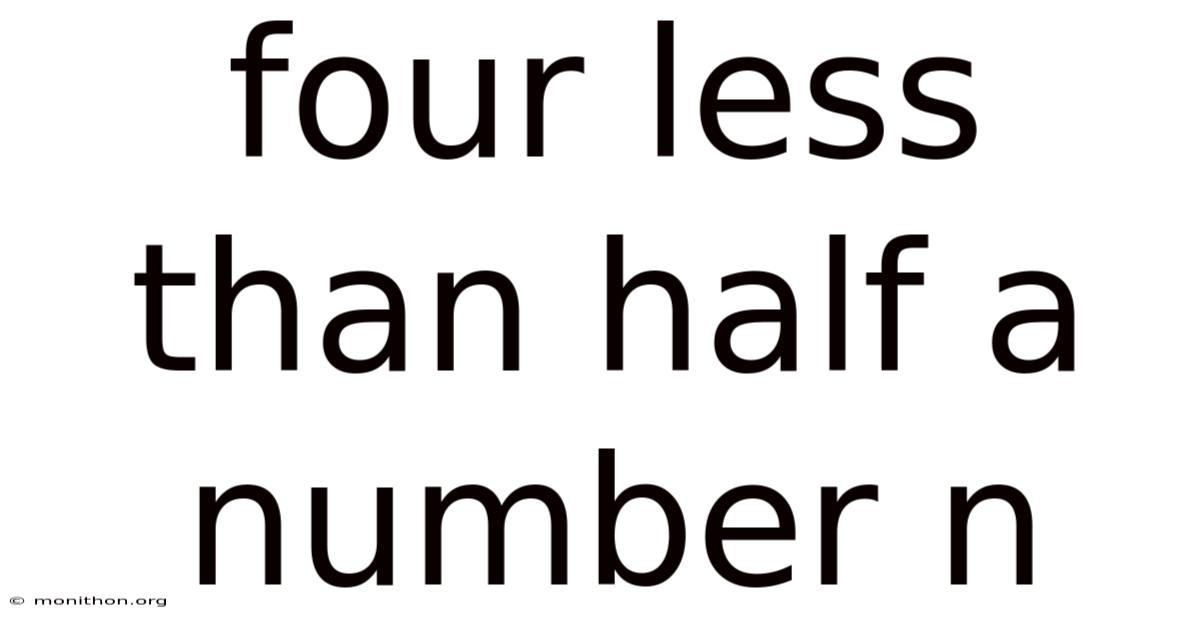
Table of Contents
Understanding "Four Less Than Half a Number n": A Comprehensive Guide
The phrase "four less than half a number n" is a common algebraic expression that often confuses students and learners new to mathematics. At first glance, it may seem straightforward, but its structure requires careful interpretation to avoid errors. This article aims to break down the concept, explain its mathematical foundation, and provide practical examples to ensure clarity. Whether you are a student struggling with algebra or someone looking to strengthen your problem-solving skills, this guide will equip you with the tools to tackle similar expressions confidently.
What Does "Four Less Than Half a Number n" Mean?
To fully grasp the phrase "four less than half a number n," it is essential to dissect its components. The term "half a number n" refers to dividing the number n by 2, which can be written as n/2 or ½n. The phrase "four less than" indicates that 4 is subtracted from this value. Therefore, the entire expression translates to ½n - 4. This is an algebraic expression, not an equation, meaning it represents a value rather than a statement of equality.
For example, if n is 10, half of 10 is 5, and four less than 5 is 1. This means ½(10) - 4 = 1. The key to understanding this expression lies in recognizing the order of operations: division occurs before subtraction. This principle is critical in algebra, where misinterpreting the sequence of operations can lead to incorrect results.
How to Solve Problems Involving "Four Less Than Half a Number n"
Solving problems with this expression requires a systematic approach. Here are the steps to follow:
- Identify the variable: The phrase mentions "a number n," so n is the variable in question.
- Apply the operations in the correct order: First, calculate half of n (i.e., n/2), then subtract 4 from the result.
- Substitute values: If a specific value for n is provided, plug it into the expression. For instance, if n = 12, the calculation becomes ½(12) - 4 = 6 - 4 = 2.
- Solve for n (if required): In some cases, you may be given the result of the expression and asked to find n. For example, if ½n - 4 = 6, add 4 to both sides to get ½n = 10, then multiply both sides by 2 to find n = 20.
These steps ensure accuracy and help avoid common mistakes, such as subtracting 4 before dividing by 2. It is also helpful to practice with different values of n to build familiarity with the expression.
The Mathematical Principles Behind the Expression
The expression ½n - 4 is rooted in fundamental algebraic principles. Let’s explore its components in more detail:
- Division and Subtraction: The expression combines two operations—division and subtraction. According to the order of operations (PEMDAS/BODMAS), division is performed before subtraction. This means ½n must be calculated first, and then 4 is subtracted from the result.
- Algebraic Expressions: This phrase is an example of an algebraic expression, which uses variables (like n) and constants (like 4) to represent relationships. Unlike equations, expressions do not include an equals sign and are used to model real-world scenarios.
- Variables and Constants: In ½n - 4, n is a variable, meaning it can take any value. The number 4 is a constant, representing a fixed value that does not change. Understanding the role of variables and constants is crucial in algebra.
A common misconception is that "four less than half a number" could be interpreted as 4 - ½n. However, the phrase "less than" always indicates that the subtraction occurs after the operation mentioned (in this case, halving the number). This distinction is vital for accurate problem-solving.
Real-World Applications of "Four Less Than Half a Number n"
While the expression ½n - 4 may seem abstract, it has practical applications in various fields. For instance:
- Budgeting: Suppose you have a budget of n dollars. If you spend half of it and then subtract $
...4 from what remains, the amount left is precisely ½n - 4. This could help in tracking expenses or planning savings.
Other scenarios include:
- Cooking and Recipes: If a recipe designed for n servings requires scaling down, and you first use half the ingredients but then need to reduce a key ingredient (like salt or spice) by a fixed 4 units (teaspoons, grams), the final quantity of that ingredient follows the same expression.
- Physics and Engineering: In problems involving linear relationships, such as calculating a adjusted measurement—for example, taking half of a recorded length and then accounting for a constant instrument error of 4 units—the result is modeled by ½n - 4.
- Data Analysis: When normalizing a dataset by halving each value and then subtracting a baseline correction of 4, the transformed variable becomes ½n - 4.
These examples illustrate how a simple algebraic expression can serve as a powerful tool for translating verbal descriptions into quantitative models, enabling clearer problem-solving across disciplines.
Conclusion
Understanding the phrase "four less than half a number n" and its algebraic representation, ½n - 4, is more than an academic exercise. It reinforces the importance of precise language in mathematics, the non-negotiable role of the order of operations, and the practical skill of converting words into symbols. By mastering this expression, one builds a foundation for tackling more complex algebraic statements and real-world problems where variables and constants interact. Whether in budgeting, science, or everyday calculations, the ability to interpret and manipulate such expressions accurately is a critical component of quantitative literacy. Ultimately, this seemingly simple example encapsulates a broader truth: clear, step-by-step reasoning is the key to unlocking mathematical understanding and application.
Extending the Concept: From Linear Expressions to Systems of Equations
The expression ½n − 4 serves as a gateway to more intricate algebraic ideas. By embedding it within a system of equations, students can explore how multiple linear relationships intersect and how each component influences the overall solution.
Consider the following system:
[ \begin{cases} y = \dfrac{1}{2}x - 4 \ y = 3x + 2 \end{cases} ]
Setting the two right‑hand sides equal yields:
[ \frac{1}{2}x - 4 = 3x + 2 \quad\Longrightarrow\quad -\frac{5}{2}x = 6 \quad\Longrightarrow\quad x = -\frac{12}{5}. ]
Substituting back gives (y = 3!\left(-\frac{12}{5}\right)+2 = -\frac{36}{5}+2 = -\frac{26}{5}).
Here, the first equation embodies “four less than half a number,” while the second introduces a contrasting linear relationship. Solving the system reinforces the mechanics of substitution and highlights how different constants shift graphs vertically or horizontally.
Parameterizing Real‑World ScenariosIn many applied contexts, the constant “4” may not be fixed. Suppose a company’s profit margin is half of its revenue minus a variable overhead that itself depends on production volume, say (4k) where (k) is the number of units produced. The profit function then becomes:
[ P = \frac{1}{2}R - 4k. ]
If revenue (R) is directly proportional to the number of units sold ((R = pr), where (p) is the unit price and (r) the quantity), the expression morphs into a bilinear form:
[ P = \frac{1}{2}(pr) - 4k. ]
Such parameterization illustrates how a simple linear template can be generalized to accommodate multiple interacting variables, a skill that is indispensable in fields ranging from economics to engineering design.
Pedagogical Strategies for Mastery1. Concrete Manipulatives – Use algebra tiles or virtual balance scales to physically demonstrate the “half” operation followed by subtraction. This visual cue helps learners internalize that halving precedes the subtraction.
-
Error‑Detection Exercises – Present deliberately mis‑phrased statements (e.g., “four less than half a number” written as (4 - \frac{1}{2}n)) and ask students to identify the mistake. Correcting these errors cultivates vigilance about order of operations.
-
Cross‑Disciplinary Projects – Assign a mini‑research task where students locate a real‑world scenario that can be modeled by (\frac{1}{2}n - 4). They must then translate the scenario into an equation, solve it, and present the findings. This bridges abstract symbolism with tangible application.
-
Technology Integration – Leverage graphing calculators or dynamic software (e.g., Desmos) to plot (y = \frac{1}{2}x - 4) alongside variations such as (y = \frac{1}{2}x + 4) or (y = 2x - 4). Observing how slope and intercept shift reinforces conceptual understanding.
Anticipating Future Directions
As learners progress, the notion of “less than” evolves from a single‑operation translation to a broader language of inequalities and optimization. The phrase “four less than half a number” can be re‑expressed as:
[ \frac{1}{2}n - 4 < k, ]
where (k) denotes a target threshold. Solving such inequalities introduces interval notation, solution sets, and the concept of feasible regions—foundational tools for linear programming.
Moreover, in the realm of functional equations, one might define a function (f(n) = \frac{1}{2}n - 4) and explore its iterates:
[ f^{(2)}(n) = f(f(n)) = \frac{1}{2}\left(\frac{1}{2}n - 4\right) - 4 = \frac{1}{4}n - 6. ]
Iterative analysis uncovers patterns in how repeated applications of a linear transformation compress or expand values, a concept that reappears in dynamical systems and computer science.
Final Reflection
The journey from the simple phrase “four less than half a number” to a rich tapestry of algebraic manipulation, real‑world modeling, and interdisciplinary problem‑solving underscores a central tenet of mathematics: precise language begets precise thought. By consistently interrogating how words map onto symbols, students cultivate a mental framework that treats mathematics as a living language rather than a static set of rules. This mindset equips them to tackle increasingly sophisticated concepts—whether they involve systems of equations, parameterized functions, or optimization challenges—with confidence and clarity.
In sum, mastering the expression (\frac{1}{2}n - 4) is not an isolated milestone; it is a stepping stone toward a deeper, more
Extending the ConceptualHorizon
Having solidified the mechanics of translating everyday language into algebraic form, learners are ready to explore how the expression (\frac{1}{2}n - 4) behaves within broader mathematical frameworks.
1. Linear Functions as Building Blocks
The function (f(n)=\frac{1}{2}n-4) is a linear function of the form (f(x)=mx+b) with slope (m=\frac12) and intercept (b=-4). Understanding its graph— a straight line that descends one unit in the vertical direction for every two units it advances horizontally—introduces key ideas such as:
- Rate of change: The slope quantifies how rapidly the output diminishes as the input grows.
- Domain and range: While the domain may initially be all real numbers, contextual constraints (e.g., a quantity that cannot be negative) can restrict permissible inputs.
- Inverse functions: Solving (y=\frac12 x-4) for (x) yields (x=2(y+4)). This inverse reveals how to retrieve the original input when only the output is known, a skill that recurs in solving real‑world problems where the desired result is prescribed.
2. From Single Variables to Systems
When multiple quantities are interrelated, the single‑variable expression expands into a system of linear equations. For instance, suppose a problem involves two interdependent quantities (n) and (m) linked by the relations:
[ \begin{cases} m = \frac12 n - 4,\[4pt] n = 3m + 7. \end{cases} ]
Substituting the first equation into the second yields a solvable linear system, reinforcing techniques such as elimination and matrix representation. This transition prepares students for more sophisticated topics like linear algebra and vector spaces.
3. Connecting to Calculus Foundations
Although the expression itself is elementary, its role as a building block becomes evident when it appears inside larger analytical constructs. Consider the limit:
[\lim_{n\to\infty}\left(\frac12 n - 4\right) = \infty, ]
which illustrates how a linear function with a positive coefficient diverges without bound. Conversely, examining the derivative of (f(x)=\frac12 x-4) yields a constant (f'(x)=\frac12), reinforcing the notion that the slope of a linear function is invariant—a cornerstone concept when students later encounter rates of change in differential calculus.
4. Modeling Growth and Decay
In applied contexts, (\frac12 n - 4) can represent a simple decay model where a quantity is halved and then reduced by a fixed amount each iteration. Such models appear in population dynamics, radioactive decay, and financial amortization. By iterating the function—(f^{(k)}(n)=\frac{1}{2^k}n - 4\left(1+\frac12+\dots+\frac{1}{2^{k-1}}\right))—learners discover geometric series and the convergence of repeated linear transformations, linking algebra to infinite series.
5. Embracing Technology for Exploration
Dynamic software environments enable students to experiment with parameters in real time. By adjusting the coefficient of (n) or the constant term, they can instantly observe shifts in intercept, slope, and x‑intercept. This visual feedback deepens intuition about how algebraic modifications translate into geometric transformations, fostering a habit of conjecture and verification that mirrors the investigative nature of mathematical research.
Synthesis and Forward‑Looking Perspective
The journey from “four less than half a number” to a fully fledged linear function encapsulates a progression from concrete translation to abstract manipulation, and finally to interdisciplinary application. Each step reinforces a fundamental truth: mathematics thrives on precise articulation of relationships, and the ability to convert narrative statements into symbolic form is the gateway to higher‑order reasoning.
As curricula evolve, educators can leverage the expression (\frac12 n-4) as a springboard for a suite of interconnected concepts—inequalities, function iteration, systems of equations, calculus foundations, and dynamical models—all of which prepare learners for the abstract landscapes of advanced mathematics and its myriad scientific manifestations. By consistently encouraging students to ask “what does this phrase really mean?” and to verify their interpretations through multiple representations, we nurture a mindset that views mathematics not as a set of isolated tricks but as a cohesive language for describing the world.
Conclusion
In mastering the seemingly modest expression “four less than half a number,” students acquire more than a procedural skill; they gain a versatile interpretive lens that they can apply across the entire spectrum of mathematical thought. This lens transforms simple verbal cues into powerful symbolic tools, opening doors to deeper inquiry, innovative problem‑solving, and ultimately, a lifelong appreciation for the elegance and utility of mathematics.
Latest Posts
Latest Posts
-
Find The Following For The Function
Mar 19, 2026
-
What Is The Gcf For 12 And 20
Mar 19, 2026
-
Each Of You Is Or Each Of You Are
Mar 19, 2026
-
The Latin Root Word Dict Is Related To
Mar 19, 2026
-
What Is The Brotherhood In 1984
Mar 19, 2026
Related Post
Thank you for visiting our website which covers about Four Less Than Half A Number N . We hope the information provided has been useful to you. Feel free to contact us if you have any questions or need further assistance. See you next time and don't miss to bookmark.
