Four Times The Sum Of A Number And 3

monithon
Mar 15, 2026 · 7 min read
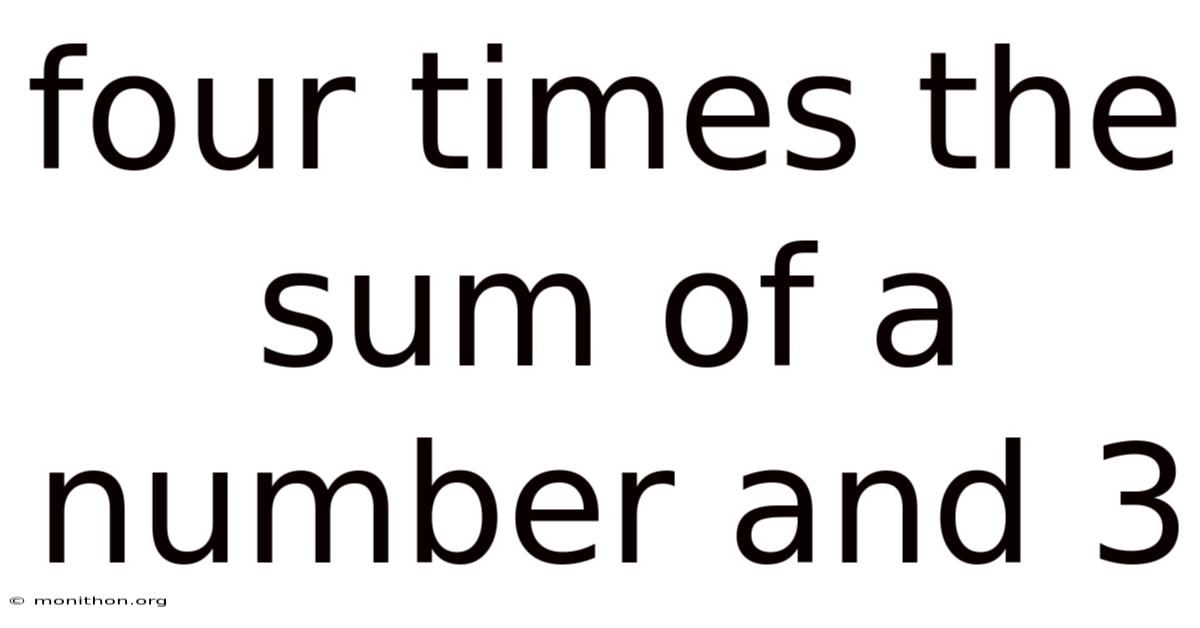
Table of Contents
Understanding "Four Times the Sum of a Number and 3": A Complete Guide
The phrase "four times the sum of a number and 3" is a classic example of how the English language describes a specific algebraic expression. At first glance, it might seem like a simple string of words, but it packs a precise mathematical meaning that is foundational for algebra and problem-solving. Mastering this translation from words to symbols is a critical skill that unlocks the ability to model real-world situations, from calculating finances to understanding scientific formulas. This article will deconstruct this phrase completely, explore its structure, highlight common pitfalls, and demonstrate its practical power.
The Step-by-Step Translation: From Words to Algebra
The core of this expression lies in understanding its two main operations: addition (sum) and multiplication (times), and, most importantly, the order in which they must be performed. The English phrasing explicitly dictates this order through the use of the word "sum."
-
Identify the Unknown: The phrase starts with "a number." In algebra, an unknown or variable number is represented by a letter, most commonly
x. So, we begin withx. -
Identify the Sum: The next key phrase is "the sum of a number and 3." The word "sum" means addition. It tells us we must first take our unknown number (
x) and add 3 to it. This operation must be grouped together because it is a single, complete unit of calculation. In algebra, we use parentheses( )to show this grouping.- So, "the sum of a number and 3" translates directly to:
(x + 3).
- So, "the sum of a number and 3" translates directly to:
-
Apply the Multiplication: The phrase begins with "four times..." The word "times" means multiplication. It tells us we must take the result of the sum we just created and multiply it by 4. The 4 is the coefficient (the number multiplying the grouped expression).
- Putting it all together, "four times" applies to the entire
(x + 3). - Therefore, the complete algebraic expression is:
4(x + 3).
- Putting it all together, "four times" applies to the entire
This structure—a number multiplying a parenthetical sum—is fundamental. The parentheses are not optional; they are mandatory. They signal that the addition inside happens before the multiplication. Without them, 4x + 3 would mean something entirely different.
Why Parentheses Matter: The Order of Operations
The expression 4(x + 3) is a perfect lesson in the order of operations, often remembered by the acronym PEMDAS (Parentheses, Exponents, Multiplication/Division, Addition/Subtraction). The parentheses force the x + 3 to be treated as a single entity.
- Correct Interpretation (
4(x + 3)): First, find the sum (x + 3). Then, multiply that sum by 4.- If
x = 5: Sum is5 + 3 = 8. Four times that sum is4 * 8 = 32.
- If
- Incorrect Interpretation (
4x + 3): This means "four times a number, then add three." The multiplication of 4 andxhappens first, and only then is 3 added.- If
x = 5: Four times the number is4 * 5 = 20. Then add 3:20 + 3 = 23.
- If
Notice the results are different (32 vs. 23). The parentheses change the outcome completely. The phrase "four times the sum" explicitly requires the sum to be calculated first, which is why 4(x + 3) is the only correct translation.
Common Mistakes and How to Avoid Them
When first encountering such phrases, two primary errors occur:
- Dropping the Parentheses: Writing
4x + 3instead of4(x + 3). This is the most frequent mistake. To avoid it, always underline or highlight the phrase "the sum of..." in the word problem. Whatever is inside that conceptual "box" must go inside algebraic parentheses. - Misinterpreting "Times": Sometimes students see "four times" and immediately write
4x, forgetting the rest of the phrase. Remember, "four times" describes what is done to the following complete phrase. The object of "four times" is "the sum of a number and 3"—it's not just "a number."
A Helpful Trick: Read the phrase backwards. Start from the end: "...and 3." Then move to the left: "the sum of a number [and 3]." Now, what is done to that entire sum? "Four times [the sum]." This reverse-engineering often clarifies the grouping.
Expanding and Simplifying the Expression
While 4(x + 3) is the direct translation, we often need to simplify or expand it using the distributive property. This property states that a number multiplying a sum is equal to that number multiplying each term inside the parentheses separately and then adding the results.
4(x + 3)becomes4 * x + 4 * 3.- Which simplifies to
4x + 12.
It is crucial to understand that 4x + 12 is equivalent in value to 4(x + 3) for any value of x, but it is a different form. The expanded form 4x + 12 no longer visually shows the original "sum" grouping. For translation from words, 4(x + 3) is the faithful representation. For solving equations or further calculations, 4x + 12 is often more convenient.
Practical Applications: Where This Expression Appears
This isn't just abstract math. This expression models countless scenarios:
- Finance: You have a base monthly subscription cost (
xdollars). The company charges a one-time setup fee of $3. Your total cost for the first month, if you prepay for four months, is4(x + 3). - Cooking/Baking: A recipe for one serving requires
xgrams of flour and 3 grams of sugar. To make four servings, you need4(x + 3)grams of total dry ingredients. - Geometry: The perimeter of a rectangle is
2(length + width). If the length isxand the width is
If the length is (x) and the width is (3), the perimeter of the rectangle can be expressed as
[ 2\bigl(x + 3\bigr) = 2x + 6 . ]
Here the phrase “twice the sum of the length and the width” translates directly to (2(x+3)); expanding it with the distributive property yields the simplified linear expression (2x+6), which is often easier to compute when a numerical value for (x) is known.
The same pattern appears in a variety of word problems that involve repeated actions combined with a fixed addition. For instance, a gym offers a monthly membership fee of (x) dollars plus a one‑time locker rental of $5. If a student decides to pay for four months up front, the total cost is modeled by (4(x+5)=4x+20). In each case, recognizing the “sum” that is being multiplied is the key step before applying the distributive property.
When the expression is part of an equation, expanding can simplify the solving process. Consider
[ 4(x+3)=28 . ]
First expand: (4x+12=28). Then isolate (x) by subtracting (12) from both sides, giving (4x=16), and finally dividing by (4) to obtain (x=4). Working with the expanded form avoids dealing with parentheses and makes the algebraic manipulation more straightforward.
Another useful perspective is to view the original expression as a factorised form that can be reversed. If you are given (4x+12) and asked to write it in factored form, you would factor out the common factor (4) to retrieve (4(x+3)). This “reverse engineering” is especially handy when checking work or when the problem later requires substituting a value for (x) into the factored version.
In summary, translating word problems that contain the phrase “four times the sum of …” hinges on two essential skills:
- Identify the exact quantity being summed and enclose it in parentheses.
- Apply the distributive property when simplification or solving demands it.
Mastering this translation process equips students to model real‑world situations—ranging from finance and cooking to geometry—accurately and to manipulate the resulting expressions with confidence.
Conclusion
The expression (4(x+3)) exemplifies how language can be converted into a precise algebraic representation. By consistently isolating the summed component, using parentheses to preserve its integrity, and then optionally expanding with the distributive property, learners can bridge the gap between everyday phrasing and mathematical expression. This disciplined approach not only prevents common errors but also opens the door to solving a wide array of practical problems, reinforcing the essential connection between spoken descriptions and algebraic thought.
Latest Posts
Latest Posts
-
What Are The Two Square Roots Of 64
Mar 15, 2026
-
What Do Angles Of A Triangle Add Up To
Mar 15, 2026
-
What Is 3 20 As A Percentage
Mar 15, 2026
-
How Many Slices In A 12 Inch Pizza
Mar 15, 2026
-
What Is The Difference Between Relative Location And Absolute Location
Mar 15, 2026
Related Post
Thank you for visiting our website which covers about Four Times The Sum Of A Number And 3 . We hope the information provided has been useful to you. Feel free to contact us if you have any questions or need further assistance. See you next time and don't miss to bookmark.
