One Half Of A Number Y Is More Than 22

monithon
Mar 12, 2026 · 7 min read
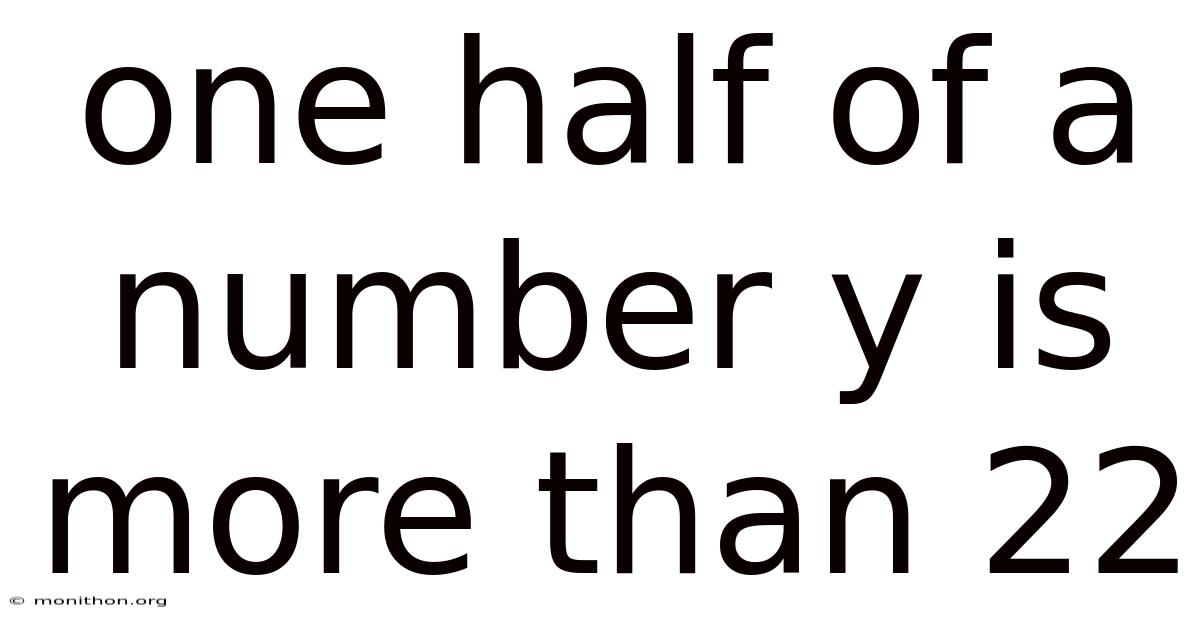
Table of Contents
Understanding the inequality "one half of a number y is more than 22" is a fundamental concept in algebra that helps students build a strong foundation for solving more complex equations later on. This topic is not only essential for academic success but also for developing logical thinking skills that are valuable in everyday problem-solving.
Let's start by breaking down the inequality: one half of a number y is more than 22. In mathematical terms, this can be written as: $\frac{1}{2}y > 22$ Here, y represents an unknown number, and we are looking for all possible values of y that satisfy this condition. The inequality symbol > means "greater than," so we are seeking numbers for which half of them is greater than 22.
To solve this inequality, we can use basic algebraic operations. Since y is being multiplied by one half, we can multiply both sides of the inequality by 2 to isolate y: $2 \times \frac{1}{2}y > 2 \times 22$ $y > 44$ This means that any number greater than 44 will satisfy the original inequality. For example, if y = 45, then one half of 45 is 22.5, which is indeed more than 22. Similarly, y = 50, 100, or even 1000 would all work, as long as y is greater than 44.
It's important to note that the inequality is strict; y cannot be equal to 44 because half of 44 is exactly 22, not more than 22. This distinction is crucial in mathematics, as it determines the solution set for the inequality.
Understanding inequalities like this is not just an academic exercise. In real life, such concepts are used in various fields, including finance, engineering, and science. For instance, when budgeting, you might need to ensure that your expenses do not exceed half of your income. In manufacturing, quality control might require that a product's weight be more than a certain threshold to meet safety standards.
To further illustrate, let's consider a few examples:
- If y = 50, then one half of 50 is 25, which is more than 22.
- If y = 44.1, then one half of 44.1 is 22.05, which is also more than 22.
- If y = 44, then one half of 44 is exactly 22, which does not satisfy the inequality.
This leads us to the solution set: all real numbers y such that y > 44. In interval notation, this is written as (44, ∞).
A common mistake students make is forgetting to reverse the inequality sign when multiplying or dividing by a negative number. However, in this case, we multiplied by a positive number (2), so the direction of the inequality remains unchanged.
Another point to consider is the graphical representation of this inequality. On a number line, the solution set would be everything to the right of 44, not including 44 itself. This visual representation helps reinforce the concept that y can be any number greater than 44, but not 44 or any number less than 44.
In conclusion, the inequality "one half of a number y is more than 22" teaches us how to manipulate and solve simple algebraic inequalities. By isolating the variable and understanding the meaning of the inequality symbol, we can determine that y must be greater than 44. This foundational skill is essential for more advanced mathematical studies and has practical applications in many areas of life. As you continue to explore algebra, remember that inequalities are a powerful tool for describing relationships between quantities and for solving real-world problems.
The process of solving inequalities is a fundamental skill in mathematics, laying the groundwork for more complex concepts in algebra and beyond. This particular example demonstrates the core principles of isolating a variable and interpreting the meaning of inequality symbols. The key takeaway is that when multiplying or dividing both sides of an inequality by a positive number, the direction of the inequality sign remains the same. However, this principle must be applied carefully, and understanding the nuances of strict inequalities is vital for arriving at the correct solution set.
Beyond the immediate algebraic solution, this problem highlights the pervasive nature of mathematical concepts in the real world. From managing personal finances to ensuring product quality, the ability to reason about quantities and their relationships is indispensable. The solution, y > 44, represents a set of possibilities – a range of values that satisfy the given condition. This ability to define and interpret solution sets is a cornerstone of mathematical thinking and problem-solving.
Ultimately, mastering inequalities empowers us to analyze situations, make informed decisions, and predict outcomes. It’s not just about finding a single answer; it’s about understanding the entire range of possibilities and the constraints that govern them. By consistently practicing and applying these principles, you will build a strong foundation for success in mathematics and in navigating the complexities of the world around you. Remember to always carefully consider the direction of the inequality sign and the implications of algebraic manipulations to arrive at the accurate solution.
This elementary understanding serves as a crucial stepping stone toward tackling more sophisticated mathematical landscapes. As students advance, they encounter compound inequalities that describe intersections or unions of multiple conditions, absolute value inequalities that model distances and deviations, and systems of inequalities that define feasible regions in two or more variables. These concepts are not merely academic; they form the backbone of optimization in economics, constraint analysis in engineering, and statistical confidence intervals in data science. The simple act of recognizing that y > 44 describes an open-ended, infinite set of solutions cultivates a mindset essential for these future challenges—a mindset that embraces ranges, boundaries, and relational thinking over isolated numerical answers.
Therefore, the lesson extends far beyond a single algebraic manipulation. It is an introduction to a language of limits and possibilities. The ability to formulate a condition like “one half of a number is more than 22” and translate it precisely into (1/2)y > 22, then correctly interpret y > 44, is a microcosm of mathematical modeling. It teaches precision in expression, rigor in transformation, and clarity in interpretation. Each correctly solved inequality reinforces a disciplined approach: define the relationship, apply valid operations, and accurately describe the resulting set.
In closing, the journey from a verbal statement to a solution set like y > 44 encapsulates the power and elegance of algebra. It is a foundational exercise in logical reasoning that prepares the mind for abstract thought and practical problem-solving alike. By mastering this process, you gain more than a correct answer; you acquire a versatile tool for quantifying “more than,” “at least,” and “between” in countless scenarios. This skill, rooted in the careful handling of inequality symbols, is an indispensable component of numerical literacy and a gateway to understanding the quantitative fabric of the world.
Building on this insight, it becomes clear that each step in solving inequalities deepens our appreciation for the nuanced interplay between logic and application. As learners explore variations in constraints—such as compound conditions or inequalities involving absolute values—they develop an intuition for how boundaries shift depending on context. This adaptability is vital, whether in solving real-world scenarios like budgeting constraints or analyzing scientific data trends. The process reinforces the idea that mathematics is not just about numbers, but about interpreting relationships and making informed decisions based on those relationships.
Understanding these complexities also highlights the importance of persistence. When working through challenging problems, it’s easy to overlook subtle details, such as whether to include or exclude endpoints in an interval. However, recognizing these nuances strengthens analytical skills and fosters confidence in tackling unfamiliar situations. Each solved inequality is a small victory that contributes to broader mathematical fluency.
Moreover, this skill extends beyond the classroom. In professional fields, professionals routinely confront similar decision-making challenges, where precision in reasoning can prevent costly errors. By internalizing the patterns and principles behind inequalities, individuals gain a competitive edge in reasoning, planning, and problem-solving.
In summary, mastering inequality concepts opens doors to deeper comprehension and versatile application. It equips learners not only with techniques but also with a mindset attuned to precision, flexibility, and critical thinking. This foundation empowers individuals to navigate the intricacies of both academic and practical challenges with clarity and confidence.
Conclusion: The journey through understanding inequalities is more than a mathematical exercise—it’s a pathway to sharpen analytical thinking and prepare for the diverse demands of a complex world. Embracing these lessons ensures that each challenge becomes an opportunity to grow.
Latest Posts
Latest Posts
-
How Do You Convert A Fraction To A Whole Number
Mar 12, 2026
-
Seven More Than Twice A Number
Mar 12, 2026
-
Least Common Multiple Of These Two Expressions
Mar 12, 2026
-
Fractions That Are Greater Than 1 2
Mar 12, 2026
-
5 X 5 X 5 X
Mar 12, 2026
Related Post
Thank you for visiting our website which covers about One Half Of A Number Y Is More Than 22 . We hope the information provided has been useful to you. Feel free to contact us if you have any questions or need further assistance. See you next time and don't miss to bookmark.
