One Less Than Three Times A Number

monithon
Mar 12, 2026 · 8 min read
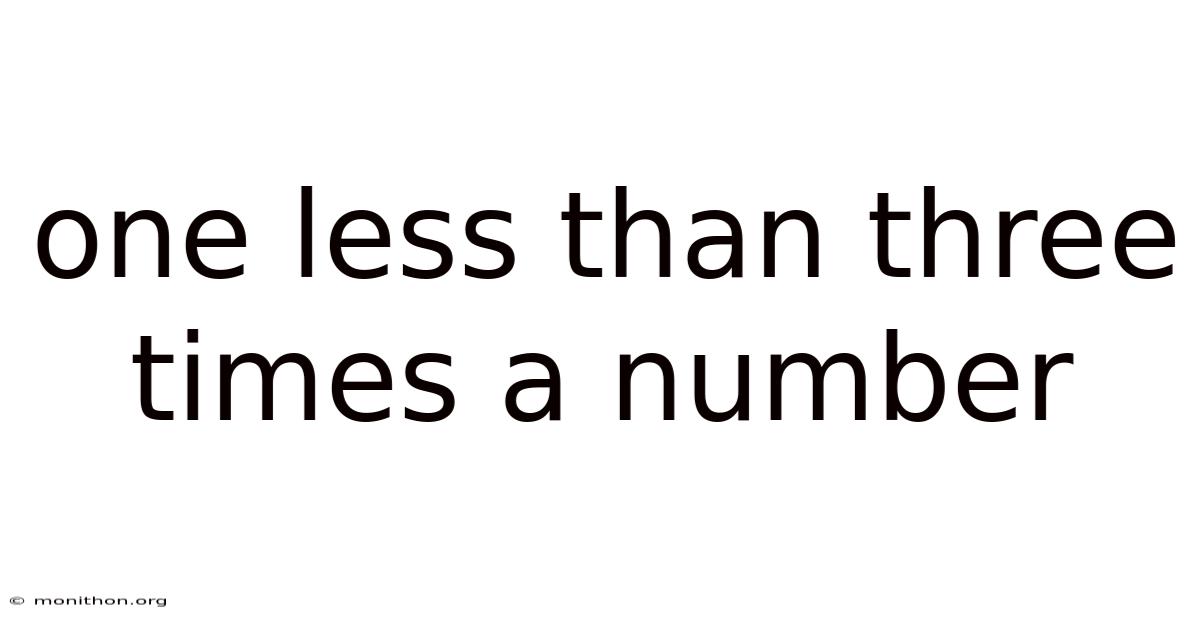
Table of Contents
Understanding "One Less Than Three Times a Number"
In mathematics, phrases like "one less than three times a number" are commonly used to describe algebraic expressions. This type of phrase requires translating words into a mathematical form, which is a fundamental skill in algebra. Understanding how to interpret and solve such expressions is essential for students, professionals, and anyone looking to improve their problem-solving abilities.
Breaking Down the Expression
The phrase "one less than three times a number" can be broken down step by step. Let's identify each part:
- "Three times a number" means multiplying 3 by an unknown value, usually represented by a variable like x. This gives us 3x.
- "One less than" indicates subtraction of 1 from the previous result.
Therefore, the complete expression is 3x - 1. This translation from words to symbols is a key skill in algebra, as it allows us to set up equations and solve for unknowns.
Why This Expression Matters
Expressions like 3x - 1 appear frequently in word problems, equations, and real-world applications. For example, if a store sells items at three times the cost of production and then offers a discount of one dollar, the final price can be modeled by this expression. Similarly, in physics, such expressions might represent relationships between variables, such as distance, time, or force.
Understanding how to construct and manipulate these expressions is crucial for solving more complex problems in algebra, calculus, and beyond.
Solving Problems with This Expression
To solve problems involving "one less than three times a number," you often need to set the expression equal to a given value and solve for x. For example:
Problem: If one less than three times a number equals 11, what is the number?
Solution:
- Set up the equation: 3x - 1 = 11
- Add 1 to both sides: 3x = 12
- Divide both sides by 3: x = 4
So, the number is 4. This process demonstrates how algebraic expressions can be used to find unknown values.
Common Mistakes to Avoid
When working with expressions like 3x - 1, it's important to avoid common pitfalls:
- Misinterpreting the order of operations. Remember, multiplication comes before subtraction.
- Forgetting to distribute negative signs or combine like terms correctly.
- Confusing "less than" with "subtracted from," which can change the meaning of the expression.
By paying attention to these details, you can ensure accurate solutions and a deeper understanding of algebraic concepts.
Real-World Applications
Expressions like "one less than three times a number" are not just academic exercises. They have practical applications in various fields:
- Finance: Calculating discounts, interest, or investment returns.
- Engineering: Modeling relationships between variables in design and analysis.
- Science: Describing physical laws or chemical reactions.
By mastering these expressions, you can develop strong analytical skills that are valuable in many careers and everyday situations.
Tips for Learning and Practice
To become proficient in translating and solving expressions like 3x - 1, consider the following tips:
- Practice translating word problems into algebraic expressions.
- Use online tools or worksheets to reinforce your skills.
- Work through example problems step by step to build confidence.
- Seek help from teachers or tutors if you encounter difficulties.
With consistent practice and a clear understanding of the underlying concepts, you can master these essential algebraic skills.
Conclusion
"One less than three times a number" is more than just a phrase—it's a gateway to understanding algebraic expressions and problem-solving. By breaking down the expression, setting up equations, and practicing with real-world examples, you can develop the skills needed to tackle a wide range of mathematical challenges. Whether you're a student, educator, or lifelong learner, mastering these concepts will serve you well in both academic and practical pursuits.
Expanding the Concept: Variations and Complexity
The core idea of "one less than three times a number" can be extended and combined with other algebraic concepts to create more complex problems. Consider variations like "two more than five times a number" (5x + 2) or "half of a number increased by seven" (x/2 + 7). The key is to carefully identify the operations and their order as described in the word problem.
Furthermore, these expressions can be incorporated into multi-step equations. For instance: "If one less than three times a number is twice the number, what is the number?" This translates to 3x - 1 = 2x. Solving this requires combining like terms: 3x - 2x = 1, resulting in x = 1. The ability to handle these combined scenarios demonstrates a more advanced understanding of algebraic manipulation.
Utilizing Expressions within Functions
Beyond simple equations, these types of expressions frequently appear within functions. A function might be defined as f(x) = 3x - 1, or f(x) = 5x + 2. Understanding how to evaluate these functions for specific values of 'x' is crucial. For example, if f(x) = 3x - 1 and x = 5, then f(5) = (3 * 5) - 1 = 14. This skill is fundamental in calculus and higher-level mathematics.
The Importance of Abstract Thinking
Working with algebraic expressions encourages abstract thinking. You're not dealing with concrete numbers initially, but rather with symbols representing unknown quantities. This ability to think abstractly is a valuable skill that extends far beyond mathematics, influencing problem-solving in various disciplines. It allows you to generalize patterns and relationships, leading to more efficient and elegant solutions.
Beyond Single Variables: Introducing Multiple Variables
The concept can be expanded to include multiple variables. For example, "one less than three times a number plus twice another number" could be represented as 3x + 2y - 1. This introduces the need to understand how different variables interact within an expression and how to solve equations involving multiple unknowns. This is a stepping stone to understanding systems of equations and linear algebra.
Conclusion
From simple equations to complex functions and abstract thinking, the seemingly straightforward phrase "one less than three times a number" unlocks a wealth of algebraic understanding. It serves as a foundational building block for more advanced mathematical concepts and cultivates essential problem-solving skills. By consistently practicing translation, equation solving, and function evaluation, you can confidently navigate the world of algebraic expressions and apply these skills to a diverse range of challenges, both within and beyond the realm of mathematics. The journey from understanding this basic expression to mastering more complex algebraic structures is a rewarding one, empowering you with a powerful tool for logical reasoning and analytical thinking.
The Power of Translation: Word Problems to Algebra
The core skill in mastering algebraic expressions lies in the ability to translate real-world scenarios into mathematical language. This often begins with identifying key information within a word problem – the unknown quantity, the operations being performed, and the relationships between them. Phrases like "more than," "less than," "the product of," and "divided by" all map to specific mathematical operations. For instance, "the product of a number and five" translates to 5x, while "ten less than twice a number" becomes 2x - 10. This translation process isn't merely about substituting numbers; it’s about understanding the underlying structure of the problem and representing it accurately using symbols.
Simplifying and Evaluating Complex Expressions
Algebraic expressions often require simplification before evaluation. This involves combining like terms, applying the distributive property, and following the order of operations (PEMDAS/BODMAS). Consider the expression 2(x + 3) - 4x. First, apply the distributive property: 2x + 6 - 4x. Then, combine like terms: (2x - 4x) + 6, resulting in -2x + 6. Finally, to evaluate this expression, you would substitute a value for 'x'. This skill of simplification is crucial for solving more complex equations and understanding the behavior of functions. It allows you to streamline calculations and identify patterns within the expression.
Visualizing Algebraic Expressions
While algebraic expressions are abstract, they can be visualized using various tools. Graphing calculators and online graphing tools allow you to plot functions and observe their behavior. For example, the function f(x) = 3x - 1 can be graphed as a straight line, demonstrating the direct relationship between 'x' and 'f(x)'. This visual representation helps to solidify understanding and provides a different perspective on the relationships encoded within the expression. Furthermore, understanding the slope and y-intercept of a linear equation, derived from its algebraic form, provides a powerful visual shortcut.
Applications in Real-World Scenarios
Algebraic expressions aren't confined to the classroom; they have widespread applications in various fields. Engineers use them to model physical systems, economists use them to analyze market trends, and computer scientists use them to develop algorithms. Financial models rely heavily on algebraic expressions to predict investment returns and assess risk. Even everyday tasks, like calculating distances, speeds, and times, involve algebraic relationships. Recognizing the underlying algebraic structure in these situations can lead to more efficient and accurate solutions.
Conclusion
The seemingly simple phrase "one less than three times a number" serves as a gateway to a vast and powerful world of algebraic thinking. It’s not just about solving for 'x'; it's about developing a fundamental skillset for abstract reasoning, problem decomposition, and logical manipulation. Mastering algebraic expressions lays the groundwork for success in higher-level mathematics, science, and a multitude of practical applications. By embracing the translation process, honing simplification techniques, and visualizing these concepts, learners can unlock a powerful tool for understanding and navigating the complexities of the world around them. This foundational knowledge empowers individuals to approach challenges with confidence, analytical rigor, and a deeper appreciation for the elegance of mathematical thought.
Latest Posts
Latest Posts
-
15 Decreased By Twice A Number
Mar 12, 2026
-
How To Find The Range Of A Rational Function
Mar 12, 2026
-
In Mitosis The Two Resulting Cells Are
Mar 12, 2026
-
Twice The Difference Of 9 And A Number
Mar 12, 2026
-
60 Grams Equals How Many Milliliters
Mar 12, 2026
Related Post
Thank you for visiting our website which covers about One Less Than Three Times A Number . We hope the information provided has been useful to you. Feel free to contact us if you have any questions or need further assistance. See you next time and don't miss to bookmark.
