Seven Less Than Twice A Number

monithon
Mar 17, 2026 · 8 min read
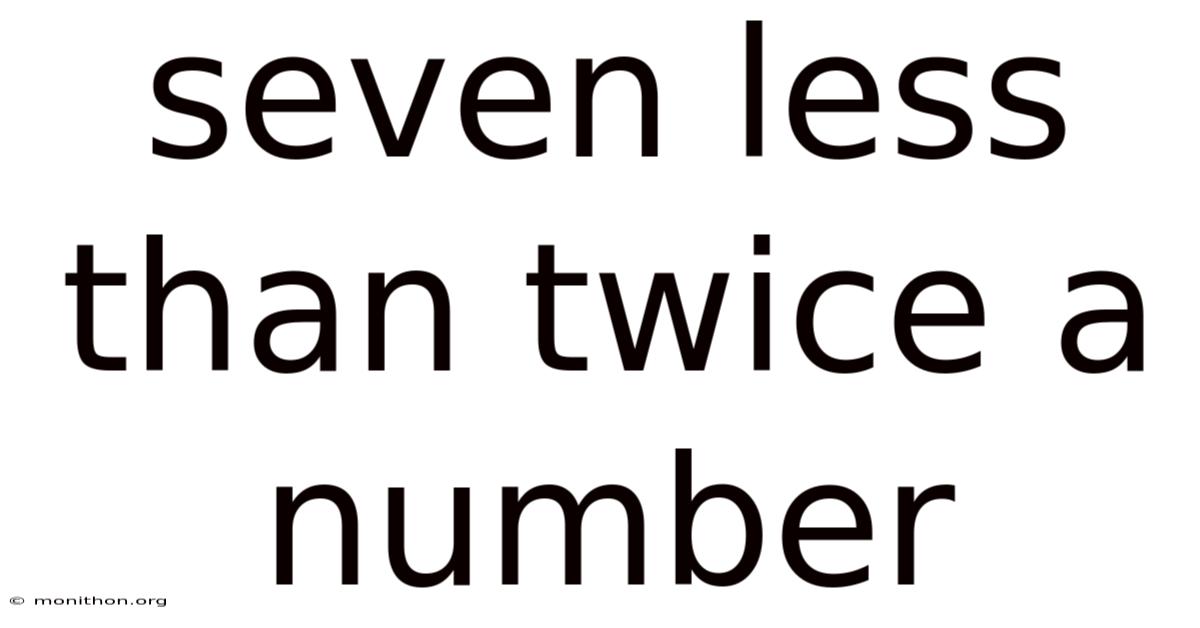
Table of Contents
Sevenless than twice a number is a phrase that appears frequently in elementary algebra and word‑problem contexts. It serves as a gateway to understanding how verbal statements can be converted into precise mathematical expressions, and it frequently shows up in equations that model real‑life situations. This article walks you through the meaning of the phrase, demonstrates how to translate it into algebraic form, explores typical equation‑solving techniques, and answers common questions that arise when students encounter this concept.
Understanding the Phrase
The expression seven less than twice a number breaks down into three simple ideas:
- Twice a number – multiplying an unknown quantity by 2.
- Seven – the constant that will be subtracted. 3. Less than – indicates subtraction, not addition.
When you combine these ideas, the resulting algebraic expression is 2 x – 7, where x represents the unknown number. Recognizing each component helps prevent misinterpretation, especially when the wording changes slightly (e.g., “seven less than a number” versus “seven less than twice a number”).
Translating to Algebraic Expression### Step‑by‑step conversion
- Identify the unknown – Choose a variable, typically x or n, to stand for the number.
- Express “twice a number” – Multiply the variable by 2, giving 2 x.
- Apply “seven less than” – Subtract 7 from the previous result, yielding 2 x – 7.
Example: If the unknown number is 10, then twice the number is 20, and seven less than that is 13. Substituting x = 10 into 2 x – 7 indeed produces 13.
Common pitfalls
- Reversing the order of operations – Some learners write 7 – 2 x, which actually represents “seven more than twice a number” with a negative sign. - Misreading “less than” – Remember that “less than” signals subtraction, but the subtrahend (the number being subtracted) comes after the quantity it modifies. Hence, “seven less than twice a number” is 2 x – 7, not 7 – 2 x.
Solving Equations Involving the PhraseMany word problems ask you to find the number that satisfies a condition involving seven less than twice a number. Below are typical scenarios and the corresponding solution steps.
Example 1: Direct equation
Find the number such that seven less than twice the number equals 15.
Equation:
(2x - 7 = 15)
Solution: 1. Add 7 to both sides: (2x = 22)
2. Divide by 2: (x = 11)
Thus, the number is 11.
Example 2: Word problem with context
A school club earns points for each project. The total points earned are equal to seven less than twice the number of projects submitted. If the club earned 27 points, how many projects did they submit?
Equation:
(2p - 7 = 27) (where p = number of projects)
Solution: 1. Add 7: (2p = 34)
2. Divide by 2: (p = 17)
The club submitted 17 projects.
General strategy
- Translate the verbal statement into an algebraic equation.
- Isolate the variable term by performing inverse operations (addition ↔ subtraction, multiplication ↔ division).
- Check the solution by plugging it back into the original expression to ensure the statement holds true.
Real‑World Applications
The concept of “seven less than twice a number” is more than an abstract algebraic exercise; it mirrors situations where a quantity is scaled and then offset by a constant.
- Finance: Calculating a discount that is “seven dollars less than twice the original price.”
- Science: Determining a temperature threshold that is “seven degrees below twice the ambient temperature.”
- Engineering: Setting a safety margin where a stress limit is “seven units less than twice the applied load.”
Understanding how to model these scenarios mathematically enables professionals to make precise predictions and adjustments.
Common Mistakes and How to Avoid Them
| Mistake | Why It Happens | Correct Approach |
|---|---|---|
| Writing 7 – 2x instead of 2x – 7 | Misreading “less than” as “more than” or reversing the order | Remember that “less than” means subtract the second quantity from the first; keep the order as it appears in the phrase. |
| Forgetting to include the variable when substituting numbers | Treating the expression as a pure constant | Always replace the variable with the given number before performing arithmetic. |
| Skipping the check step | Assuming the algebraic manipulation is automatically correct | Substitute the found value back into the original phrase to verify the result matches the problem’s condition. |
Frequently Asked Questions (FAQ)
Q1: What does “less than” imply in algebraic terms?
A: “Less than” indicates subtraction, where the number mentioned second is taken away from the first. For example, “seven less than twice a number” translates to 2 x – 7.
Q2: Can the phrase be used with negative numbers?
A: Yes. If the unknown number is negative, the same translation applies. For instance, if x = –3, then 2 (–3) – 7 = –6 – 7 = –13.
Q3: How do I handle “seven less than twice a number” when the problem asks for “the number that makes the expression equal to zero”?
A: Set the expression to zero: 2x – 7 = 0. Solving gives x = 3.5. This means 3.5 is the number that makes the phrase exactly zero.
Q4: Is there a shortcut for mental calculations?
A: Add the constant to both sides first, then divide. In the equation 2x – 7 = 15, you can quickly add 7 to get 2x = 22, then halve to obtain **x
… then halve to obtain x = 11. This two‑step maneuver—first neutralizing the constant, then halving the coefficient—works for any linear expression of the form ax – b = c and can shave seconds off mental arithmetic during timed tests or quick estimations.
Putting It All Together
When faced with a verbal description like “seven less than twice a number,” the translation process is straightforward: identify the operation applied to the unknown (here, doubling), then apply the stated offset (subtracting seven). Once the algebraic form 2x – 7 is established, solving for x follows the familiar steps of isolating the variable—add the constant, divide by the coefficient, and finally verify by substitution. Recognizing common pitfalls, such as reversing the order of subtraction or neglecting to replace the variable with a test value, helps maintain accuracy. The same pattern appears in practical contexts ranging from financial discounts to engineering safety margins, demonstrating the utility of a simple algebraic model.
Conclusion
Mastering the phrase “seven less than twice a number” equips you with a reliable tool for converting everyday scenarios into solvable equations. By consistently applying the translation rule, avoiding typical errors, and checking your work, you ensure that your mathematical models reflect reality accurately—whether you’re balancing a budget, calibrating a sensor, or setting a design limit. This foundational skill bridges the gap between abstract algebra and tangible problem‑solving, reinforcing the idea that mathematics is not just a classroom exercise but a practical language for the world around us.
Continuing from the pointwhere the mental shortcut was introduced:
Beyond the Shortcut: Recognizing Patterns and Avoiding Pitfalls
The two-step method—neutralizing the constant first, then dividing by the coefficient—is powerful, but its efficiency hinges on recognizing the underlying structure: linear expressions of the form ax – b = c. This pattern is ubiquitous. For instance, "three more than half a number" translates to (1/2)x + 3 = c, and solving it mentally involves first subtracting 3, then multiplying by 2. The core principle remains: isolate the variable term by performing the inverse operation on the constant, then isolate the variable by performing the inverse operation on its coefficient.
However, vigilance is crucial. The shortcut assumes the expression follows the ax – b format. If the phrase describes addition instead of subtraction ("seven more than twice a number" becomes 2x + 7), the constant is added, requiring subtraction to isolate the variable term. Misreading the operation is a common error. Similarly, phrases like "the product of a number and 5, decreased by 8" (5x – 8) follow the same logic, but require careful parsing of the verbal description to identify the correct coefficient and operation.
The Ubiquity of the Translation
The skill of translating phrases like "seven less than twice a number" into 2x – 7 is far more than an academic exercise. It forms the bedrock of quantitative reasoning in countless real-world contexts. Consider personal finance: calculating a discount ("the price after a 20% reduction on an item costing P dollars" translates to 0.8P) or determining a loan payment schedule relies on similar algebraic translations. In engineering, safety margins might be expressed as "the maximum load is five less than twice the rated capacity" (2C – 5), requiring precise calculation to ensure structural integrity. Even in everyday planning, phrases like "I need seven fewer hours of sleep than twice my usual amount" (2U – 7) necessitate translating words into equations to manage time effectively.
Conclusion
Mastering the translation of verbal descriptions involving subtraction from a multiple (like "seven less than twice a number") into the algebraic form ax – b is a fundamental and versatile skill. It provides a systematic approach to solving problems across diverse fields, from finance and engineering to personal planning. By understanding the core pattern, recognizing the operation
This ability to deconstruct language and convert it into mathematical language not only sharpens analytical thinking but also empowers individuals to tackle complex scenarios with confidence. As you practice these translations, pay attention to the relationships between words and numbers—each phrase is a clue waiting to reveal its mathematical form. The process reinforces the importance of precision, encouraging a deeper engagement with the logic behind the numbers. Over time, this skill becomes second nature, transforming abstract concepts into actionable insights.
In summary, embracing this method enriches your problem-solving toolkit, making it easier to navigate challenges both in theory and in practice. The journey from interpretation to equation is a testament to the power of clarity in communication.
Conclusion: By consistently refining your ability to translate verbal phrases into mathematical expressions, you equip yourself with a valuable asset that bridges understanding and application across various domains.
Latest Posts
Latest Posts
-
What Are The Three Ways That An Object Can Accelerate
Mar 17, 2026
-
A Bag Contains 5 Red Marbles
Mar 17, 2026
-
Use The Laws Of Logarithms To Combine The Expression
Mar 17, 2026
-
What Fractions Are Greater Than 1 2
Mar 17, 2026
-
How Do You Find The Nth Term Of A Sequence
Mar 17, 2026
Related Post
Thank you for visiting our website which covers about Seven Less Than Twice A Number . We hope the information provided has been useful to you. Feel free to contact us if you have any questions or need further assistance. See you next time and don't miss to bookmark.
