Seven Less Than Twice A Number Is 5

monithon
Mar 08, 2026 · 7 min read
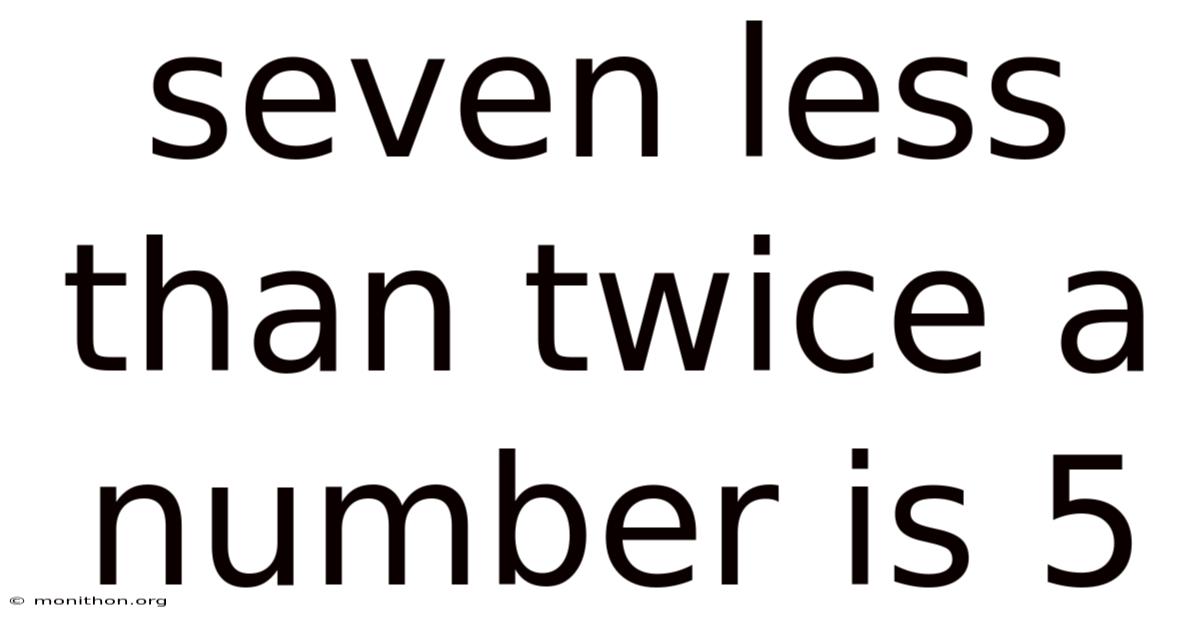
Table of Contents
Seven less than twice a number is 5 is a concise algebraic statement that translates directly into the equation 2x − 7 = 5. Solving this equation not only teaches fundamental algebraic manipulation but also illustrates how everyday situations can be expressed mathematically. This article walks you through the complete process, from interpreting the wording to verifying the solution, while highlighting common pitfalls and real‑world relevance.
Understanding the Problem
The phrase “seven less than twice a number is 5” contains three key components:
- Twice a number – this means multiplying an unknown quantity by 2.
- Seven less than – subtracting 7 from the previous result.
- Is 5 – the final result equals 5.
Identifying these parts helps you convert the verbal description into a precise algebraic equation. The unknown quantity, often represented by x, becomes the variable you will solve for.
Step‑by‑Step Solution
1. Translate the sentence into an equation
- Let the unknown number be x.
- “Twice a number” → 2x.
- “Seven less than twice a number” → 2x − 7.
- “Is 5” → = 5.
Thus, the equation is:
2x − 7 = 5.
2. Isolate the variable
-
Add 7 to both sides to eliminate the subtraction:
2x − 7 + 7 = 5 + 7 → 2x = 12. -
Divide both sides by 2 to solve for x:
(2x)/2 = 12/2 → x = 6.
3. Check the solution
Substitute x = 6 back into the original statement:
- Twice the number: 2 × 6 = 12.
- Seven less than that: 12 − 7 = 5.
Since the result matches the given value (5), the solution is correct.
Verification and Interpretation
Verification is a crucial step that reinforces confidence in your answer. By plugging the found value back into the original expression, you confirm that no arithmetic error occurred during manipulation. This practice also builds a habit that will serve you well in more complex problems.
Interpretation of the solution reveals that the unknown number is 6. In practical terms, if you were told “seven less than twice a number equals five,” the number you’re looking for is six. This kind of reasoning is foundational for word‑problem solving in algebra.
Real‑World Contexts
Algebraic equations like 2x − 7 = 5 appear in numerous everyday scenarios:
- Budgeting: Suppose you spend $7 less than twice your weekly savings and end up with $5 left. How much did you originally save?
- Physics: If an object’s speed is described as “twice the time minus seven seconds,” and you know the speed is 5 m/s, you can solve for the time.
- Cooking: A recipe might require “seven grams less than twice the amount of flour you have,” resulting in a specific quantity.
Understanding how to set up and solve such equations equips you to model and solve practical problems efficiently.
Common Mistakes
Even simple equations can trip up learners. Here are frequent errors and how to avoid them:
- Misreading “less than” as “more than.” The phrase “seven less than” indicates subtraction, not addition.
- Incorrectly distributing the multiplication. Remember that “twice a number” applies only to the unknown, not to the entire expression.
- Forgetting to perform the same operation on both sides. Maintaining balance is essential; always add, subtract, multiply, or divide both sides by the same value.
- Skipping the verification step. Skipping this check can leave subtle errors unnoticed.
Frequently Asked Questions
Q1: Can the unknown number be negative?
Yes. While the solution x = 6 is positive in this specific problem, the algebraic process works for any real number. If the equation yielded a negative result, it would still be valid.
Q2: What if the equation were “seven less than twice a number is –5”?
You would follow the same steps: 2x − 7 = –5 → 2x = 2 → x = 1. The negative target simply changes the arithmetic on the right‑hand side.
Q3: How does this relate to linear equations?
The equation 2x − 7 = 5 is a first‑degree linear equation because the variable appears only to the first power and is not inside any exponents or roots. Linear equations form straight lines when graphed and are the building blocks of algebra.
Q4: Is there a shortcut to solve such problems?
The straightforward approach—translation, isolation, and verification—is the most reliable. Shortcuts may lead to mistakes, especially with more complex expressions.
Conclusion
The statement seven less than twice a number is 5 translates neatly into the algebraic equation 2x − 7 = 5, which solves to x = 6. By breaking down the wording, isolating the variable, and verifying the result, you reinforce both procedural fluency and conceptual understanding. This methodical approach applies to a wide range of word problems, making it an essential skill for students, professionals, and anyone looking to harness the power of algebra in everyday life. Embrace the process, check your work, and let the logic of equations guide you to clear, confident answers.
Beyond the Basics: Expanding Your Algebraic Toolkit
Once you've mastered solving simple one-step and two-step equations, the possibilities expand significantly. The principles remain the same – translating words into symbols, applying inverse operations, and maintaining balance – but the complexity of the expressions increases. You'll encounter equations with variables on both sides, equations involving fractions, and those requiring multiple steps to isolate the unknown.
For example, consider the equation: (3x + 2)/2 = 7. Here, the equation requires you to first isolate the term containing x, then solve for x. This involves multiplying both sides by 2 to eliminate the denominator and then subtracting 2 from both sides. Similarly, equations with fractions often benefit from finding a common denominator before proceeding with algebraic manipulations.
Furthermore, understanding the concept of variables and their roles is crucial. A variable isn't just a placeholder; it represents an unknown quantity that can change. The goal of solving an equation is to determine the value of that variable that satisfies the equation. This understanding extends beyond simple calculations; it's foundational to modeling real-world situations where quantities are not known but are related to each other.
The skills developed through algebraic equation solving are incredibly versatile. They're not confined to the classroom or the realm of mathematics. From calculating discounts and interest rates to determining distances and speeds, algebra provides a powerful framework for analyzing and solving problems in countless fields. It empowers you to think logically, break down complex situations into manageable steps, and arrive at well-reasoned conclusions. By consistently practicing and reinforcing these fundamental skills, you'll unlock a deeper understanding of the world around you and gain a valuable tool for problem-solving in all aspects of life.
Mastering the Art of Algebraic Problem-Solving
As you tackle more intricate equations, techniques like combining like terms and distributing become increasingly important. For instance, in the equation 4*(x + 3) = 2x + 10, you’ll need to distribute the 4 across the terms inside the parentheses before simplifying and solving for x. Recognizing and applying these fundamental algebraic rules is paramount to success. Moreover, learning to recognize different types of equations – linear, quadratic, exponential – allows you to select the most appropriate solution method. Each type demands a slightly different approach, requiring a broader understanding of algebraic principles.
Beyond the standard techniques, exploring concepts like inequalities offers another layer of complexity and utility. Solving inequalities, such as 2x - 5 > 11, requires a slightly different strategy than solving equations. The key difference lies in the direction of the inequality sign; when solving inequalities, you must flip the inequality sign after multiplying or dividing by a negative number. Understanding this subtle but crucial distinction is vital for accurately representing and solving problems involving ranges of values.
Furthermore, the use of graphing calculators and computer algebra systems can significantly aid in the process, particularly when dealing with more complex equations. These tools can perform calculations quickly and accurately, allowing you to focus on the underlying concepts and strategic thinking. However, it’s crucial to remember that technology should supplement, not replace, a solid understanding of algebraic principles. Always verify your solutions using the original equation to ensure accuracy.
Finally, developing a strong sense of algebraic intuition – a “feel” for how equations behave – is a hallmark of a proficient algebra student. This intuition comes from consistent practice and a deep engagement with the underlying concepts. It’s about recognizing patterns, anticipating potential pitfalls, and developing a flexible approach to problem-solving.
In conclusion, algebraic equation solving is far more than just memorizing formulas and procedures. It’s a powerful methodology for logical reasoning, critical thinking, and problem-solving that extends far beyond the confines of a textbook. By embracing a systematic approach, diligently practicing, and continually refining your understanding, you can unlock the transformative potential of algebra and equip yourself with a valuable skillset applicable to a vast array of challenges and opportunities throughout your life.
Latest Posts
Latest Posts
-
Which Product Is Greater Than 1 2
Mar 08, 2026
-
Which Expression Is Equivalent To The Expression Below
Mar 08, 2026
-
How Many Cups Is 3 Quarts Water
Mar 08, 2026
-
How Do Elephants And Lions Use Proteins
Mar 08, 2026
-
Two Times The Difference Of A Number And 7
Mar 08, 2026
Related Post
Thank you for visiting our website which covers about Seven Less Than Twice A Number Is 5 . We hope the information provided has been useful to you. Feel free to contact us if you have any questions or need further assistance. See you next time and don't miss to bookmark.
