Simplify This Fraction To It's Simplest Form : 15/100

monithon
Mar 19, 2026 · 6 min read
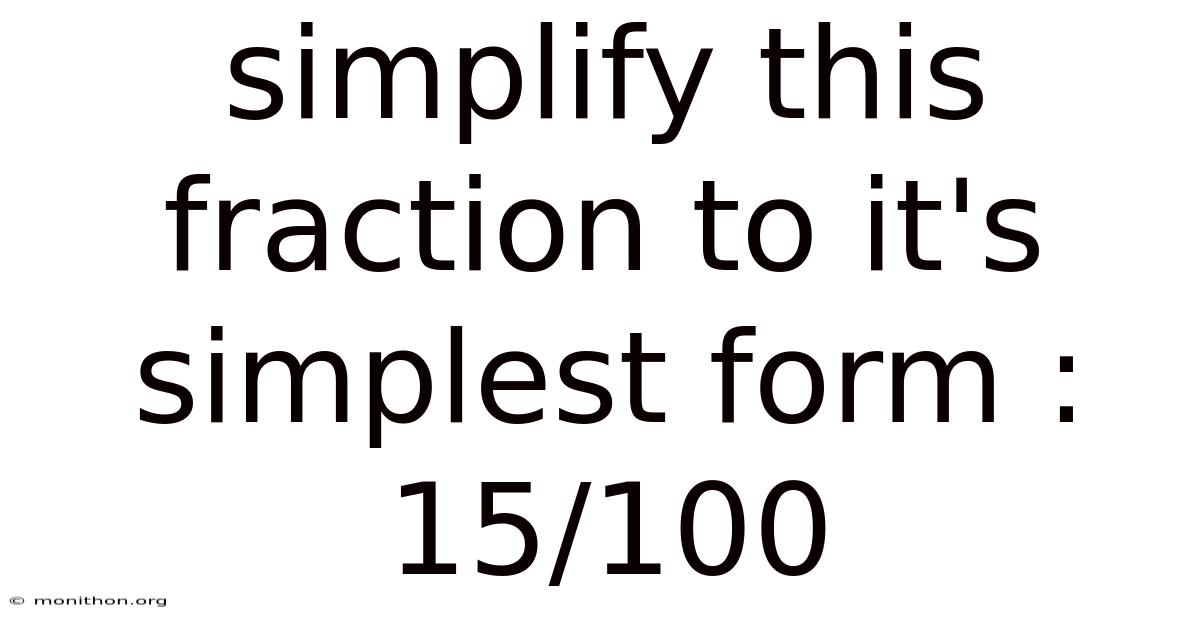
Table of Contents
Understanding How to Simplify the Fraction 15/100
Simplifying fractions is a fundamental skill in mathematics that helps make numbers more manageable and easier to work with. When we look at the fraction 15/100, we're dealing with a ratio that can be reduced to its simplest form. This process not only makes calculations more straightforward but also helps in understanding the relationship between numbers better.
The fraction 15/100 represents 15 parts out of a total of 100 parts. While this is a perfectly valid fraction, it can be simplified to make it more concise and easier to use in various mathematical operations. Simplifying fractions involves finding the greatest common divisor (GCD) of the numerator and denominator and then dividing both by this number.
Finding the Greatest Common Divisor
To simplify 15/100, we first need to find the greatest common divisor of 15 and 100. The GCD is the largest number that divides both numbers without leaving a remainder. For 15 and 100, we can list the factors:
Factors of 15: 1, 3, 5, 15 Factors of 100: 1, 2, 4, 5, 10, 20, 25, 50, 100
The largest number that appears in both lists is 5, so the GCD of 15 and 100 is 5.
The Simplification Process
Now that we know the GCD is 5, we can simplify the fraction by dividing both the numerator and the denominator by 5:
15 ÷ 5 = 3 100 ÷ 5 = 20
Therefore, the simplified form of 15/100 is 3/20.
Why Simplifying Fractions Matters
Simplifying fractions is more than just a mathematical exercise; it has practical applications in various fields. In science, simplified fractions are used in formulas and equations to make them more readable and easier to manipulate. In everyday life, simplified fractions help in understanding proportions and percentages more intuitively.
For example, 3/20 is easier to visualize than 15/100. You can quickly understand that 3/20 means 3 parts out of 20, which is equivalent to 15%. This simplified form makes it easier to compare with other fractions or to convert to decimals or percentages.
Converting to Decimal and Percentage
Once we have the simplified fraction 3/20, we can easily convert it to other forms:
Decimal: 3 ÷ 20 = 0.15 Percentage: 0.15 × 100 = 15%
These conversions show that 15/100, 3/20, 0.15, and 15% are all equivalent representations of the same value, just expressed in different forms.
Practical Applications
Understanding how to simplify fractions like 15/100 has numerous real-world applications. In cooking, recipes often require measurements that can be simplified for easier scaling. In construction and engineering, simplified fractions make calculations more manageable and reduce the chance of errors.
For instance, if a recipe calls for 15/100 of a cup of an ingredient, simplifying it to 3/20 makes it easier to measure, especially if you need to adjust the recipe for more or fewer servings.
Common Mistakes to Avoid
When simplifying fractions, there are some common pitfalls to watch out for:
- Forgetting to divide both the numerator and denominator by the GCD
- Not finding the greatest common divisor, resulting in an incomplete simplification
- Confusing simplification with other operations like addition or subtraction of fractions
Always double-check your work by ensuring that the simplified fraction cannot be reduced further and that both the numerator and denominator have been divided by the same number.
Advanced Simplification Techniques
For more complex fractions, finding the GCD might require additional steps. The Euclidean algorithm is a method that can be used to find the GCD of larger numbers efficiently. This algorithm involves repeatedly dividing the larger number by the smaller one and replacing the larger number with the remainder until the remainder is zero.
While this might seem complicated for simple fractions like 15/100, understanding these advanced techniques can be helpful when dealing with more complex mathematical problems.
Conclusion
Simplifying the fraction 15/100 to its simplest form, 3/20, is a straightforward process that demonstrates the power of basic mathematical principles. This simplification not only makes the fraction more manageable but also reveals its equivalence to 15% or 0.15 in decimal form.
Mastering the skill of simplifying fractions opens up a world of mathematical understanding and practical applications. Whether you're a student learning the basics of fractions, a professional dealing with complex calculations, or simply someone looking to better understand proportions in daily life, the ability to simplify fractions is an invaluable tool.
Remember, mathematics is not just about getting the right answer; it's about understanding the relationships between numbers and being able to manipulate them effectively. Simplifying fractions like 15/100 is a step towards developing this deeper mathematical intuition and problem-solving ability.
In practical terms, this skill translates into a more efficient and accurate approach to various disciplines. For example, in finance, simplifying ratios and fractions can make financial statements and analyses clearer and more comprehensible. In science, it aids in understanding concentrations, dilutions, and other proportional relationships.
Moreover, simplifying fractions encourages a deeper understanding of number properties and relationships. It fosters critical thinking and analytical skills, which are essential in both academic and everyday contexts. By breaking down complex fractions into their simplest forms, individuals can better grasp underlying principles and apply them to a wide range of problems.
In educational settings, teaching fraction simplification from an early stage can build a strong foundation for more advanced mathematical concepts. It prepares students for algebraic manipulations, proportional reasoning, and even calculus, where understanding ratios and proportions is crucial.
In summary, the process of simplifying fractions, as illustrated with 15/100, is more than just a mathematical exercise. It is a fundamental skill that enhances numerical literacy, promotes problem-solving, and has wide-ranging applications across various fields. By mastering this skill, individuals can navigate the world of numbers with greater confidence and precision, ultimately leading to better decision-making and problem-solving abilities in both personal and professional spheres.
Beyond immediate applications, the discipline of simplification cultivates a mindset essential for navigating an increasingly data-driven world. In fields like computer science and data analysis, the ability to reduce complex sets of information to their core ratios and relationships is a form of digital literacy. Algorithms often rely on normalized or simplified data structures to operate efficiently, and the intuitive grasp of proportionality—honed through fraction simplification—directly informs this kind of computational thinking.
This foundational skill also serves as a historical bridge, connecting modern problem-solving to the mathematical traditions of ancient civilizations that first grappled with ratios for trade, construction, and astronomy. Understanding how to simplify is, in essence, participating in a long-standing human endeavor to make the complex comprehensible.
Ultimately, the simplicity achieved through processes like reducing 15/100 to 3/20 is not about diminishing complexity but about revealing clarity. It transforms a raw numerical fact into an insight with context and utility. This act of distillation is a microcosm of effective thinking: identifying the essential pattern within the noise. As we advance into an era defined by big data and intricate systems, the capacity to simplify—to see the 3/20 within the 15/100—remains one of the most powerful and enduring tools in our intellectual toolkit, proving that the most advanced solutions are often built upon the most fundamental understandings.
Latest Posts
Latest Posts
-
Each Of You Is Or Each Of You Are
Mar 19, 2026
-
The Latin Root Word Dict Is Related To
Mar 19, 2026
-
What Is The Brotherhood In 1984
Mar 19, 2026
-
What Is The Fraction Of 0 9
Mar 19, 2026
-
Location Of Dna In A Eukaryotic Cell
Mar 19, 2026
Related Post
Thank you for visiting our website which covers about Simplify This Fraction To It's Simplest Form : 15/100 . We hope the information provided has been useful to you. Feel free to contact us if you have any questions or need further assistance. See you next time and don't miss to bookmark.
