Six Less Than Six Times A Number Is 12

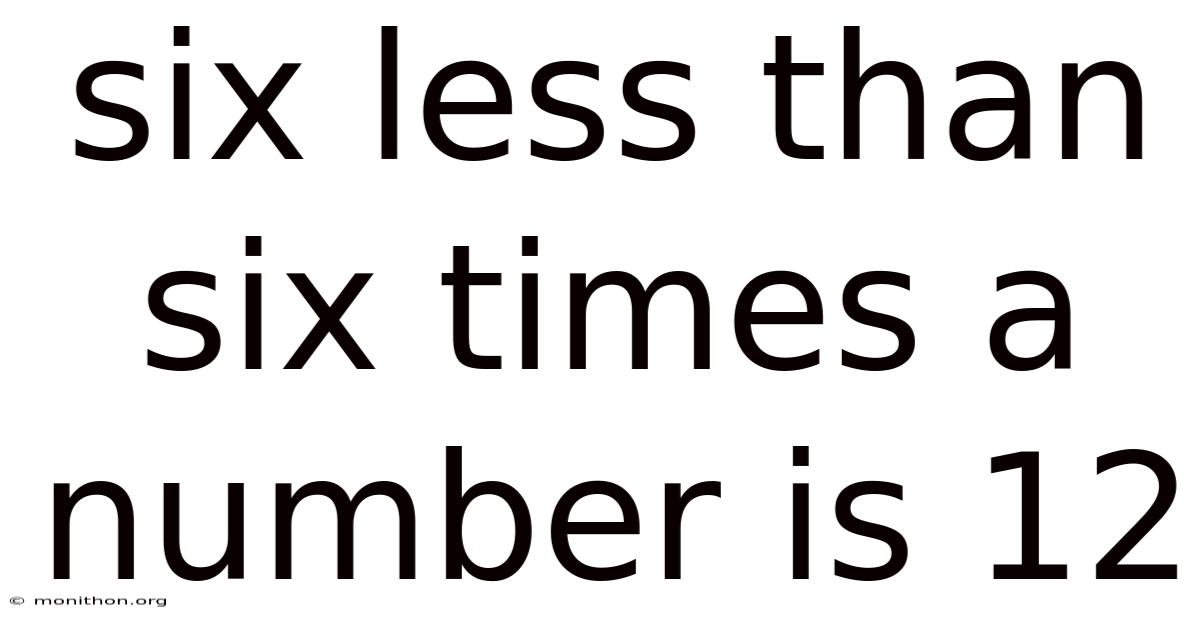
The phrase "six less than six times a number is 12" is more than just a word problem—it’s a fundamental bridge between everyday language and the precise world of algebra. Mastering this translation empowers you to decode countless real-world situations, from budgeting to engineering. This article will guide you through every step, transforming this seemingly simple sentence into a powerful lesson in mathematical thinking, problem-solving, and logical reasoning.
Decoding the Phrase: From Words to Mathematics
The first and most critical skill is translating English phrases into algebraic expressions. We must proceed with surgical precision, identifying each component.
-
"a number": This is your unknown quantity. In algebra, we represent unknowns with variables, most commonly the letter x. So, a number becomes x.
-
"six times a number": The word "times" signals multiplication. Therefore, this part translates directly to 6x.
-
"six less than...": This is the trickiest part for many learners. The phrase "less than" indicates a subtraction, but it reverses the order of the terms. It does not mean "6 minus something." It means "take the following quantity and subtract 6 from it."
- Less than is a reverse-operator. You must identify what comes after the phrase "less than"—in this case, "six times a number" (6x). You then subtract 6 from that result.
- Therefore, "six less than six times a number" becomes 6x - 6.
-
"is 12": The word "is" in mathematical contexts almost always means equals (=). It states that the expression on the left has the same value as the number on the right.
Putting it all together, the complete sentence "six less than six times a number is 12" is elegantly captured by the linear equation: 6x - 6 = 12
Solving the Equation: A Step-by-Step Journey
Now that we have our equation, we solve for the variable x. The goal is to isolate x on one side of the equals sign, using inverse operations that undo each other. Think of the equation as a balanced scale; whatever you do to one side, you must do to the other to maintain balance.
Step 1: Eliminate the constant term (-6) from the left side. The operation attached to the x term is subtraction. Its inverse is addition. To cancel the "-6," we add 6 to both sides of the equation.
6x - 6 + 6 = 12 + 6
This simplifies to:
6x = 18
Why? On the left, -6 and +6 cancel out, leaving just 6x. On the right, 12 + 6 equals 18.
Step 2: Eliminate the coefficient (6) from the left side. The operation now is multiplication (6 * x). Its inverse is division. To isolate x, we divide both sides by 6.
(6x) / 6 = 18 / 6
This simplifies to:
x = 3
Why? 6x divided by 6 leaves just x. 18 divided by 6 is 3.
The solution is x = 3. The original number we sought is 3.
Verification: The Non-Negotiable Check
A professional mathematician never skips verification. Substituting our solution back into the original equation proves its correctness.
- Original Equation: 6x - 6 = 12
- Substitute x = 3: 6(3) - 6 = 12
- Calculate: 18 - 6 = 12
- Result: 12 = 12 ✅
The left side equals the right side. Our solution is verified. This step confirms we translated and solved correctly and catches any potential sign errors.
Common Pitfalls and How to Avoid Them
Misinterpretation of phrases like "less than" is the most frequent error.
- Mistake: Writing 6 - 6x = 12. This incorrectly interprets "six less than" as starting with 6.
- Correction: Remember the reverse-operator rule. The phrase "A less than B" always means B - A. Here, A is "six" and B is "six times a number" (6x), so it is 6x - 6.
Another pitfall is forgetting to perform the
Latest Posts
Latest Posts
-
What Is Half Of 17 3 4
Mar 24, 2026
-
What Does The Vacuole Do In The Animal Cell
Mar 24, 2026
-
Dashed Line Vs Solid Line Inequalities
Mar 24, 2026
-
What Is 1 4 Divided By 3
Mar 24, 2026
-
What State Of Matter Is Fire
Mar 24, 2026
