The Difference Of A Number And 5

monithon
Mar 17, 2026 · 2 min read
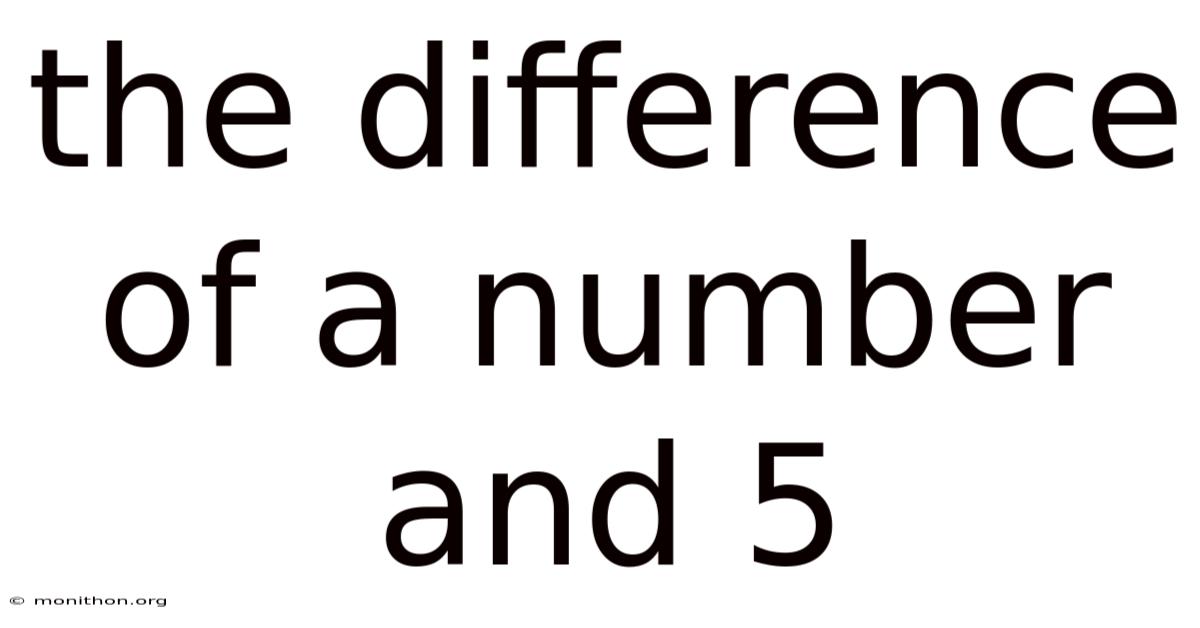
Table of Contents
The difference of a number and 5 is a fundamental concept in mathematics that involves subtracting 5 from a given number or vice versa. This operation is essential for solving problems in arithmetic, algebra, and real-world scenarios where comparisons or adjustments are required. Understanding how to calculate and interpret this difference allows individuals to analyze numerical relationships, make informed decisions, and apply mathematical reasoning in practical contexts. Whether dealing with simple calculations or complex equations, the difference between a number and 5 serves as a building block for more advanced mathematical operations.
To determine the difference of a number and 5, the process is straightforward. First, identify the number in question. Then, subtract 5 from that number. For example, if the number is 12, the difference would be 12 minus 5, which equals 7. Conversely, if the number is 3, subtracting 5 results in -2. This outcome highlights that the difference can be positive, negative, or zero, depending on the value of the original number. The key is to maintain the correct order of subtraction, as the result varies significantly based on whether 5 is subtracted from the number or the number is subtracted from 5.
A common point of confusion arises when distinguishing between the difference of a number and 5 versus the difference of 5 and the number. For instance, if the number is 8, the difference of 8 and 5 is 8 - 5 = 3, while the difference of 5 and 8 is 5 - 8 = -3. This distinction underscores the non-commutative nature of subtraction, where the order of operands directly affects the result. In many cases, especially in real-life applications, the absolute value of the difference is considered to ensure a positive outcome. For example, the absolute difference between 8 and 5 is |8 - 5| = 3, which is useful in scenarios where only the magnitude of the difference matters, such as measuring distances or errors.
The concept of difference is not limited to basic arithmetic. In algebra, it plays a critical role in solving equations and inequalities. For instance, if an equation states that the difference between a variable x and 5 is 10, the equation would be written as x - 5 = 10. Solving this requires adding 5 to both sides, resulting in x = 15. This demonstrates how understanding the difference of a number and 5 is foundational for algebraic manipulation. Similarly, in calculus, differences are used to approximate rates of change, such as in the difference quotient, which is a precursor to derivatives.
Real-life applications of the difference of a number and 5 are abundant. In finance, for example, calculating profit or loss often involves comparing actual values to expected values. If a business expects to earn $500 but only earn
Latest Posts
Latest Posts
-
18 Is 30 Of What Number
Mar 17, 2026
-
Does Receptor Mediated Endocytosis Require Energy
Mar 17, 2026
-
How To Ask What Time It Is In Spanish
Mar 17, 2026
-
What Is 3 4 1 3
Mar 17, 2026
-
Write The Range Of The Function Using Interval Notation
Mar 17, 2026
Related Post
Thank you for visiting our website which covers about The Difference Of A Number And 5 . We hope the information provided has been useful to you. Feel free to contact us if you have any questions or need further assistance. See you next time and don't miss to bookmark.
