The Product Of -7 And A Number Squared Is -28

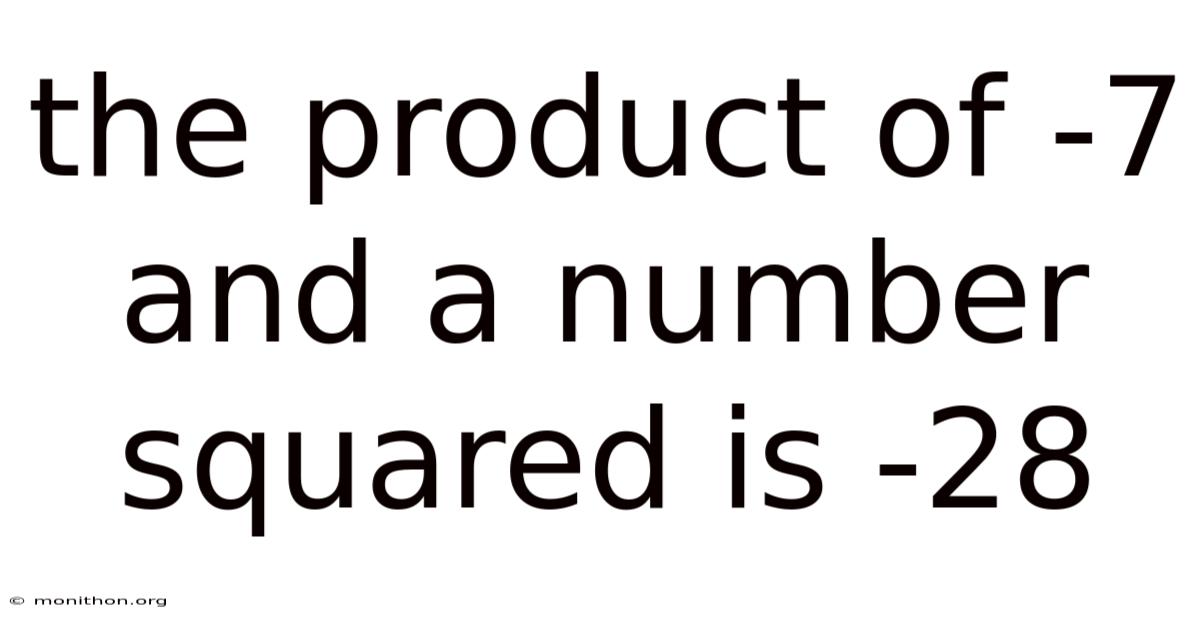
The product of -7 and anumber squared equals -28. This specific algebraic statement represents a clear equation: -7 multiplied by the square of some unknown number, denoted as n, results in -28. Mathematically, this is expressed as:
-7 × n² = -28
This equation presents a fundamental problem in algebra, requiring the solver to find the value(s) of n that satisfy the condition. It involves understanding the properties of negative numbers, the concept of squaring, and basic algebraic manipulation. The solution process will reveal the specific number(s) whose square, when multiplied by -7, yields the given result of -28. This type of problem is crucial for developing skills in solving quadratic equations and manipulating expressions involving exponents and negative values.
Steps to Solve the Equation
Solving the equation -7 × n² = -28 involves a systematic approach to isolate the variable n. Here's a step-by-step breakdown:
-
Isolate the Squared Term: The first step is to isolate n² on one side of the equation. Since -7 is multiplied by n², we need to undo this multiplication. This is done by dividing both sides of the equation by -7.
- -7 × n² = -28
- Divide both sides by -7: (-7 × n²) / (-7) = -28 / (-7)
- Simplifying both sides: n² = 4
-
Solve for n: Now we have n² = 4. This means we need to find the number(s) that, when squared, equal 4. Squaring a number means multiplying it by itself.
- What number times itself equals 4? Both 2 and -2 satisfy this condition because:
- 2 × 2 = 4
- (-2) × (-2) = 4
- Therefore, the solutions are n = 2 and n = -2.
- What number times itself equals 4? Both 2 and -2 satisfy this condition because:
-
Verify the Solutions: It's always good practice to check your solutions by plugging them back into the original equation.
- For n = 2: -7 × (2²) = -7 × (4) = -28. This matches the given product.
- For n = -2: -7 × ((-2)²) = -7 × (4) = -28. This also matches the given product.
- Both solutions are valid.
Scientific Explanation: Understanding the Components
To fully grasp the equation -7 × n² = -28, it's helpful to understand the underlying mathematical concepts:
- The Negative Sign (-7): This indicates a negative multiplier. Multiplying any number by a negative number changes the sign of the result. Here, it's multiplying the square of n.
- Squaring (n²): Squaring a number means raising it to the power of 2. This operation is always non-negative because:
- A positive number squared is positive (e.g., 3² = 9).
- A negative number squared is positive (e.g., (-3)² = 9).
- Zero squared is zero (0² = 0).
- Therefore, n² is always greater than or equal to zero for any real number n. This is crucial because the product of a negative number (-7) and a non-negative number (n²) will always be negative or zero. The result here is specifically -28, a negative number, which is consistent with the equation.
- The Equal Sign (=): This signifies that the expression on the left side must have the exact same value as the expression on the right side (-28). The equation defines a relationship that must hold true for the unknown number n.
- Solving the Equation: The process of isolating n² by dividing both sides by -7 demonstrates the fundamental algebraic principle of performing the same operation on both sides of an equation to maintain equality. This isolates the squared term, allowing us to find its value (4). Finding the square root of that value then gives us the possible values for n (±2).
Frequently Asked Questions (FAQ)
Q: Why does squaring a negative number result in a positive number?
A: Squaring involves multiplying a number by itself. When you multiply two negative numbers together, the result is always positive. For example, (-3) × (-3) = (+9). This is a fundamental property of multiplication with negative numbers.
Q: Could there be other solutions besides n = 2 and n = -2?
A: For real numbers, no. The equation n² = 4 has exactly two real solutions: +2 and -2. Complex numbers introduce the imaginary unit i (where i² = -1), but the context here is real numbers.
Q: What if the equation was -7 × n² = 28 instead of -28?
A: If the product was +28, then the equation would be -7 × n² = 28. Dividing both sides by -7 gives n² = -4. However, the square of any real number cannot be negative. Therefore, there would be no real number solution in this case. This highlights how the sign of the product affects the existence of real solutions.
Q: How is this different from solving a linear equation like -7n = -28?
A: In a linear equation like -7n = -28, you isolate n by dividing both sides by -7, resulting in n = 4. Solving -7 × n² = -28 involves isolating n² first (resulting in n² = 4) and then finding the square root of that result (±2). The key difference is the presence of the exponent (2) on the variable.
Q: Why is it important to check both solutions?
A: Checking both solutions (n = 2 and
Q:Why is it important to check both solutions? A: When we solve (n^{2}=4) by taking the square root, we obtain two candidates, (n=+2) and (n=-2). Squaring a number erases information about its original sign, so each candidate must be substituted back into the original equation (-7\times n^{2}=-28) to verify that it truly satisfies the given condition.
- For (n=+2): (-7\times (2)^{2} = -7\times 4 = -28).
- For (n=-2): (-7\times (-2)^{2} = -7\times 4 = -28).
Both yield (-28), confirming that each is a valid solution. If we had skipped this verification step, we might mistakenly accept a value that solves the squared equation but not the original (for example, in equations where additional operations like division by the variable are involved). Thus, checking both roots guards against accepting extraneous solutions and ensures the solution set is complete and accurate.
Additional FAQ
Q: How does the graph of (y=-7n^{2}) relate to the solution?
A: The graph is a downward‑opening parabola with vertex at the origin. The horizontal line (y=-28) intersects this parabola at two points, corresponding to (n=-2) and (n=+2). Visualizing the intersection reinforces why there are exactly two real solutions.
Q: Can this method be applied to equations with higher even powers?
A: Yes. For an equation of the form (a n^{2k}=b) (with (a\neq0) and (k) a positive integer), isolate (n^{2k}=b/a), then take the (2k)‑th root. Because an even root yields both positive and negative real values (when the radicand is non‑negative), you will obtain up to two real solutions, which must be checked in the original equation.
Conclusion
The equation (-7\times n^{2}=-28) illustrates fundamental algebraic principles: squaring eliminates sign information, isolating the squared term via division preserves equality, and extracting the square root introduces both positive and negative candidates. Verifying each candidate against the original equation confirms that both (n=2) and (n=-2) are valid solutions. This process not only solves the specific problem but also reinforces a reliable strategy for tackling similar quadratic‑type equations, ensuring accuracy and a deeper understanding of how algebraic manipulations interact with the properties of real numbers.
Latest Posts
Latest Posts
-
You Have Me Wrapped Around Your Finger
Mar 20, 2026
-
Calories Evolved Per Mole Of H
Mar 20, 2026
-
What Is The Measure Of C
Mar 20, 2026
-
How Do You Find Rate Of Change From A Table
Mar 20, 2026
-
How To Find Mass Percent Of A Solution
Mar 20, 2026
