The Quotient Of 3 And A Number

monithon
Mar 12, 2026 · 7 min read
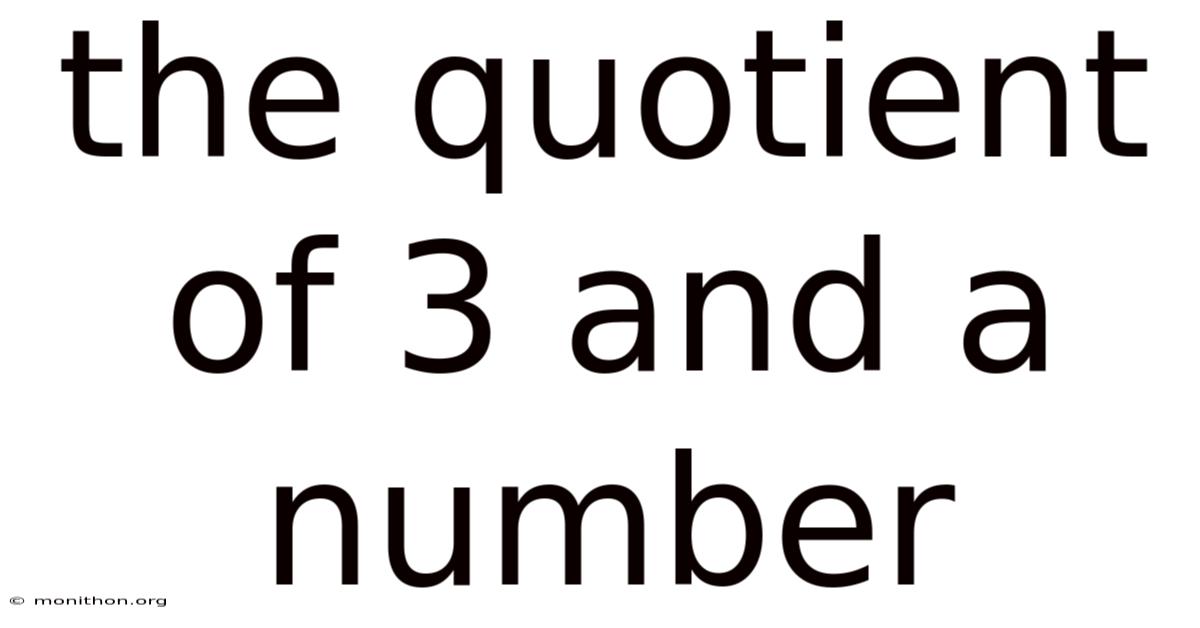
Table of Contents
The quotient represents the fundamental result ofdivision, a cornerstone operation in mathematics. Understanding how to express and manipulate quotients unlocks the ability to solve countless problems, from simple arithmetic to complex algebraic equations. This article delves into the concept of the quotient, specifically focusing on the expression "the quotient of 3 and a number," exploring its meaning, representation, properties, and practical applications.
Mathematical Representation and Meaning
At its core, a quotient is the answer obtained when one number (the dividend) is divided by another number (the divisor). The phrase "the quotient of 3 and a number" directly translates to the mathematical expression ( \frac{3}{x} ), where ( x ) represents any real number. Here, 3 is the dividend, and ( x ) is the divisor. The quotient ( \frac{3}{x} ) quantifies how many times ( x ) fits entirely into 3.
This concept is ubiquitous. For instance, if you have 3 apples and want to share them equally among 3 friends, the quotient is ( \frac{3}{3} = 1 ) apple per friend. If you have 3 dollars and want to buy items costing $0.25 each, the quotient ( \frac{3}{0.25} = 12 ) tells you how many items you can purchase. The quotient provides a precise measure of distribution, partitioning, or scaling.
Properties of Quotients
Understanding the behavior of quotients like ( \frac{3}{x} ) reveals important mathematical principles:
- Commutativity of Multiplication (Underlying Principle): While division itself is not commutative (( \frac{a}{b} \neq \frac{b}{a} ) in general), the relationship between multiplication and division is crucial. The quotient ( \frac{3}{x} ) is the unique number that, when multiplied by ( x ), gives 3. This inverse relationship defines division.
- Non-Commutativity: The order matters significantly. ( \frac{3}{x} ) is fundamentally different from ( \frac{x}{3} ). For example, ( \frac{3}{2} = 1.5 ) while ( \frac{2}{3} \approx 0.666 ), demonstrating distinct values.
- Division by Zero is Undefined: A critical property is that the quotient ( \frac{3}{x} ) is undefined when ( x = 0 ). Dividing any number by zero has no meaningful mathematical result. It represents an operation that cannot be performed, leading to contradictions or undefined behavior in equations. This is why ( x ) cannot be zero in the expression ( \frac{3}{x} ).
- Reciprocal Relationship: The quotient ( \frac{3}{x} ) is the reciprocal of ( \frac{x}{3} ). If you know one, you can find the other by flipping the fraction and adjusting the numerator/denominator accordingly.
- Sign Behavior: The sign of the quotient ( \frac{3}{x} ) depends on the signs of 3 and ( x ):
- Positive divided by Positive = Positive (( \frac{3}{2} = 1.5 ))
- Positive divided by Negative = Negative (( \frac{3}{-2} = -1.5 ))
- Negative divided by Positive = Negative (( \frac{-3}{2} = -1.5 ))
- Negative divided by Negative = Positive (( \frac{-3}{-2} = 1.5 ))
Exploring Examples
Applying the concept to specific values of ( x ) illustrates its versatility:
- Positive Divisor: Let ( x = 2 ). The quotient is ( \frac{3}{2} = 1.5 ). This means 3 divided by 2 equals 1.5, or one and a half.
- Negative Divisor: Let ( x = -4 ). The quotient is ( \frac{3}{-4} = -0.75 ). This indicates that 3 divided by -4 results in a negative value, representing a decrease or opposite direction.
- Fraction as Divisor: Let ( x = \frac{1}{2} ). The quotient is ( \frac{3}{\frac{1}{2}} = 3 \times 2 = 6 ). Dividing by a fraction is equivalent to multiplying by its reciprocal.
- Large Divisor: Let ( x = 100 ). The quotient is ( \frac{3}{100} = 0.03 ). This shows the quotient can be a very small positive number.
- Large Negative Divisor: Let ( x = -100 ). The quotient is ( \frac{3}{-100} = -0.03 ). This demonstrates the quotient can also be a very small negative number.
Key Considerations and Common Questions
Several important points arise when working with quotients like ( \frac{3}{x} ):
- Variable Nature: The quotient is a function of ( x ). Its value changes depending on what number ( x ) represents. It's not a fixed number but a relationship.
- Graphical Representation: Plotting ( y = \frac{3}{x} ) on a coordinate plane reveals a hyperbola. It shows how the quotient behaves dramatically as ( x ) approaches zero (vertical asymptote) and as ( x ) becomes very large or very negative (horizontal asymptote at y=0).
- Solving Equations: Quotients are central to solving equations. For example, solving ( \frac{3}{x} = 1.5 ) requires finding ( x ) such that the quotient equals 1.5, leading to
... leading to the simple algebraic step of multiplying both sides by (x) (provided (x\neq0)) to obtain (3 = 1.5x). Dividing both sides by (1.5) yields (x = \frac{3}{1.5} = 2). Substituting (x=2) back into the original expression confirms the quotient equals (1.5), illustrating how solving a rational equation hinges on isolating the variable while respecting the domain restriction that (x) cannot be zero.
Beyond isolated equations, quotients of the form (\frac{3}{x}) appear frequently in modeling inverse relationships. For instance, if a fixed quantity of work (3 units) is shared among (x) workers, the work per worker is (\frac{3}{x}); as the workforce grows, each individual's share diminishes, approaching zero but never becoming negative unless the notion of “workers” is extended to signed quantities. Similarly, in physics, the intensity of a point source varies inversely with distance squared; setting the constant to 3 gives an intensity model (I = \frac{3}{d^{2}}), where the same asymptotic behavior near the source (large intensity as distance → 0) mirrors the vertical asymptote of (y=\frac{3}{x}).
When dealing with inequalities, the sign analysis from Section 4 becomes essential. Solving (\frac{3}{x} > 0) requires (x) to share the same sign as the numerator, i.e., (x>0). Conversely, (\frac{3}{x} < 0) holds for (x<0). Multiplying both sides of an inequality by (x) demands caution: if (x) is positive the inequality direction stays the same, but if (x) is negative the direction flips, a common source of error that underscores the importance of tracking the sign of the variable before clearing denominators.
Graphically, the hyperbola (y=\frac{3}{x}) not only exhibits the vertical asymptote at (x=0) and the horizontal asymptote at (y=0), but also displays symmetry about the origin: the function is odd, satisfying (f(-x) = -f(x)). This rotational symmetry simplifies sketching and reinforces the sign‑behavior rules discussed earlier. Transformations such as shifting ((y=\frac{3}{x-h}+k)) or scaling ((y=a\frac{3}{x})) translate directly into real‑world scenarios where a baseline inverse relationship is adjusted by an offset or a proportional factor.
In summary, the quotient (\frac{3}{x}) serves as a compact exemplar of how a simple algebraic expression encapsulates domain restrictions, sign dependence, asymptotic behavior, and practical modeling power. Mastery of manipulating such quotients—through solving equations, interpreting graphs, and applying sign analysis—equips learners with a versatile toolkit for tackling a wide range of mathematical and scientific problems. By recognizing both the strengths and the pitfalls inherent in rational expressions, one can navigate from abstract symbolism to concrete insight with confidence.
The quotient (\frac{3}{x}) stands as a fundamental example of how a simple algebraic expression can encapsulate rich mathematical behavior and practical utility. Its structure immediately imposes a domain restriction—(x \neq 0)—which is not merely a technicality but a gateway to understanding asymptotes, inverse variation, and the careful handling of inequalities. Whether solving equations, analyzing graphs, or modeling real-world phenomena like work distribution or physical intensity, the principles governing (\frac{3}{x}) recur across disciplines.
Mastering this expression means recognizing its symmetry, asymptotic trends, and the critical role of sign analysis when manipulating inequalities or clearing denominators. These skills translate directly to more complex rational functions and to applications where inverse relationships are central. By internalizing both the algebraic rules and the graphical intuition behind (\frac{3}{x}), learners build a robust foundation for advanced mathematics and its myriad applications, turning a seemingly simple quotient into a powerful tool for insight and problem-solving.
Latest Posts
Latest Posts
-
What Is A Polymer Of Amino Acids
Mar 12, 2026
-
Surface Area To Volume Ratio Biology
Mar 12, 2026
-
What Is 3 3 4 As A Decimal
Mar 12, 2026
-
How Do You Graph Y 3x 2
Mar 12, 2026
-
How Many Inches Is A Hand In Horse Measurement
Mar 12, 2026
Related Post
Thank you for visiting our website which covers about The Quotient Of 3 And A Number . We hope the information provided has been useful to you. Feel free to contact us if you have any questions or need further assistance. See you next time and don't miss to bookmark.
