The Quotient Of 5 Times A Number And 2

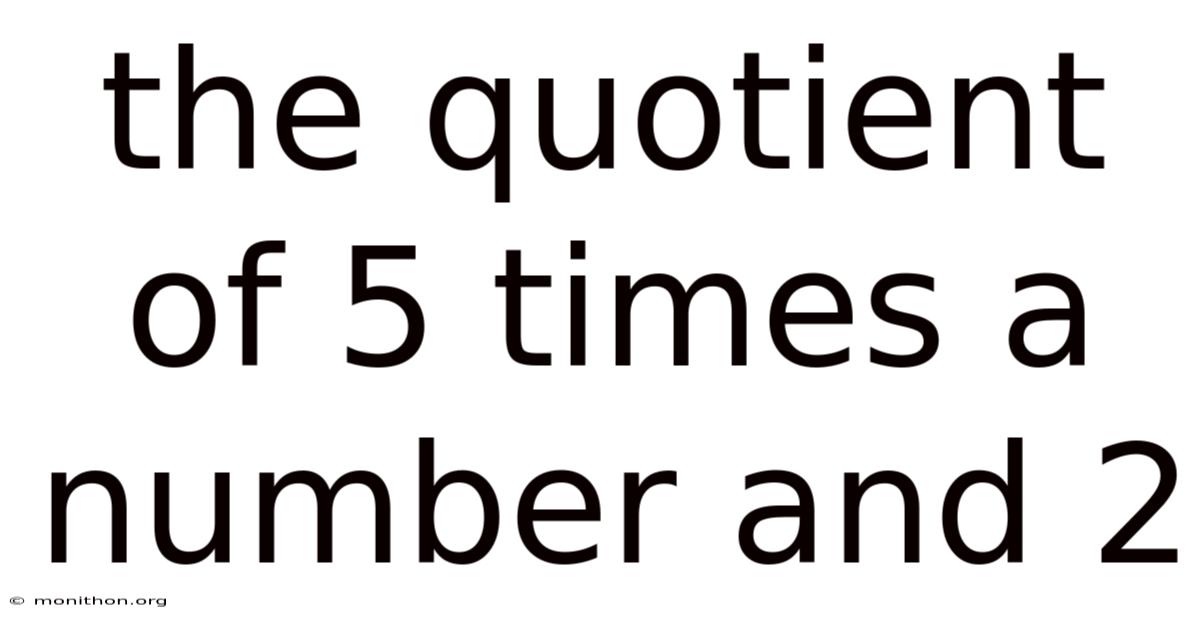
Understanding the Quotient of 5 Times a Number and 2
The phrase “the quotient of 5 times a number and 2” represents a fundamental algebraic expression that bridges everyday language and mathematical precision. At its core, this expression translates to (5 × n) ÷ 2, where n represents any unknown number. Mastering this translation is a critical step in developing algebraic literacy, enabling you to model real-world scenarios—from splitting a bill to calculating average speeds—with clarity and confidence. This article will deconstruct the phrase, explore its practical applications, and highlight common misunderstandings, providing a comprehensive guide to this essential mathematical concept.
Decoding the Phrase: From Words to Algebra
Translating verbal descriptions into mathematical symbols is a skill that empowers problem-solving. Let’s break down “the quotient of 5 times a number and 2” systematically.
Step 1: Identifying the Unknown
The phrase “a number” signals the presence of a variable—an unknown quantity we wish to generalize. In algebra, we typically represent this unknown with a letter such as n, x, or a. For this discussion, we will use n.
Step 2: Understanding “5 Times a Number”
The operation “times” unequivocally means multiplication. Therefore, “5 times a number” is expressed algebraically as 5 × n or simply 5n. This component represents a quantity that is fivefold our unknown number.
Step 3: The Meaning of “Quotient”
The word “quotient” is the specific result of a division operation. When we seek “the quotient of A and B,” we are calculating A ÷ B. Here, A is the dividend (the thing being divided), and B is the divisor (what we divide by).
Step 4: Assembling the Complete Expression
Applying the definition from Step 3, the entire phrase asks for the quotient where:
- A (the dividend) = “5 times a number” = 5n
- B (the divisor) = “2”
Thus, the complete algebraic expression is: (5n) ÷ 2 or, more commonly written as (\frac{5n}{2}).
Crucially, the parentheses around 5n are often implied but conceptually vital. They indicate that the multiplication of 5 and n is performed first, and then that product is divided by 2. This distinguishes it from 5 × (n ÷ 2), which would be phrased as “5 times the quotient of a number and 2.” The placement of the words “and 2” directly after “5 times a number” groups them together as the divisor.
Why This Expression Matters: Real-World Applications
This seemingly abstract expression is a powerful tool for modeling situations involving proportional division or scaling. Here are concrete examples:
- Cost Sharing: You and four friends (five people total) decide to buy a gift costing $2n. The cost per person is the total cost divided by the number of people: (5 × n dollars) ÷ 5 people = n dollars per person. If the gift costs $100 (so n = 20), each pays $20. The expression (\frac{5n}{2}) would model a scenario where a $5n item is split between **2
Latest Posts
Latest Posts
-
How To Find Slope Of A Perpendicular Line
Mar 22, 2026
-
Which Of The Following Events Occurred First
Mar 22, 2026
-
How To Find The Height Of A Triangular Prism
Mar 22, 2026
-
How To Calculate Mass Of Solute
Mar 22, 2026
-
Common Multiples Of 3 And 8
Mar 22, 2026
