The Quotient Of A Number And 2

monithon
Mar 12, 2026 · 7 min read
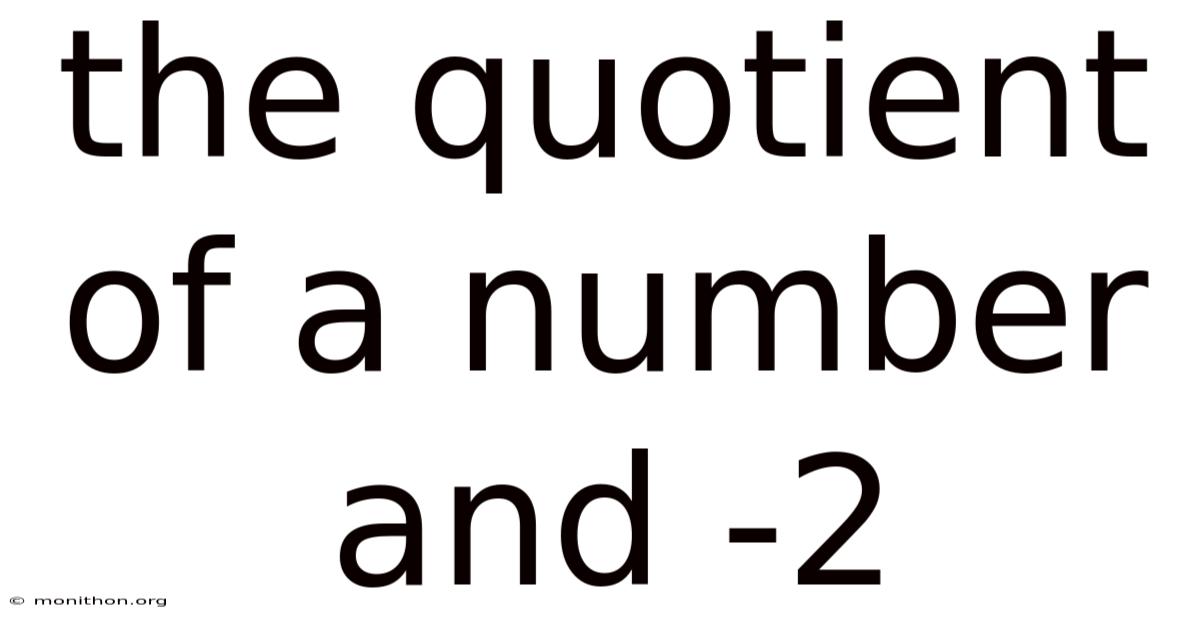
Table of Contents
When we talk about the quotient of a number and 2, we are essentially referring to the result of dividing a number by 2. This simple mathematical operation is foundational in arithmetic and serves as a stepping stone to more complex concepts in mathematics. Understanding how to find and interpret this quotient is crucial for students, educators, and anyone who deals with numbers in everyday life.
The quotient is the answer you get when you divide one number by another. In this case, we are dividing by 2, which means we are splitting the original number into two equal parts. For example, if you have the number 10 and you want to find the quotient of 10 and 2, you simply perform the division: 10 ÷ 2 = 5. Here, 5 is the quotient.
This operation is not just limited to whole numbers. You can find the quotient of any real number and 2, including fractions and decimals. For instance, if you divide 7 by 2, the quotient is 3.5. Similarly, if you divide 1/2 by 2, the quotient is 1/4. Understanding these examples helps illustrate that the concept of a quotient is versatile and applies across different types of numbers.
One important aspect to consider is the sign of the quotient. If you divide a positive number by 2, the quotient will be positive. If you divide a negative number by 2, the quotient will be negative. For example, -8 ÷ 2 = -4. This property is essential when working with integers and algebraic expressions.
In algebra, the quotient of a number and 2 is often represented as x/2, where x is the number in question. This notation is useful when setting up equations or solving problems. For example, if you are told that the quotient of a number and 2 is 7, you can write the equation x/2 = 7 and solve for x by multiplying both sides by 2, giving you x = 14.
The quotient of a number and 2 also appears in real-world contexts. For instance, if you are splitting a bill between two people, you would divide the total amount by 2 to find out how much each person owes. Similarly, if you are halving a recipe, you are essentially finding the quotient of each ingredient and 2.
Understanding the quotient of a number and 2 is also foundational for more advanced topics, such as ratios, proportions, and percentages. For example, finding half of a quantity is the same as finding the quotient of that quantity and 2. This concept is frequently used in data analysis, statistics, and even in scientific research.
Let's consider a few more examples to solidify our understanding:
- If you have 24 and you want to find the quotient of 24 and 2, you get 12.
- If you have 0 and you want to find the quotient of 0 and 2, you get 0 (since zero divided by any non-zero number is zero).
- If you have -15 and you want to find the quotient of -15 and 2, you get -7.5.
It's also important to note that division by zero is undefined, but since we are always dividing by 2 (a non-zero number), we don't encounter this issue here.
In summary, the quotient of a number and 2 is a fundamental mathematical concept that involves dividing a number by 2 to find how many times 2 fits into that number. This operation is straightforward but has wide-ranging applications in mathematics and everyday life. Whether you're solving equations, splitting resources, or analyzing data, understanding how to find and interpret this quotient is an essential skill.
Beyond these basic examples, the quotient of a number and 2 can be manipulated using algebraic rules. Like any division operation, it’s reversible – the product of a number and its quotient with 2 equals the original number. For instance, if x/2 = 5, then x = 10. This principle extends to more complex expressions involving fractions and variables. Furthermore, the concept of a quotient is intimately linked to the idea of rate – a rate expresses how much of one quantity changes in relation to a change in another, and often involves division. Consider a car traveling at 60 miles per hour; this represents the quotient of 60 miles and 1 hour – it tells us how far the car travels in one hour.
Expanding on the practical applications, the quotient of a number and 2 plays a crucial role in geometry. Calculating the area of a rectangle, for example, involves multiplying its length and width. If you know the area and one dimension, you can find the other by dividing the area by that dimension – effectively finding the quotient of the area and the known dimension. Similarly, in trigonometry, finding an angle often involves using the quotient of the opposite side and the adjacent side in a right triangle.
Moreover, the concept isn’t limited to numerical values. Quotients can be applied to ratios and proportions. If a recipe calls for a ratio of flour to sugar of 3:1, then the quotient of flour to sugar is 3. This ratio dictates the precise amounts needed for the recipe to be successful. Understanding this relationship is vital for consistent results, whether baking or conducting scientific experiments.
Finally, let’s revisit the initial examples to reinforce the core understanding. The calculations of 12, 0, and -7.5 all demonstrate the consistent application of division by 2, highlighting the importance of maintaining accuracy and recognizing the sign of the result.
In conclusion, the quotient of a number and 2 is more than just a simple arithmetic operation; it’s a foundational building block within mathematics. From basic calculations to complex problem-solving across diverse fields, this concept provides a powerful tool for understanding and manipulating numerical relationships. Its versatility and widespread applicability underscore its significance as a core mathematical principle, deserving of continued study and appreciation.
Continuing the Exploration of Quotients in Advanced Contexts
In calculus, the concept of a quotient evolves into a cornerstone of understanding change and motion. The derivative, which measures the instantaneous rate of change of a function, is defined as the limit of the quotient of the change in the function’s output over the change in its input as the input’s change approaches zero. For example, if a car’s position over time is modeled by a function ( f(t) ), its velocity at any moment is the derivative ( f'(t) ), representing the quotient ( \frac{\Delta f}{\Delta t} ) as ( \Delta t ) becomes infinitesimally small. This application of division by an infinitesimal interval underscores how quotients underpin dynamic systems, from physics to economics.
In computer science, division by 2 manifests in binary operations, where shifting bits to the right by one position effectively divides a number by 2. This principle is critical in low-level programming, algorithms, and data compression. For instance, halving a dataset’s size through bit manipulation optimizes memory usage, while algorithms like binary search rely on repeatedly dividing problems into halves to enhance efficiency. Such applications reveal how the simple act of dividing by 2 transcends arithmetic,
becoming a tool for managing complexity in digital systems.
In statistics, division by 2 often appears in formulas for central tendency and variability. The median of an even-numbered dataset, for example, is the quotient of the sum of the two middle values divided by 2, providing a measure of central location that is robust to outliers. Similarly, in probability, the expected value of a uniform distribution over an interval [a, b] is (a + b)/2, illustrating how division by 2 helps summarize random phenomena.
Beyond these technical applications, the quotient of a number and 2 also has intuitive, everyday relevance. Consider splitting a bill evenly between two people: each person’s share is the total divided by 2. Or, in time management, halving a task’s duration to estimate progress relies on the same principle. These scenarios demonstrate how division by 2 serves as a bridge between abstract mathematics and practical decision-making.
Ultimately, the quotient of a number and 2 is a microcosm of mathematical thinking—simple in form, yet profound in reach. Whether in the precise language of calculus, the efficiency of computer algorithms, the analysis of data, or the rhythms of daily life, this concept exemplifies how foundational ideas in mathematics ripple outward, shaping our understanding of the world. By mastering such basics, we equip ourselves to tackle more complex challenges, appreciating the elegance and utility that lie at the heart of mathematical inquiry.
Latest Posts
Latest Posts
-
5 X 5 X 5 X
Mar 12, 2026
-
The Perimeter Of A Rectangle Is 38
Mar 12, 2026
-
Comma Inside Or Outside Of Quotation Marks
Mar 12, 2026
-
X 3 X 1 X 1 X 3
Mar 12, 2026
-
For The Polynomial Below Is A Zero
Mar 12, 2026
Related Post
Thank you for visiting our website which covers about The Quotient Of A Number And 2 . We hope the information provided has been useful to you. Feel free to contact us if you have any questions or need further assistance. See you next time and don't miss to bookmark.
