The Quotient Of A Number And 4.

Understanding the Quotient of a Number and 4
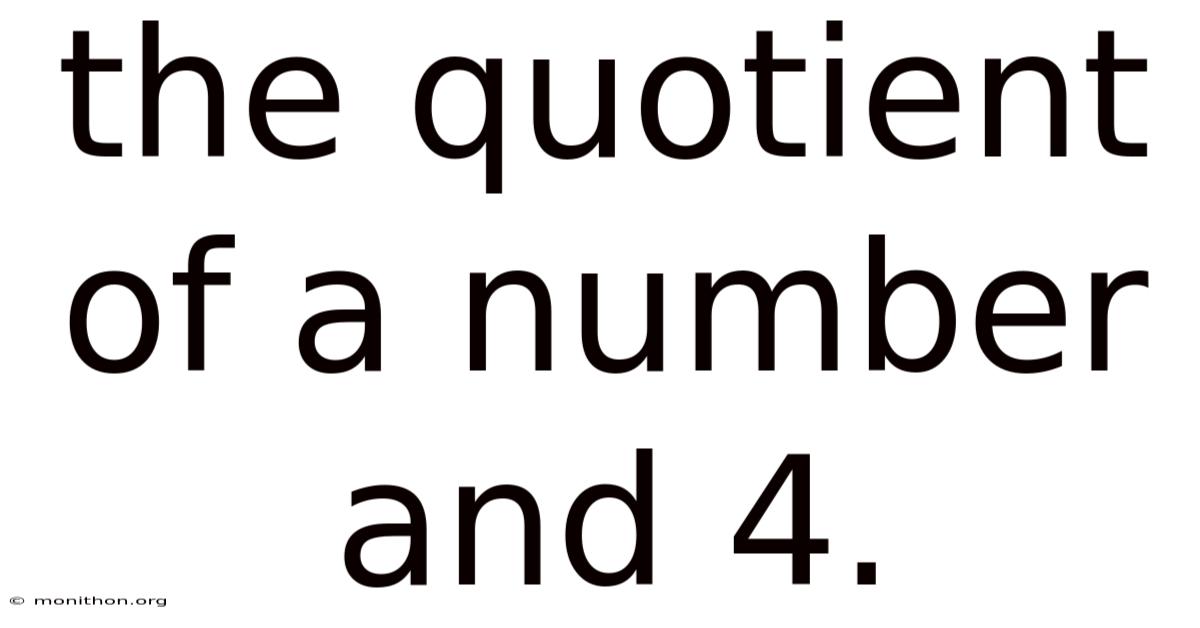
At its heart, the phrase “the quotient of a number and 4” describes one of the most fundamental operations in mathematics: division. It represents the result you obtain when you take any arbitrary number—which we call the dividend—and split it into four equal parts. The answer to this operation is the quotient. This simple concept is a cornerstone of arithmetic, permeating everything from basic daily calculations to advanced scientific theories. Whether you are dividing a pizza among friends, calculating a monthly budget, or programming a computer algorithm, the principle of finding the quotient when a number is divided by 4 is a vital skill. This article will demystify this operation, exploring its mechanics, properties, and profound applications in a clear, structured manner.
What Exactly is a Quotient?
In a division problem, the quotient is the primary result. The standard format is: Dividend ÷ Divisor = Quotient (+ Remainder) When we specify “the quotient of a number and 4,” the divisor is fixed at 4. The “number” is the dividend, which can be any real number: positive, negative, zero, a whole number, or a decimal. The quotient tells us how many times the divisor (4) fits into the dividend.
For example:
- 20 ÷ 4 = 5. Here, 5 is the quotient. Four fits into twenty exactly five times.
- 17 ÷ 4 = 4.25. Here, 4.25 is the quotient. Four fits into seventeen four whole times, with a fractional part (0.25, or 1/4) remaining.
- 17 ÷ 4 can also be expressed as 4 with a remainder of 1, written as 4 R 1. The remainder is what is left over after the divisor has been used to form the whole number part of the quotient.
Understanding this relationship is the first step to mastering division by 4.
How to Calculate the Quotient: Methods and Steps
Calculating the quotient of a number and 4 can be approached in several ways, depending on the nature of the number and the required precision.
1. Direct Recall and Mental Math
For dividends that are multiples of 4 (e.g., 4, 8, 12, 16, 20, 24, 28, 32, etc.), the quotient is simply the corresponding whole number. This is often memorized as the four times table in reverse. For numbers close to a multiple of 4, mental adjustment is easy. For 18 ÷ 4, you know 16 ÷ 4 = 4, and there are 2 left over, so the quotient is 4.5 or 4 R 2.
2. The Long Division Algorithm
This is the universal, step-by-step method for any size number.
- Step 1: Set up the problem with the dividend inside the division bracket and the divisor (4) outside.
- Step 2: Determine how many times 4 goes into the leading digit(s) of the dividend without exceeding it. If the first digit is smaller than 4 (e.g., dividing 137 by 4), take the first two digits (13).
- Step 3: Write this first digit of the quotient above the division bracket.
- Step 4: Multiply the divisor (4) by this quotient digit and subtract the result from the portion of the dividend you considered.
- Step 5: Bring down the next digit of the dividend and repeat the process from Step 2 until all digits have been used.
- Step 6: The final number written above the bracket is the whole number part of the quotient. If a non-zero value remains at the end, this is the remainder. To find a decimal quotient, add a decimal point and zeros to the dividend and continue the process.
Example: 137 ÷ 4
- 4 goes into 13 three times (3 x 4 = 12). Write 3. Subtract: 13 - 12 = 1.
- Bring down the 7, making 17.
- 4 goes into 17 four times (4 x 4 = 16). Write 4 next to the 3.
- Subtract: 17 - 16 = 1. No more digits to bring down.
- Result: Quotient = 34, Remainder = 1 (34 R 1).
- For a decimal: Add a decimal point and a zero to the remainder (1 becomes 10). 4 goes into 10 twice (2 x 4 = 8). Write 2 after the decimal point. Subtract: 10 - 8 = 2. Add another zero (20). 4 goes into 20 five times (5 x 4 = 20). Write 5.
- Final Decimal Quotient: 34.25.
3. Using Fractions and Multiplicative Inverses
Dividing by 4 is mathematically identical to multiplying by its multiplicative inverse, which is ¹⁄₄ or 0.25.
- To find the quotient of any number N and 4, calculate N × 0.25.
- This is often the fastest mental math trick. To find 20% of a number (which is ¹⁄₅), you might not know instantly, but finding one-fourth (25%) is often simpler: just halve the number and halve it again.
- Example: 60 ÷ 4 = 60 × 0.25 = (60 ÷ 2) ÷ 2 = 30 ÷ 2 = 15.
Special Properties and Patterns When Dividing by 4
Dividing by 4 reveals consistent and useful patterns, especially with integers.
- Even Numbers: Any even number divisible by 4 will yield
Latest Posts
Latest Posts
-
What Are The Purpose Of Spindle Fibers
Mar 24, 2026
-
How To Change A Fraction Into A Whole Number
Mar 24, 2026
-
How Many Ml Are In 5 Mg
Mar 24, 2026
-
How Many Hours Is 100 000 Minutes
Mar 24, 2026
-
How To Find Angle Of Triangle Given 2 Sides
Mar 24, 2026
