The Quotient Of Five And A Number

monithon
Mar 17, 2026 · 8 min read
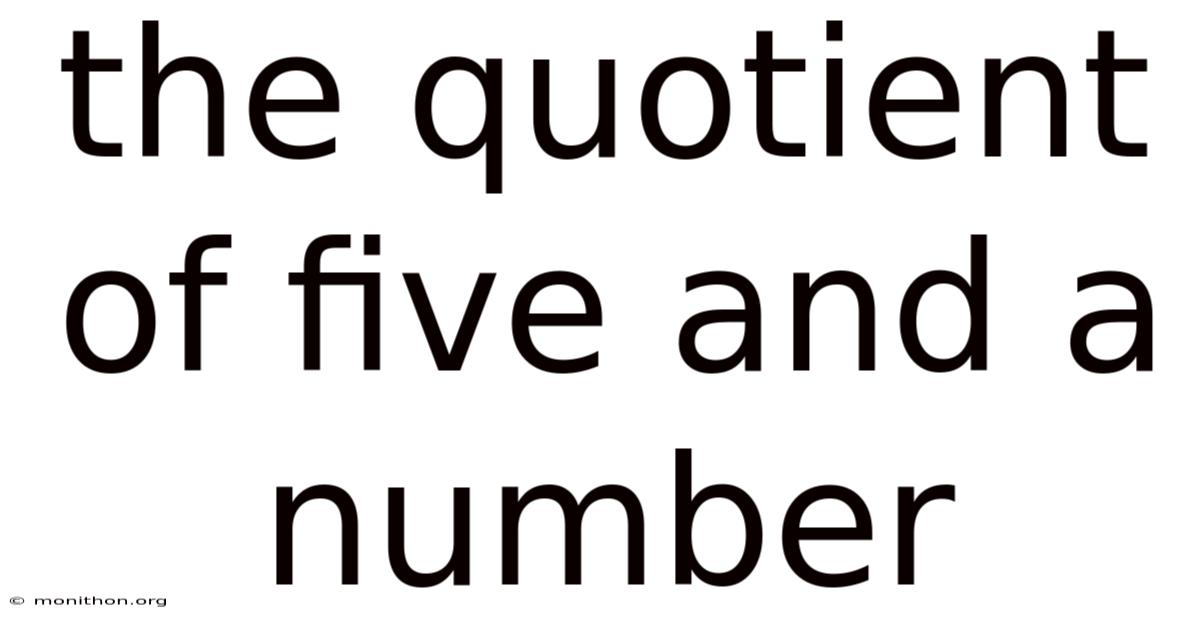
Table of Contents
Understanding the Quotient of Five and a Number: A Deep Dive into Division and Variables
The expression “the quotient of five and a number” is a fundamental phrase in algebra that translates directly into the mathematical operation of division. At its core, it represents the result you obtain when the number five is divided by an unspecified, variable quantity. This seemingly simple concept is a gateway to understanding rational expressions, functions, and the profound relationship between numbers and variables. Mastering this idea is not just about performing a calculation; it’s about developing a flexible mathematical mindset capable of handling unknowns, analyzing change, and modeling real-world situations where quantities are not fixed.
Decoding the Phrase: What Does It Actually Mean?
In everyday language, a “quotient” is the answer to a division problem. When we say “the quotient of five and a number,” the word “and” signals the two operands of the division. The standard interpretation in mathematics is that the first number mentioned (five) is the dividend—the quantity being divided. The second item (“a number”) is the divisor—the quantity by which we are dividing. Therefore, if we let the unknown number be represented by the variable x, the algebraic expression is written as 5 ÷ x or, more commonly in higher mathematics, as the fraction 5/x.
This distinction in order is critical. “The quotient of five and a number” (5/x) is fundamentally different from “the quotient of a number and five” (x/5). The first means “five divided by some number,” while the second means “some number divided by five.” This precision in language is what allows mathematics to serve as a clear and unambiguous tool for communication.
Mathematical Representation and Core Properties
The expression f(x) = 5/x is a rational function, where f(x) denotes the quotient value for any given input x. Its behavior is governed by a few essential properties:
- The Domain: The variable x can be any real number except zero. Division by zero is undefined in mathematics because it asks the impossible question: “What number, when multiplied by zero, gives five?” No such number exists. This creates a discontinuity in the function at x = 0. The domain of this function is therefore all real numbers, x ≠ 0.
- Sign of the Quotient: The sign of 5/x depends entirely on the sign of x. Since 5 is positive:
- If x is positive (e.g., 2, 10, 0.5), the quotient 5/x is positive.
- If x is negative (e.g., -2, -10, -0.5), the quotient 5/x is negative.
- Magnitude and Reciprocal Relationship: The size of the quotient is inversely proportional to the absolute value of x. As |x| gets larger, |5/x| gets smaller, approaching zero. As |x| gets smaller (closer to zero), |5/x| gets larger, growing without bound. This inverse relationship is key: 5/x is mathematically equivalent to 5 multiplied by the reciprocal of x, or 5 * (1/x).
Visualizing the Function: The Hyperbola
When graphed on a Cartesian plane, the function y = 5/x produces a curve known as a hyperbola. This graph has two distinct branches, one in the first quadrant (where both x and y are positive) and one in the third quadrant (where both are negative). The graph never touches or crosses the x-axis (where y=0) or the y-axis (where x=0). These axes act as asymptotes—lines that the curve approaches infinitely closely but never reaches. The x-axis is a horizontal asymptote (as x goes to ±∞, y approaches 0), and the y-axis is a vertical asymptote (as x approaches 0, y grows without bound).
Real-World Applications: Where Does This Appear?
The abstract expression 5/x models countless practical scenarios where a fixed total (5) is distributed, shared, or affected by a variable factor.
- Sharing and Division: If you have 5 identical pizzas to share equally among x people, each person’s share is 5/x pizzas. If x=5, each gets 1 pizza. If x=10, each gets 0.5 pizzas. If x=2, each gets 2.5 pizzas.
- Rates and Speeds: If a car travels a fixed distance of 5 kilometers, the time taken (t) is related to its speed (s) by t = 5/s. Faster speeds (larger s) result in smaller travel times (smaller t).
- Concentration and Mixtures: In chemistry, if you dissolve 5 grams of a substance in x milliliters of water, the concentration is 5/x grams per milliliter.
- Economics and Unit Cost: If 5 identical items cost a total of $50, the cost per item is 50/5 = $10. But if the total cost is fixed at $5 and you buy x items, the price per item is 5/x dollars. Buying more items (larger x) lowers the individual cost.
- Physics and Inverse Laws: Many physical principles follow an inverse-square or inverse relationship. For example, the intensity of light or sound from a point source often diminishes inversely with distance. If a sensor measures an intensity of 5 units at a reference distance, its measurement at d meters might be modeled as 5/d.
Common Misconceptions and Pitfalls
Learners often stumble on specific aspects of this concept:
-
Confusing the Order: The most frequent error is reversing the dividend and divisor. Remember the phrase: “quotient of A and B” means A/B.
-
Forgetting the Domain: Attempting to evaluate 5/x at *x=
-
Forgetting the Domain: Attempting to evaluate 5/x at x=0 is a fundamental error. Division by zero is undefined in standard arithmetic, so x cannot be zero in this expression. This creates a "hole" or a vertical asymptote in the function's graph.
-
Misinterpreting the Graph: The hyperbola's shape can be counterintuitive. It's crucial to understand that the curve never touches the axes and that the relationship is not linear. As x increases, y decreases, but it never reaches zero.
-
Confusing Notation: In some contexts, especially in programming or informal writing, a slash (/) can be mistaken for a hyphen or a separator. Always ensure clarity in notation to avoid misinterpretation.
Conclusion
The expression 5/x, while seemingly simple, is a gateway to understanding a wide array of mathematical and real-world concepts. It represents the fundamental operation of division, where a fixed quantity is distributed across a variable number of parts. Its graphical representation as a hyperbola illustrates the nature of inverse relationships, with asymptotes marking the boundaries of the function's behavior. From sharing resources and calculating rates to modeling physical laws and economic principles, the applications of 5/x are diverse and essential. By grasping its meaning, avoiding common pitfalls, and recognizing its practical significance, one can unlock a deeper appreciation for the power and elegance of mathematical relationships.
Continuing seamlessly from the point where the article discusses notation:
...Always ensure clarity in notation to avoid misinterpretation. For instance, writing "5 per x" or "5 ÷ x" can sometimes prevent confusion with other uses of the slash symbol, especially in contexts where fraction bars are visually distinct.
Conceptual Depth and Broader Implications
Understanding 5/x goes beyond simple arithmetic; it forms a cornerstone for grasping more advanced mathematical ideas. It serves as the simplest non-trivial example of a rational function (a ratio of polynomials), introducing students to concepts like asymptotes, discontinuities, and the behavior of functions as they approach undefined points. Calculus relies heavily on such expressions: the derivative of 5/x is -5/x², illustrating how the rate of change of an inverse relationship itself follows an inverse-square pattern. Furthermore, 5/x is fundamental to understanding inverse proportionality, a relationship where one quantity increases as the other decreases by the same multiplicative factor. This principle underpins countless scientific models, from the inverse relationship between pressure and volume in gases (Boyle's Law) to the decay of radioactive substances.
The expression also highlights the importance of context. The meaning of "5/x" is entirely dependent on the scenario: it could represent a unit cost, a concentration, a probability, a rate, or a physical measurement. This contextual dependence underscores a critical skill in applied mathematics: correctly translating a real-world problem into the appropriate mathematical model. Recognizing whether a situation involves direct variation (y = kx) or inverse variation (y = k/x) is often the first and most crucial step in solving the problem.
Conclusion
The expression 5/x, while seemingly simple, is a gateway to understanding a wide array of mathematical and real-world concepts. It represents the fundamental operation of division, where a fixed quantity is distributed across a variable number of parts. Its graphical representation as a hyperbola illustrates the nature of inverse relationships, with asymptotes marking the boundaries of the function's behavior. From sharing resources and calculating rates to modeling physical laws and economic principles, the applications of 5/x are diverse and essential. By grasping its meaning, avoiding common pitfalls, and recognizing its practical significance, one can unlock a deeper appreciation for the power and elegance of mathematical relationships.
Latest Posts
Latest Posts
-
1 8 Smaller Than 1 4
Mar 17, 2026
-
How Do You Find Supplementary Angles
Mar 17, 2026
-
How Many Months Is 1000 Hours
Mar 17, 2026
-
How Do You Get Square Inches
Mar 17, 2026
-
Is Marginal Cost The Derivative Of Total Cost
Mar 17, 2026
Related Post
Thank you for visiting our website which covers about The Quotient Of Five And A Number . We hope the information provided has been useful to you. Feel free to contact us if you have any questions or need further assistance. See you next time and don't miss to bookmark.
