The Sum Of Twice A Number And 9 Is 25

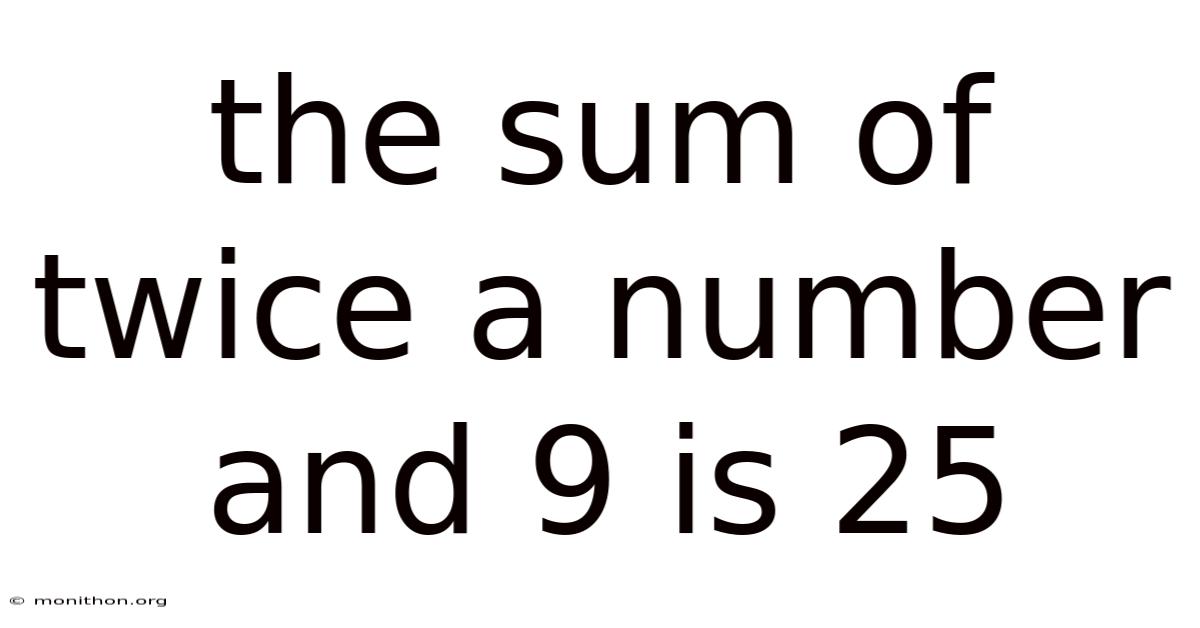
Solving linear equations like "the sum oftwice a number and 9 is 25" is a fundamental skill in algebra, crucial for tackling more complex mathematical problems and real-world situations. This seemingly simple equation, 2x + 9 = 25, serves as an excellent starting point to understand the core principles of isolating variables and finding solutions. Mastering this process builds confidence and lays the groundwork for advanced mathematical concepts. Let’s break down the steps clearly and explore why this skill matters.
Steps to Solve 2x + 9 = 25
- Identify the Goal: The objective is to find the value of the variable x (the unknown number). The equation states that twice this number, plus nine, equals twenty-five.
- Isolate the Variable Term: The term containing x is 2x. To isolate it, we need to remove the constant term (+9) from the left side. We do this using the inverse operation of addition, which is subtraction.
- Subtract 9 from both sides of the equation: 2x + 9 - 9 = 25 - 9
- Simplify: 2x = 16
- Solve for x: Now, we have 2x = 16. The coefficient of x is 2, meaning x is multiplied by 2. To isolate x, we use the inverse operation of multiplication, which is division.
- Divide both sides by 2: 2x / 2 = 16 / 2
- Simplify: x = 8
- Verify the Solution: Always check your answer by plugging it back into the original equation.
- Substitute x = 8 into 2x + 9: 2(8) + 9 = 16 + 9 = 25
- Since 25 equals the right side of the original equation (25), the solution x = 8 is correct.
Why This Matters: The Logic Behind the Equation
This process relies on the properties of equality. These fundamental rules ensure that whatever operation you perform on one side of the equation, you must perform identically on the other side to maintain balance. This balance is what allows us to systematically unravel the equation and find the hidden value of x.
- Inverse Operations: Subtraction undoes addition, and division undoes multiplication. Using these inverses moves terms step-by-step towards isolating the variable.
- Order of Operations (Reverse): Solving equations often requires reversing the order of operations (PEMDAS/BODMAS) applied to the expression. If the expression is built by multiplying by 2 and then adding 9, solving involves first subtracting 9 and then dividing by 2.
Real-World Applications
Understanding how to solve equations like this has practical value far beyond the classroom. Here are a few examples:
- Budgeting: Suppose you have a monthly budget where your savings (S) are twice your entertainment spending (E), plus a fixed $9 bill. If your total savings goal is $25, the equation 2E + 9 = 25 helps you calculate how much you can spend on entertainment (E = 8).
- Distance & Speed: If a car travels a distance (D) that is twice a certain base distance (B), plus 9 miles, and the total distance is 25 miles, solving 2B + 9 = 25 finds the base distance (B = 8 miles).
- Recipe Scaling: If a recipe requires twice the amount of an ingredient (X) plus 9 grams, and you need a total of 25 grams, solving 2X + 9 = 25 tells you how much of the ingredient to use (X = 8 grams).
Common Mistakes to Avoid
- Forgetting to Apply Operations to Both Sides: Always perform the same operation on both sides of the equation to maintain balance.
- Incorrect Order: Don't subtract or divide before isolating the variable term. Follow the steps methodically.
- Not Checking the Answer: Verification is crucial. Plugging the solution back in catches errors.
- Misinterpreting "Twice a Number": Ensure "twice a number" is correctly translated to 2x and not x² (which would be "the square of the number").
Frequently Asked Questions (FAQ)
- Q: Why do we subtract 9 first and then divide by 2?
A: We subtract 9 first to eliminate the constant term (+9) and isolate the term with the variable (2x). Then, we divide by 2 to isolate the single variable x itself. This sequence follows the inverse operations needed to undo the original operations applied to the variable. - Q: Can I divide both sides by 2 first?
A: You could, but it might be less efficient. Dividing 2x + 9 = 25 by 2 gives x + 4.5 = 12.5. Then you'd still need to subtract 4.5 from both sides to get x = 8. It's the same solution, but the first method (subtracting 9 first) avoids decimals and is generally cleaner for integer solutions. - Q: What if the equation had subtraction or division instead of addition?
A: The same
A: The principle remains identical—use inverse operations in reverse order. For an equation like 2x – 9 = 25, you would add 9 first (undoing the subtraction) and then divide by 2. For x/2 + 9 = 25, you would subtract 9 first and then multiply by 2 (undoing the division).
Conclusion
Mastering the technique of solving simple linear equations such as 2x + 9 = 25 is more than an academic exercise; it is a fundamental logical skill. It teaches structured problem-solving, the critical importance of maintaining balance, and the power of inverse operations. These same principles scale directly to tackle far more complex algebraic expressions, functions, and real-world modeling. By practicing with concrete examples—from budgeting to cooking—and by consciously avoiding common pitfalls, learners build a robust foundation. This foundation not only supports future success in mathematics and science but also equips individuals with a reliable framework for analyzing and solving a vast array of practical, quantitative problems they will encounter beyond the classroom. Ultimately, the ability to deconstruct and solve an equation is a cornerstone of analytical thinking.
Latest Posts
Latest Posts
-
How Many Grams Is 1 10 Oz
Mar 19, 2026
-
10 X 7 X 3 7
Mar 19, 2026
-
Why Did Mendel Use Pea Plants
Mar 19, 2026
-
The Product Of Eight And A Number
Mar 19, 2026
-
What Is The Least Common Multiple Of 4 And 8
Mar 19, 2026
