Twice A Number Divided By 6 Is 42

monithon
Mar 15, 2026 · 6 min read
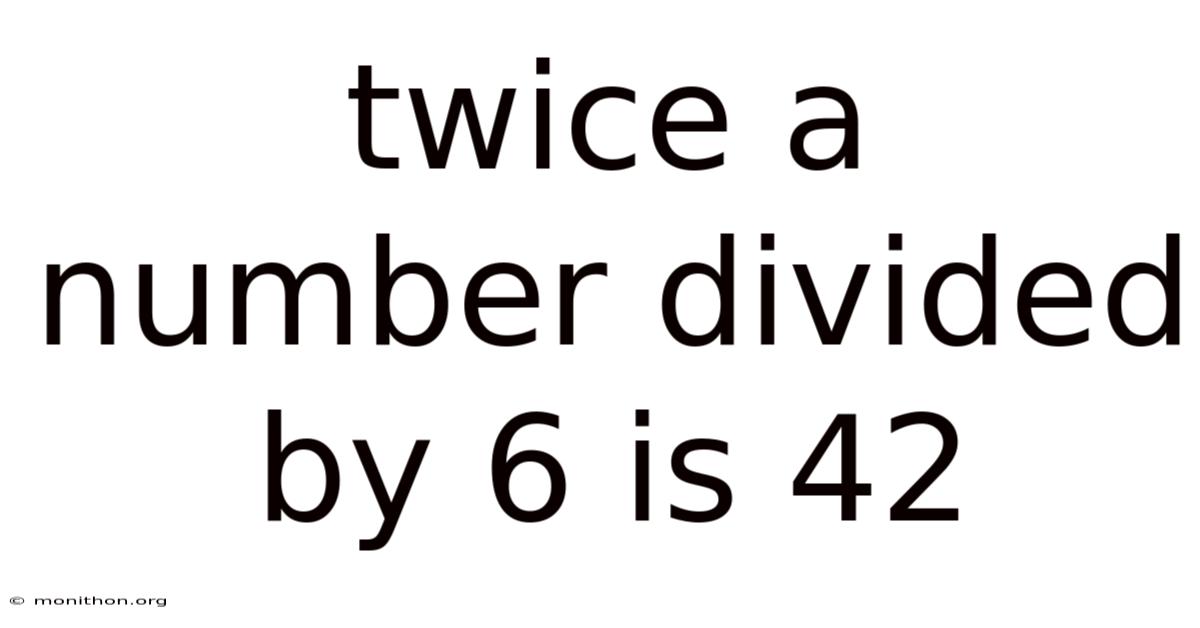
Table of Contents
Solving the Equation: Twice a Number Divided by 6 is 42
Understanding how to translate a simple English statement into a solvable mathematical equation is a foundational skill in algebra. The phrase "twice a number divided by 6 is 42" is a classic example of a one-step linear equation in disguise. This problem teaches us to decode language into mathematical symbols, apply inverse operations systematically, and verify our solutions. Mastering this process builds confidence for tackling more complex word problems in mathematics, science, and everyday financial calculations. Let's break down this statement piece by piece to find the unknown number.
Translating Words into an Algebraic Equation
The first and most critical step is converting the verbal description into a precise algebraic expression. We must identify the unknown and the operations performed on it.
- Identify the unknown: The phrase "a number" refers to an unknown quantity we need to find. In algebra, we represent an unknown number with a variable, most commonly
x. - Interpret "twice a number": The word "twice" means "two times." Therefore, "twice a number" translates directly to the expression
2x. - Interpret "divided by 6": This phrase indicates that the entire quantity from the previous step (
2x) is being divided by 6. In mathematical notation, this is written as(2x) / 6or2x ÷ 6. The parentheses are crucial as they show that the division applies to the entire product2x. - Interpret "is 42": The word "is" in a mathematical context almost always means "equals." Therefore, "is 42" translates to
= 42.
Combining these components in the order they appear gives us the complete equation: (2x) / 6 = 42
This equation states that if you take an unknown number, multiply it by 2, and then divide the result by 6, the final outcome is 42. Our goal is to isolate the variable x on one side of the equation to determine its value.
Step-by-Step Solution: Isolating the Variable
Solving for x requires us to "undo" the operations performed on it, working in reverse order. We use inverse operations: the inverse of division is multiplication, and the inverse of multiplication is division.
Step 1: Eliminate the Division by 6.
The last operation applied to 2x is division by 6. To undo this, we multiply both sides of the equation by 6. This maintains the equation's balance.
(2x / 6) * 6 = 42 * 6
The /6 and *6 on the left side cancel each other out.
2x = 252
We have now simplified the equation to "two times the number equals 252."
Step 2: Eliminate the Multiplication by 2.
The remaining operation on x is multiplication by 2. To undo this, we divide both sides of the equation by 2.
2x / 2 = 252 / 2
The *2 and /2 on the left side cancel out.
x = 126
The solution to the equation is x = 126. The unknown number is 126.
Verifying the Solution: A Non-Negotiable Habit
A solution is not complete until it is verified. We substitute our found value (126) back into the original equation to ensure it makes the statement true.
Original equation: (2x) / 6 = 42
Substitute x = 126:
(2 * 126) / 6 = ?
First, calculate twice the number: 2 * 126 = 252
Then, divide that result by 6: 252 / 6 = 42
The result is 42, which matches the right side of the equation.
Verification: (2 * 126) / 6 = 252 / 6 = 42. The statement holds true. Therefore, 126 is the correct and only solution.
The Underlying Mathematical Principles
This simple problem illustrates two universal algebraic laws:
- The Division Property of Equality: If you divide both sides of an equation by the same non-zero number, the two sides remain equal. We used its inverse (multiplication) in Step 1.
- The Multiplication Property of Equality: If you multiply both sides of an equation by the same number, the two sides remain equal. We used its inverse (division) in Step 2. These properties are the bedrock of solving all linear equations. They guarantee that whatever operation you perform on one side of the equals sign, you must perform on the other to preserve the equality.
Real-World Applications of This Structure
The structure (2 * unknown) / 6 = known_value appears in numerous practical scenarios:
- Unit Conversion & Scaling: If a recipe for 6 people requires 42 grams of an ingredient, how much is needed for 2 people? The per-person amount is
(42 * 6) / 2, which is a variation of our solved structure. - Average Calculations: If the average score of 6 tests is 42, and you know the sum of all scores is
2x(wherexmight represent a pair of related scores), you could set up a similar equation. - Financial Planning: If splitting a total cost (
2x) equally among 6 friends results in each paying $42, the total cost is2x = 42 * 6. - Science & Engineering: Formulas for density, speed, or electrical resistance often require isolating a variable using the same sequence of inverse operations.
Common Mistakes and How to Avoid Them
- Misinterpreting "Twice a Number": Writing
2 / xinstead of2x. Remember, "twice a number" means 2 times that number, not 2 divided by it. - Ignoring Order of Operations: Writing
2x / 6as2 * (x / 6). While mathematically equivalent due to the associative property, the standard interpretation from the phrase "twice a number divided by
...6" implies multiplication first. 3. Incorrectly Applying the Division Property: Attempting to divide the known value by the number of people before isolating the variable. The goal is always to get the variable by itself on one side of the equation. 4. Forgetting to Maintain Balance: Failing to perform the same operation on both sides of the equation. This is the most fundamental error in solving equations.
To avoid these pitfalls, always double-check your work, especially when dealing with multiplication and division. A systematic approach – substituting your proposed solution, verifying it, and carefully tracking each step – is crucial for success.
Beyond the Basics: Expanding the Concept
While this example focuses on a simple linear equation, the underlying principles extend to more complex algebraic expressions. The core concept remains the same: isolating the variable by strategically applying inverse operations while maintaining the balance of the equation. As you progress through algebra, you’ll encounter equations with multiple variables, exponents, and more intricate operations, but the fundamental logic – verifying your solutions and utilizing the properties of equality – will always be your guide. Furthermore, understanding the why behind these properties, not just the how, will significantly strengthen your problem-solving abilities.
Conclusion:
This seemingly straightforward equation, (2x) / 6 = 42, serves as a powerful illustration of fundamental algebraic principles. Through careful substitution, verification, and an understanding of the Division and Multiplication Properties of Equality, we successfully arrived at the correct solution, 126. More importantly, the exercise highlights the importance of methodical problem-solving, rigorous verification, and a solid grasp of mathematical logic – skills that are not only essential for success in algebra but also invaluable across a wide range of disciplines and everyday situations. By consistently applying these principles, you can confidently tackle any algebraic challenge that comes your way.
Latest Posts
Latest Posts
-
What Is The Value Of Y 88
Mar 15, 2026
-
Cos 2x 1 2 1 Cos 2x
Mar 15, 2026
-
Why Might Two Elements Possess Similar Chemical Properties
Mar 15, 2026
-
How Many Square Inches In A Yard
Mar 15, 2026
-
You Have A Good Day In Spanish
Mar 15, 2026
Related Post
Thank you for visiting our website which covers about Twice A Number Divided By 6 Is 42 . We hope the information provided has been useful to you. Feel free to contact us if you have any questions or need further assistance. See you next time and don't miss to bookmark.
