Twice The Difference Of A Number And 1

monithon
Mar 16, 2026 · 5 min read
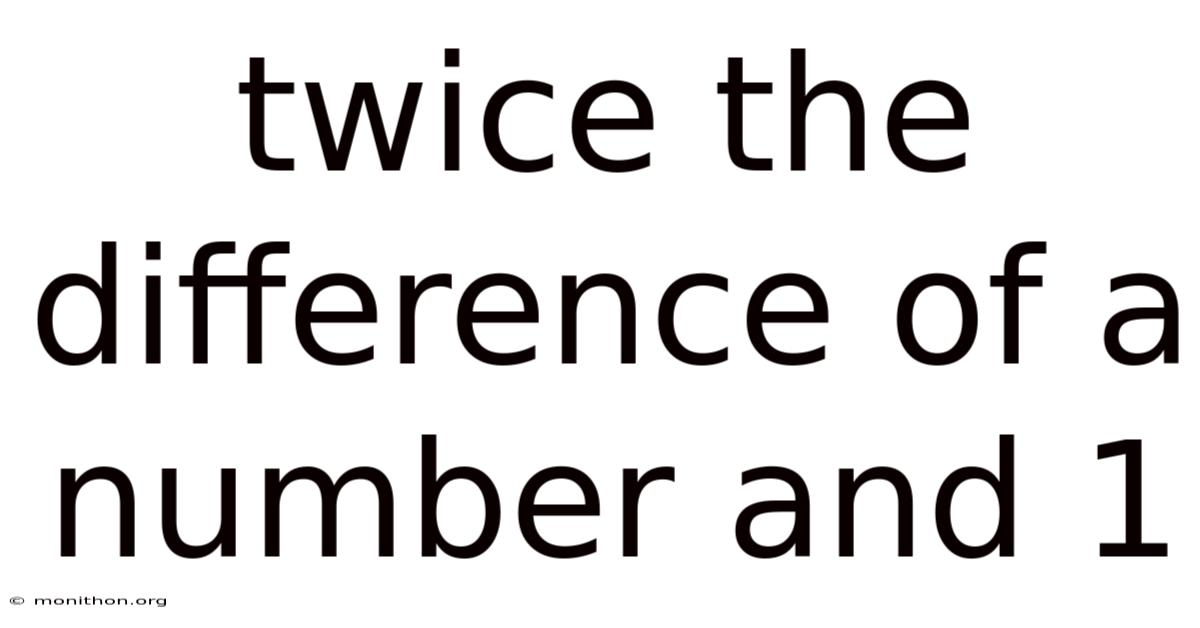
Table of Contents
Twice the Difference of a Number and 1: A Fundamental Algebraic Concept Explained
The phrase "twice the difference of a number and 1" is more than just a string of words; it is a precise algebraic instruction that unlocks a foundational skill in mathematics: translating verbal descriptions into symbolic expressions. Mastering this translation is the first step toward solving equations, analyzing functions, and modeling real-world situations. This concept serves as a critical building block for algebra and beyond, demanding a clear understanding of order of operations and the role of parentheses. Whether you are a student encountering algebra for the first time, a parent helping with homework, or someone refreshing their math skills, a deep comprehension of this phrase will strengthen your entire mathematical framework. This article will deconstruct the phrase piece by piece, provide clear translation rules, explore numerous examples, address common pitfalls, and demonstrate its practical utility.
Breaking Down the Phrase: A Step-by-Step Translation
To convert any verbal mathematical expression into algebra, we must dissect it into its operational components. The phrase "twice the difference of a number and 1" contains three key instructions:
- "A number": This is the unknown quantity. In algebra, we represent an unknown or variable number with a letter, most commonly x. So, "a number" becomes x.
- "the difference of a number and 1": The word "difference" signals subtraction. It specifically means we subtract 1 from our number. Therefore, "the difference of a number and 1" translates to x - 1. Crucially, this entire subtraction must be treated as a single unit.
- "twice": This means "two times" or multiplied by 2. The word "twice" applies to the entire result of the previous step (the difference). Therefore, we multiply the entire expression (x - 1) by 2.
The correct algebraic expression is: 2(x - 1).
The Non-Negotiable Role of Parentheses
The parentheses in 2(x - 1) are not optional; they are essential. They explicitly tell us that the multiplication by 2 happens after the subtraction is computed. Without parentheses, the expression 2x - 1 would mean something entirely different: "twice a number, then subtract 1." The placement of the word "difference" inside the phrase dictates that the subtraction is grouped together first. This is a direct application of the mathematical convention known as PEMDAS/BODMAS (Parentheses/Brackets, Exponents/Orders, Multiplication and Division, Addition and Subtraction).
Illustrative Examples with Different Numbers
Let's solidify this by substituting actual numbers for the variable x and evaluating both the correct expression 2(x - 1) and the common incorrect alternative 2x - 1.
-
If the number (x) is 5:
- Correct: 2(5 - 1) = 2(4) = 8
- Incorrect: 2(5) - 1 = 10 - 1 = 9
- The results differ, proving the expressions are not equivalent.
-
If the number (x) is -3:
- Correct: 2(-3 - 1) = 2(-4) = -8
- Incorrect: 2(-3) - 1 = -6 - 1 = -7
- Again, a different result highlights the error.
-
If the number (x) is ½:
- Correct: 2(½ - 1) = 2(-½) = -1
- Incorrect: 2(½) - 1 = 1 - 1 = 0
These examples demonstrate that the grouping defined by the parentheses fundamentally changes the outcome. The phrase "twice the difference" mandates that the difference is calculated first, then doubled.
Common Misinterpretations and How to Avoid Them
Students frequently make two primary errors when encountering this phrase:
- Dropping the Parentheses: Writing 2x - 1. This mistake occurs when the reader processes "twice a number" (2x) and then sees "minus 1" as a separate, subsequent step. To avoid this, always identify the main operation that "twice" (or any multiplier) is acting upon. In this case, it's acting on the difference, which is a complete sub-expression.
- Reversing the Order in the Difference: Writing 2(1 - x). The phrase states "the difference of a number and 1." In standard English mathematical phrasing, "difference of A and B" almost universally means A - B. Therefore, it is "number minus 1," not "1 minus number." The phrase "the difference between 1 and a number" would imply 1 - x.
A reliable strategy: When translating, underline or mentally box the phrase that follows the main multiplier or operator. Here, "twice" modifies "the difference of a number and 1." Box that entire phrase and translate it first to get (x - 1), then apply the "twice."
Scientific and Practical Applications
While the expression 2(x - 1) may seem abstract, it models countless real-world linear relationships.
- Physics & Engineering: Imagine a spring's extension x (in meters) from its natural length. If a force is applied that is proportional to twice the displacement from the 1-meter mark, the force F could be modeled as F = k * 2(x - 1), where k is a constant.
- Finance: Suppose a bank account balance is x dollars. A special promotional bonus is calculated as twice the amount by which the balance exceeds $100. The bonus would be 2(x - 100). Our specific phrase is the same model with a threshold of $1.
- Computer Science: In algorithm analysis, if a loop's runtime depends on an input size n, and the core computation time is proportional to twice the difference between n and a base case of 1,
the core operation might be expressed as T(n) = 2(n - 1) + c, where c represents a constant baseline cost. This highlights how a seemingly simple verbal description directly informs the structure of an efficiency formula.
Conclusion
The phrase "twice the difference of a number and 1" serves as an excellent case study in the precise translation of verbal descriptions into algebraic notation. Its correct interpretation, 2(x - 1), hinges on recognizing that the multiplier "twice" applies to the entire difference sub-expression, not to the number in isolation. The common errors of writing 2x - 1 or 2(1 - x) stem from misidentifying the scope of the multiplier or reversing the implied order within the difference.
Mastering this translation is more than an academic exercise; it cultivates a disciplined habit of parsing language to uncover mathematical structure. This skill is fundamental in STEM fields, where specifications, formulas, and algorithms are often described in words before being encoded into symbols. By consistently asking, "What is the main operation acting upon?" and respecting the conventional meaning of terms like "difference," one builds a reliable framework for converting any complex verbal statement into a correct and meaningful algebraic expression. The integrity of the entire mathematical model depends on this first, critical step.
Latest Posts
Latest Posts
-
Draw The Major Organic Product Of The Reaction Shown Below
Mar 16, 2026
-
Standard Form To Point Slope Form
Mar 16, 2026
-
How Many Quarters Are In 10
Mar 16, 2026
-
Does Light Travel Faster In Air Or Water
Mar 16, 2026
-
Greatest Common Factor Of 16 And 36
Mar 16, 2026
Related Post
Thank you for visiting our website which covers about Twice The Difference Of A Number And 1 . We hope the information provided has been useful to you. Feel free to contact us if you have any questions or need further assistance. See you next time and don't miss to bookmark.
