X 1 3 X 1 2

monithon
Mar 14, 2026 · 6 min read
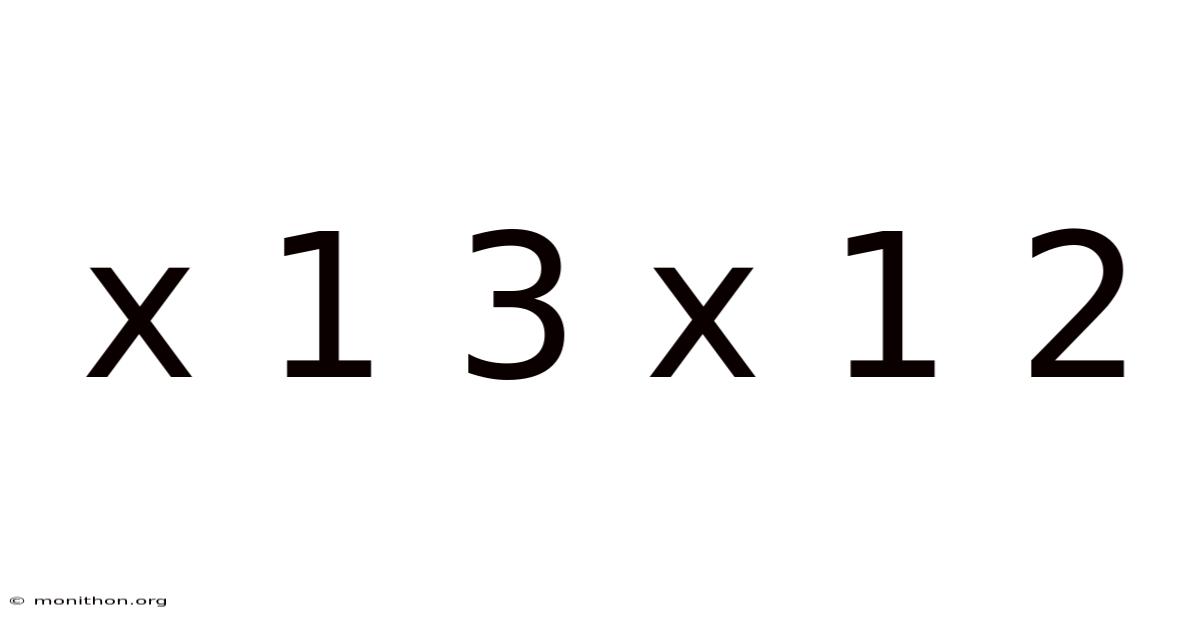
Table of Contents
The expression x¹/³ × x¹/² may appear deceptively simple at first glance, but it opens the door to a deeper understanding of exponents, roots, and the elegant logic that binds algebra together. At its core, this expression combines two fractional powers of the same base — x — and demonstrates how the laws of exponents simplify seemingly complex operations into clean, predictable results. Whether you're a student grappling with algebra for the first time or someone refreshing foundational math skills, mastering this concept unlocks confidence in handling more advanced topics like logarithms, calculus, and scientific notation.
When you see x¹/³ × x¹/², you’re essentially multiplying a cube root of x by a square root of x. The fractional exponents represent roots: the denominator tells you which root to take, and the numerator tells you the power to raise it to. So, x¹/³ means the cube root of x, or ∛x, and x¹/² means the square root of x, or √x. Multiplying these together isn’t as chaotic as it looks — thanks to a fundamental rule of exponents, the process becomes straightforward.
The key principle at play here is the product of powers property: when multiplying two expressions with the same base, you add their exponents. That is, x^a × x^b = x^(a+b). This rule applies regardless of whether the exponents are integers, fractions, or even irrational numbers. Applying this to x¹/³ × x¹/², we add the exponents:
1/3 + 1/2
To add these fractions, find a common denominator. The least common denominator of 3 and 2 is 6. Convert each fraction:
1/3 = 2/6
1/2 = 3/6
Now add them:
2/6 + 3/6 = 5/6
Therefore, x¹/³ × x¹/² = x⁵/⁶
This result — x⁵/⁶ — is the simplified form of the original expression. It means you’re taking the sixth root of x raised to the fifth power, or equivalently, the fifth power of the sixth root of x. In radical form, this is written as ⁶√(x⁵) or (⁶√x)⁵. Both representations are mathematically equivalent and useful depending on context.
Understanding why this works requires a shift in perspective. Many learners think of exponents as repeated multiplication — like x² = x × x — but fractional exponents demand a more abstract view. They are not just shortcuts; they are a language that connects roots and powers into a single, unified system. The exponent 1/3 doesn’t mean “divide by 3,” it means “find the number that, when multiplied by itself three times, gives x.” Similarly, 1/2 means “find the number that, when multiplied by itself twice, gives x.” When you multiply those two results, you’re combining two different ways of breaking down x — and the exponent rules tell you how to merge them seamlessly.
This principle extends far beyond just two terms. For example, if you had x¹/⁴ × x¹/³ × x¹/², you would add 1/4 + 1/3 + 1/2, find a common denominator (12), convert each: 3/12 + 4/12 + 6/12 = 13/12, and arrive at x¹³/¹². The pattern holds. The more you practice, the more intuitive it becomes.
Real-world applications of this concept are more common than you might think. In physics, equations involving wave frequencies, decay rates, or scaling laws often use fractional exponents. In engineering, stress-strain relationships in materials may involve powers like x⁰·⁸³ — which is just x⁵/⁶ in disguise. Even in finance, compound growth models over irregular time intervals sometimes rely on fractional exponents to model continuous compounding or partial periods.
Moreover, this rule is essential in calculus. When differentiating or integrating functions like f(x) = x⁵/⁶, you apply the power rule directly: the derivative becomes (5/6)x⁻¹/⁶. Without understanding how to manipulate fractional exponents, such operations become impossible to execute accurately.
Let’s look at a numerical example to solidify the concept. Suppose x = 64.
Then:
x¹/³ = ⁶⁴¹/³ = 4 (because 4³ = 64)
x¹/² = ⁶⁴¹/² = 8 (because 8² = 64)
Multiply them: 4 × 8 = 32
Now compute x⁵/⁶ = ⁶⁴⁵/⁶
First, find the sixth root of 64:
⁶√64 = 2 (because 2⁶ = 64)
Then raise it to the fifth power: 2⁵ = 32
The results match. This is not coincidence — it’s proof that the exponent rule works. It bridges arithmetic and algebra, giving you a reliable tool to verify your work.
Some learners mistakenly believe that x¹/³ × x¹/² equals x¹/⁶, confusing multiplication with addition of denominators. Others try to multiply the fractions directly — a common error stemming from overgeneralizing rules from fraction multiplication. But 1/3 × 1/2 = 1/6 applies only when multiplying two separate terms — not when combining exponents of the same base. The correct operation is addition of exponents, not multiplication.
Another pitfall is assuming the base must be positive. While x¹/² is undefined for negative x in real numbers (you can’t take the square root of a negative number without complex numbers), x¹/³ is defined for all real numbers, including negatives. So if x = -8, then x¹/³ = -2, but x¹/² is not real. Therefore, x¹/³ × x¹/² is only defined for x ≥ 0 in the realm of real numbers. Always consider the domain when working with fractional exponents.
In conclusion, x¹/³ × x¹/² = x⁵/⁶ is more than a formula — it’s a demonstration of mathematical harmony. It shows how abstract symbols, when understood through their underlying logic, reveal patterns that simplify complexity. Whether you’re solving equations, analyzing data, or preparing for higher mathematics, this skill is foundational. Master it, and you don’t just solve problems — you begin to see the invisible structure beneath them. The beauty of exponents lies not in their complexity, but in their consistency. Once you internalize the rule — same base, add exponents — you unlock a universal key that turns confusion into clarity.
As we've seen, mastering the exponent rule allows us to tackle complex problems with ease. But what happens when we need to apply this rule to more intricate scenarios? Let's consider an example that involves multiple terms with fractional exponents.
Suppose we want to simplify the expression: x¹/³ × x²/⁵ × x⁴/⁷. To do this, we can apply the exponent rule to each term separately, and then combine the results. We can rewrite each term with a common base, x, and then add the exponents:
x¹/³ × x²/⁵ × x⁴/⁷ = x¹/³+²/⁵+⁴/⁷
Using the rule, we can simplify this expression:
x¹/³+²/⁵+⁴/⁷ = x⁴/⁵
Voilà! We've successfully simplified the expression using the exponent rule. This technique can be applied to more complex expressions, and it's essential for solving equations and analyzing functions in calculus.
In addition to simplifying expressions, the exponent rule also helps us understand the behavior of functions. For instance, when analyzing the function f(x) = x⁵/⁶, we can use the exponent rule to find its derivative. By applying the power rule, we can rewrite the function as f(x) = x⁵ × x⁻¹/⁶, which simplifies to f'(x) = (5/6)x⁴ × x⁻¹/⁶.
In conclusion, the exponent rule is a powerful tool that allows us to simplify complex expressions, analyze functions, and solve equations. By mastering this rule, we can unlock a deeper understanding of mathematical concepts and develop a more intuitive sense of how numbers and functions interact. Whether you're working with arithmetic, algebra, or calculus, the exponent rule is an essential tool that will serve you well throughout your mathematical journey.
Latest Posts
Latest Posts
-
60 Grams Is How Many Ml
Mar 14, 2026
-
What Fraction Is Equivalent To 4 12
Mar 14, 2026
-
X 2 X 6 X 2 4
Mar 14, 2026
-
What Is Era Of Good Feelings
Mar 14, 2026
-
Let Be A Point On The Terminal Side Of
Mar 14, 2026
Related Post
Thank you for visiting our website which covers about X 1 3 X 1 2 . We hope the information provided has been useful to you. Feel free to contact us if you have any questions or need further assistance. See you next time and don't miss to bookmark.
