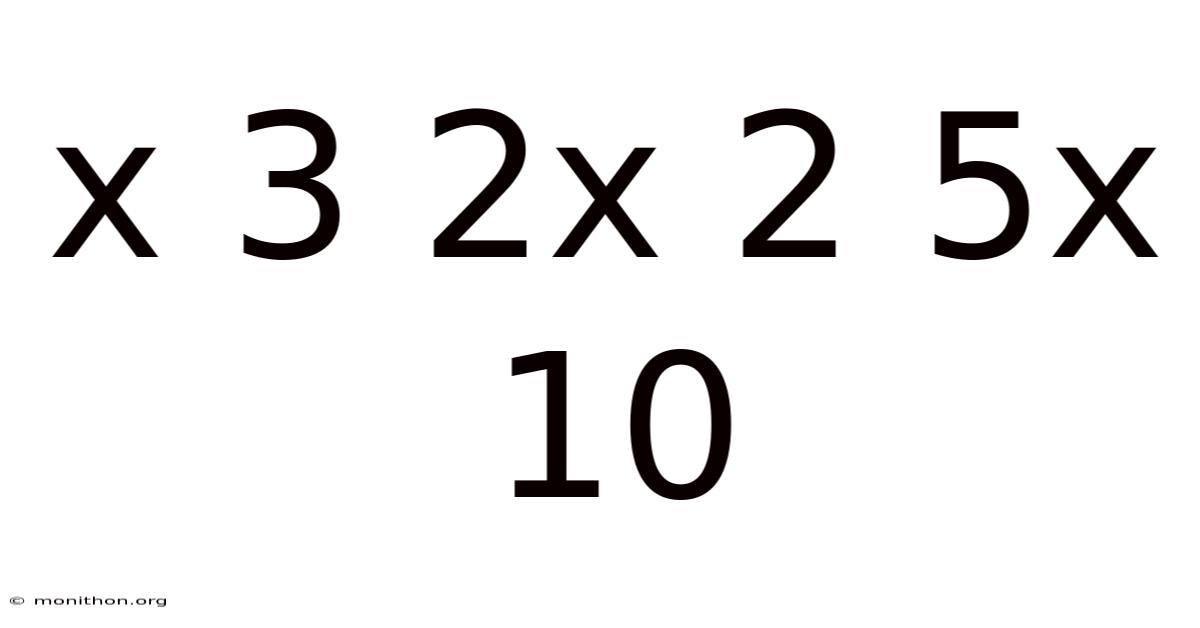
X 3 2x 2 5x 10
Solving the Cubic Polynomial: A Step-by-Step Guide to x³ + 2x² + 5x + 10
At first glance, the string of numbers and variables "x 3 2x 2 5x 10" represents a classic algebraic expression waiting to be decoded. When interpreted with standard mathematical notation, this becomes the cubic polynomial x³ + 2x² + 5x + 10. Solving such an equation—finding the values of x that make the entire expression equal to zero—is a fundamental skill that bridges basic algebra and more advanced calculus. This journey will demystify the process, transforming a seemingly complex string of symbols into a clear, solvable problem. We will explore systematic methods, from logical guesswork to powerful theorems, ensuring you not only find the roots but also understand the why behind each step.
Decoding the Expression and Setting the Goal
Before any solving begins, we must correctly interpret the given input. The sequence "x 3 2x 2 5x 10" implies:
x 3meansx³(x raised to the third power).2x 2means2x²(2 times x squared).5xremains5x.10is the constant term.
Thus, our equation to solve is: x³ + 2x² + 5x + 10 = 0
The primary goal is to find all real and complex numbers x that satisfy this equation. These solutions are called the roots or zeros of the polynomial. A cubic equation, by the Fundamental Theorem of Algebra, will always have exactly three roots (counting multiplicities), which can be a combination of real and complex conjugate pairs.
The Rational Root Theorem: Your First Strategic Tool
For polynomials with integer coefficients, like our example, the Rational Root Theorem provides an invaluable starting point. It dramatically narrows down the infinite field of possible numbers we need to test.
Understanding the Theorem
The theorem states that any possible rational root, expressed in its lowest terms as p/q, must have:
- p as a factor of the constant term (here, 10).
- q as a factor of the leading coefficient (the coefficient of x³, which is 1 in our case).
Generating the Candidate List
- Factors of the constant term (10): ±1, ±2, ±5, ±10.
- Factors of the leading coefficient (1): ±1.
- Possible rational roots (p/q): Since q is only ±1, our list of candidates is simply the factors of 10: ±1, ±2, ±5, ±10.
This list is our shortlist. We now must test each candidate by substituting it into the original equation or, more efficiently, using synthetic division.
Testing Candidates with Synthetic Division
Synthetic division is a streamlined shortcut for polynomial long division when dividing by a linear factor of the form (x - c). If c is a root, the division will yield a remainder of zero.
Let's systematically test our candidates: 1, -1, 2, -2, 5, -5, 10, -10.
Testing x = 1: Coefficients: 1 (x³), 2 (x²), 5 (x), 10 (constant). Bring down the 1. Multiply by 1: 1. Add to next coefficient: 2 + 1 = 3. Multiply by 1: 3. Add to next: 5 + 3 = 8. Multiply by 1: 8. Add to last: 10 + 8 = 18. Remainder is 18, not 0. So, x = 1 is not a root.
Testing x = -1: Bring down 1. Multiply by -1: -1. Add to 2: 2 + (-1) = 1. Multiply by -1: -1. Add to 5: 5 + (-1) = 4. Multiply by -1: -4. Add to 10: 10 + (-4) = 6. Remainder is 6. x = -1 is not a root.
Testing x = -2: Bring down 1. Multiply by -2: -2. Add to 2: 2 + (-2) = 0. Multiply by -2: 0. Add to 5: 5 + 0 = 5. Multiply by -2: -10. Add to 10: 10 + (-10) = 0. Remainder is 0! Success. x = -2 is a root.
This means (x + 2) is a factor of our polynomial. The numbers on the bottom row (1, 0, 5) are the coefficients of the quotient polynomial. Therefore: x³ + 2x² + 5x + 10 = (x + 2)(x² + 0x + 5) = (x + 2)(x² + 5)
Solving the Remaining Quadratic Factor
Our cubic equation is now factored into a linear term and a quadratic term: (x + 2)(x² + 5) = 0
The Zero Product Property tells us that if a product of factors equals zero, at least one of the factors must be zero. We set each factor equal to zero and solve.
-
First Factor: x + 2 = 0 This gives our first, real root: x = -2.
-
Second Factor: x² + 5 = 0 This is a simple quadratic equation. Solving for x: x² = -5 x = ±√(-5) Here we encounter a negative number under the square root, which introduces imaginary numbers. Recall that i is defined as √(-1). Therefore: x = ±√(5) * √(-1) = ±i√5
This yields two complex conjugate roots: x = i√5 and x = -i√5.
The Complete Solution Set and Verification
We have now identified all three roots of the original cubic polynomial:
- x = -2 (a real, rational root)
- x = i√5 (a complex root)
- x = -i√5 (its complex conjugate)
Verification is a crucial final step. Substitute each root back into the original equation **x³
Latest Posts
Latest Posts
-
Translate The Phrase Into An Algebraic Expression
Mar 26, 2026
-
Judy Is Now Twice As Old As Adam
Mar 26, 2026
-
What Are Three Advantages Of Being Multicellular
Mar 26, 2026
-
A Square Is Always A Rhombus
Mar 26, 2026
-
Is Accounting The Language Of Business
Mar 26, 2026
