X 3 3x 2 16x 48

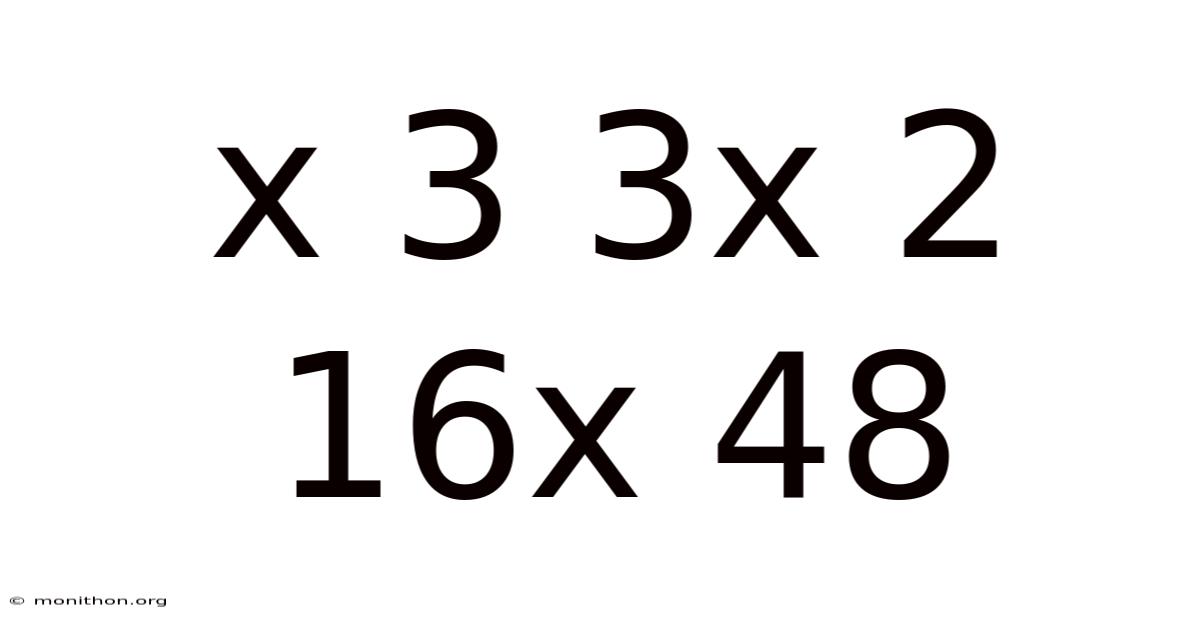
Understanding the Polynomial Expression: x³ + 3x² + 16x + 48
Polynomials are fundamental building blocks in algebra, and expressions like x³ + 3x² + 16x + 48 often appear in various mathematical contexts. Whether you're a student tackling algebra homework, a teacher preparing lessons, or simply curious about how these expressions work, understanding the structure and properties of such polynomials is essential. This article will guide you through the analysis of the polynomial x³ + 3x² + 16x + 48, exploring its components, factoring possibilities, and practical applications.
Breaking Down the Expression
Let's begin by identifying the structure of the polynomial x³ + 3x² + 16x + 48. This is a cubic polynomial, meaning its highest power of x is 3. The expression can be written as:
x³ + 3x² + 16x + 48
Here, each term consists of a coefficient (the number in front of x) and a power of x. The coefficients are 1, 3, 16, and 48, and the powers of x are 3, 2, 1, and 0 (since the constant term 48 is 48x⁰).
Analyzing the Coefficients
Looking at the coefficients—1, 3, 16, and 48—there isn't an obvious pattern or common factor among all four terms. However, it's worth noting that 48 is a multiple of several numbers, including 1, 2, 3, 4, 6, 8, 12, 16, 24, and 48. This observation might help when trying to factor the polynomial or find its roots.
Factoring the Polynomial
Factoring cubic polynomials can be challenging, especially when there isn't a clear common factor among the terms. Let's attempt to factor x³ + 3x² + 16x + 48 by grouping or using the Rational Root Theorem.
First, let's try grouping:
x³ + 3x² + 16x + 48 = (x³ + 3x²) + (16x + 48)
Factoring out the greatest common factor from each group:
= x²(x + 3) + 16(x + 3)
Now, we see that both groups have a common factor of (x + 3):
= (x + 3)(x² + 16)
So, the polynomial can be factored as:
x³ + 3x² + 16x + 48 = (x + 3)(x² + 16)
Understanding the Factors
The factored form (x + 3)(x² + 16) reveals important information:
- The factor (x + 3) suggests that -3 is a root of the polynomial. This means that when x = -3, the entire expression equals zero.
- The quadratic factor x² + 16 does not factor further over the real numbers, since it is always positive (as x² is always non-negative and adding 16 makes it strictly positive).
Finding the Roots
To find all the roots of the polynomial, we set each factor equal to zero:
- x + 3 = 0 → x = -3
- x² + 16 = 0 → x² = -16
The second equation has no real solutions, but it does have two complex solutions:
x = ±4i
Thus, the polynomial x³ + 3x² + 16x + 48 has one real root (x = -3) and two complex roots (x = 4i and x = -4i).
Practical Applications
Understanding polynomials like x³ + 3x² + 16x + 48 is crucial in many areas:
- Algebra: Factoring and finding roots are essential skills for solving equations and simplifying expressions.
- Calculus: Polynomials are used in limits, derivatives, and integrals.
- Engineering and Physics: Cubic equations often model real-world phenomena, such as motion or electrical circuits.
- Computer Science: Polynomials are used in algorithms and data structures.
Frequently Asked Questions
Q: Can x³ + 3x² + 16x + 48 be factored further? A: Over the real numbers, the polynomial factors as (x + 3)(x² + 16). The quadratic factor x² + 16 does not factor further in the real number system.
Q: What are the roots of the polynomial? A: The polynomial has one real root (x = -3) and two complex roots (x = ±4i).
Q: How can I verify the factorization? A: You can expand (x + 3)(x² + 16) to check that it equals the original polynomial:
(x + 3)(x² + 16) = x³ + 16x + 3x² + 48 = x³ + 3x² + 16x + 48
Conclusion
The polynomial x³ + 3x² + 16x + 48 provides a clear example of how cubic expressions can be analyzed, factored, and understood. By breaking down the expression, factoring it into (x + 3)(x² + 16), and finding its roots, we gain insight into the structure and behavior of such polynomials. These skills are foundational for further study in mathematics and have wide-ranging applications in science and engineering. Whether you're solving equations, modeling real-world problems, or preparing for exams, mastering these concepts will serve you well.
Exploring the deeper implications of this factorization opens doors to more advanced topics, such as polynomial graphs, function behavior, and applications in optimization. Mastery of such concepts not only strengthens analytical thinking but also enhances problem-solving capabilities across disciplines. As you continue to dive into mathematics, remember that each equation is a puzzle waiting to be solved, and every solution brings you closer to understanding the bigger picture. Conclusion
This exploration of the polynomial x³ + 3x² + 16x + 48 highlights the significance of factorization and root analysis. By breaking it down and examining its components, we uncover both its real and complex solutions, reinforcing the value of systematic problem-solving. Such insights are not just academic—they empower you to tackle challenges with confidence and precision. Embrace these lessons, and let them guide your journey through the world of mathematics.
Extending the Analysis
Beyond the basic factorisation, there are several additional perspectives that deepen our understanding of the cubic (x^{3}+3x^{2}+16x+48).
1. Graphical Interpretation
When plotted, the function (y = x^{3}+3x^{2}+16x+48) exhibits the characteristic “S‑shape” of a cubic with a positive leading coefficient. Because the real root is (-3) and the remaining quadratic factor never crosses the (x)-axis, the graph touches the axis only at ((-3,0)) and then rises monotonically for all larger (x). The vertex of the quadratic factor, (x^{2}+16), occurs at (x=0) with a minimum value of (16); this translates into a local minimum of the cubic at (x=-3) where the slope is zero. Observing the curvature helps visualise how the complex conjugate pair contributes to the overall shape without introducing additional (x)-intercepts.
2. Synthetic Division as a Diagnostic Tool
The rational‑root test quickly narrowed the search to (\pm1,\pm2,\pm3,\pm4,\pm6,\pm8,\pm12,\pm16,\pm24,\pm48). Testing (-3) revealed a zero remainder, confirming that ((x+3)) is a factor. Performing synthetic division:
[ \begin{array}{r|rrrr} -3 & 1 & 3 & 16 & 48 \ & & -3 & 0 & -48 \ \hline & 1 & 0 & 16 & 0 \end{array} ]
produces the depressed quadratic (x^{2}+16). This method not only validates the factorisation but also isolates the remaining quadratic factor in a single, systematic step.
3. Connections to Higher‑Degree Polynomials
If we consider the cubic as part of a larger family, say (x^{3}+ax^{2}+bx+c) with (a,b,c\in\mathbb{R}), the presence of a rational root guarantees that the polynomial can be reduced to a quadratic. This reduction is the cornerstone of algorithms for solving general cubic equations (e.g., Cardano’s method) and illustrates how factorisation acts as a bridge between elementary algebra and more sophisticated techniques.
4. Real‑World Modelling
Cubic expressions frequently arise when a physical quantity depends on the cube of a variable. For instance, the drag force on a spherical object moving through a viscous fluid is proportional to the cube of its velocity. If a simplified model yields an equation of the form (v^{3}+3v^{2}+16v+48=0), the real root (-3) would correspond to a velocity that satisfies equilibrium conditions, while the complex roots would be non‑physical and thus discarded. Recognising the nature of the roots therefore directly informs the feasibility of a solution in an engineering context.
5. Computational Shortcuts
When dealing with higher‑order polynomials that share a common factor, one can exploit polynomial remainder sequences or Euclidean algorithms to extract the greatest common divisor (GCD). In computational software, commands such as factor or roots automatically perform these steps, but understanding the underlying mechanics empowers analysts to troubleshoot unexpected outputs and to design custom algorithms for niche problems.
Synthesis
The journey from the original cubic to its factorised form ((x+3)(x^{2}+16)) showcases a cascade of techniques—rational‑root testing, synthetic division, graph analysis, and physical interpretation—all converging on a single, elegant structure. Each step not only confirms the algebraic identity but also enriches the conceptual framework that students and practitioners alike can apply to broader classes of equations.
Final Perspective
Mastering the dissection of a seemingly simple polynomial equips you with a portable toolkit: the ability to locate roots, anticipate graph behaviour, and translate abstract symbols into tangible models. As you encounter more intricate equations in future studies, the habits cultivated here—questioning, testing, and verifying—will remain indispensable. Embrace the systematic approach, and let every new problem be an opportunity to refine your analytical craft.
Conclusion
By unpacking (x^{3}+3x^{2}+16x+48) we have illuminated the power of factorisation, the insight gained from root analysis, and the practical relevance across disciplines. This disciplined yet creative process transforms a collection of symbols into a clear narrative of cause and effect, bridging theory with real‑world impact. Keep this mindset as you progress, and let each algebraic adventure deepen both your competence and your curiosity.
Latest Posts
Latest Posts
-
5 Letter Words With 1 Vowel
Mar 20, 2026
-
2 Is Subtracted From Twice A Number
Mar 20, 2026
-
250 Mg Is How Many Ml
Mar 20, 2026
-
How Do You Combine Like Terms
Mar 20, 2026
-
How Did Leonardo Da Vinci Impact The Renaissance
Mar 20, 2026
