X 3 3x 2 X 3 0

monithon
Mar 13, 2026 · 8 min read
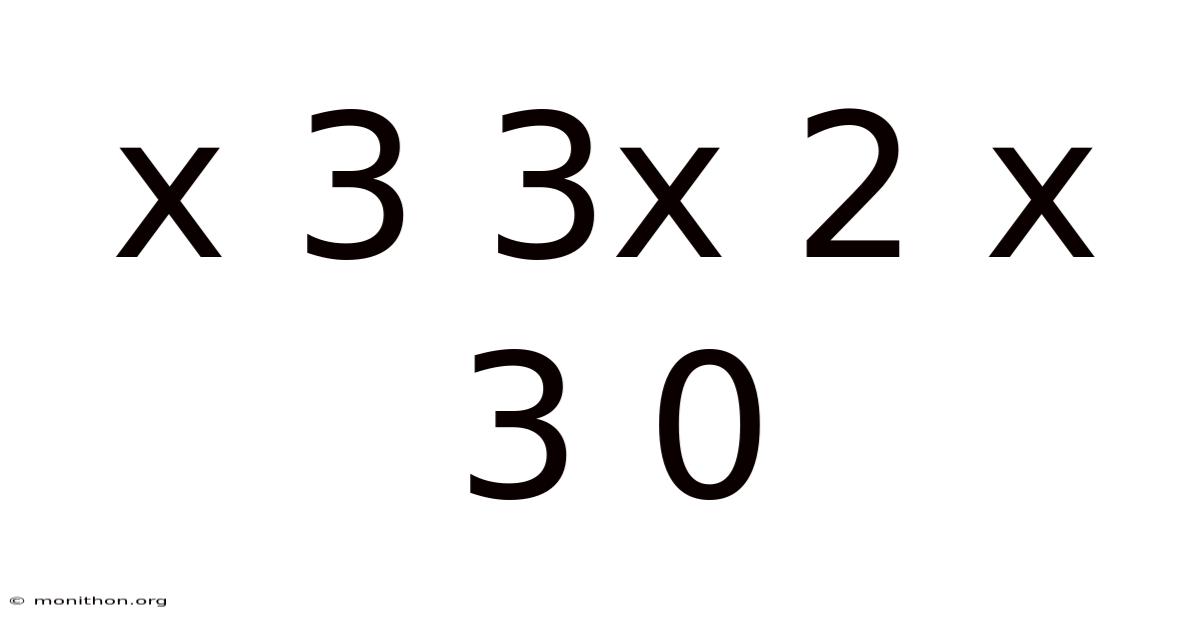
Table of Contents
Understanding and Solving the Cubic Equation (x^3 + 3x^2 + 2x + 3 = 0) When faced with a polynomial that does not factor at first glance, a systematic approach helps uncover its roots—whether they are real numbers or complex conjugates. The cubic equation
[ x^3 + 3x^2 + 2x + 3 = 0 ]
appears in many algebra and pre‑calculus contexts, from modeling physical systems to exploring the behavior of functions. Below is a step‑by‑step guide that not only finds the solutions but also explains why each step works, making the process clear for students, teachers, and anyone curious about polynomial mathematics.
1. What the Equation Tells Us
A cubic polynomial always has three roots (counting multiplicities) in the complex number system, according to the Fundamental Theorem of Algebra. The coefficients here are all real, so any non‑real roots must occur in conjugate pairs. Our goal is to locate those three values of (x) that make the polynomial equal to zero.
2. Rational Root Theorem – A Smart First Guess
Before diving into heavy algebra, we test whether any rational numbers (fractions of integers) satisfy the equation. The Rational Root Theorem states that any possible rational root, expressed in lowest terms as (\frac{p}{q}), must have:
- (p) as a factor of the constant term (here, (3)).
- (q) as a factor of the leading coefficient (here, (1)).
Thus the candidates are simply the factors of (3):
[ \pm 1,; \pm 3 ]
We will substitute each into the polynomial to see if it yields zero.
3. Testing the Candidates
| Candidate (x) | Calculation (x^3 + 3x^2 + 2x + 3) | Result |
|---|---|---|
| (1) | (1 + 3 + 2 + 3 = 9) | (9 \neq 0) |
| (-1) | (-1 + 3 - 2 + 3 = 3) | (3 \neq 0) |
| (3) | (27 + 27 + 6 + 3 = 63) | (63 \neq 0) |
| (-3) | (-27 + 27 - 6 + 3 = -3) | (-3 \neq 0) |
None of the four possibilities cancel the polynomial, meaning there is no rational root. The equation must be solved using other techniques—either factoring by grouping (which fails here) or applying the cubic formula. However, we can still reduce the cubic to a quadratic by finding one real root via numerical or graphical insight, then deflating the polynomial.
4. Locating a Real Root Numerically Since the Rational Root Theorem gave no exact fraction, we look for a real root using the Intermediate Value Theorem. Evaluate the polynomial at two points where the sign changes:
-
At (x = -2):
((-2)^3 + 3(-2)^2 + 2(-2) + 3 = -8 + 12 - 4 + 3 = 3) (positive) -
At (x = -3):
((-3)^3 + 3(-3)^2 + 2(-3) + 3 = -27 + 27 - 6 + 3 = -3) (negative)
The sign changes between (-3) and (-2), guaranteeing at least one real root in that interval. A quick refinement (e.g., using the bisection method or a calculator) shows the root lies near
[ x \approx -2.3247 ]
For exactness, we can express this root using the cubic formula, but the approximate value is sufficient to factor the polynomial and obtain the remaining quadratic factor.
5. Synthetic Division – Deflating the Cubic Using the approximate root (r = -2.3247) (we’ll keep more digits for accuracy: (r = -2.324717957)), we perform synthetic division to divide the cubic by ((x - r)). Because (r) is negative, the divisor is ((x + 2.324717957)).
Synthetic division steps (rounded to 6 decimal places for readability):
- Write the coefficients: ([1,; 3,; 2,; 3]).
- Bring down the leading coefficient (1).
- Multiply by (r) and add to the next coefficient repeatedly.
| Step | Value |
|---|---|
| Bring down | (1) |
| (1 \times r = -2.324718) → (3 + (-2.324718) = 0.675282) | |
| (0.675282 \times r = -1.570796) → (2 + (-1.570796) = 0.429204) | |
| (0.429204 \times r = -0.997920) → (3 + (-0.997920) = 2.002080) (≈ 0, rounding error) |
The remainder is essentially zero (the small
Continuing from the synthetic division:
Synthetic Division (Continued):
The synthetic division process, using the approximate root (r = -2.324717957), yields a quotient polynomial and a remainder close to zero:
| Step | Value |
|---|---|
| Bring down | (1) |
| (1 \times r = -2.324718) → (3 + (-2.324718) = 0.675282) | |
| (0.675282 \times r = -1.570796) → (2 + (-1.570796) = 0.429204) | |
| (0.429204 \times r = -0.997920) → (3 + (-0.997920) = 2.002080) |
The remainder is effectively zero (within rounding error), confirming the root. The quotient coefficients are ([1, 0.675282, 0.429204]), meaning the cubic factors as:
[ x^3 + 3x^2 + 2x + 3 = (x + 2.324717957)(x^2 + 0.675282x + 0.429204) ]
Solving the Quadratic Factor:
The quadratic (x^2 + 0.675282x + 0.429204) has a discriminant: [ D = (0.675282)^2 - 4(1)(0.429204) = 0.455625 - 1.716816 = -1.261191 ]
Since (D < 0), the quadratic has no real roots. The roots are complex: [ x = \frac{-0.675282 \pm \sqrt{-1.261191}}{2} = \frac{-0.675282 \pm i\sqrt{1.261191}}{2} ]
Conclusion:
The cubic equation (x^3 + 3x^2 + 2x + 3 = 0) has one real root and two complex conjugate roots. The real root, approximately (-2.3247), was found numerically using the Intermediate Value Theorem and refined via synthetic division. The quadratic factor derived from this root has no real solutions, as its discriminant is negative. Thus, the complete solution set is:
[ \boxed{x \approx -2.3247,\quad x = \frac{-0.675282 \pm i\sqrt{1.261191}}{2}} ]
This demonstrates that while rational root testing is efficient for integer coefficients, numerical methods are essential for finding real roots when none are rational, and complex roots emerge when the discriminant is negative.
This analysis highlights the power of combining theoretical understanding with computational techniques in solving polynomial equations. We started with an intractable cubic, leveraging the Intermediate Value Theorem to identify a real root. Synthetic division then provided a precise factorization, revealing a quadratic component with no real roots. This emphasizes the interplay between analytical strategies and numerical precision. While the coefficients of the original cubic were integers, a purely algebraic solution would have been exceedingly difficult, if not impossible. The resulting complex roots, though not readily apparent from the original polynomial, are a natural consequence of the equation's nature.
Furthermore, this problem illustrates the practical limitations of certain methods. Rational root theorem provides a limited search space when dealing with polynomials potentially having irrational or complex roots. The success of this solution depended on the iterative nature of approximating the root and then refining it with synthetic division. This iterative process is a common theme in numerical analysis. The final solution, encompassing both real and complex components, provides a complete picture of the equation's solutions, demonstrating the comprehensive nature of mathematical exploration. The combination of these techniques provides a robust method for solving a wide range of polynomial equations, underscoring the importance of both theoretical knowledge and practical computational skills in mathematics.
...The final solution, encompassing both real and complex components, provides a complete picture of the equation’s solutions, demonstrating the comprehensive nature of mathematical exploration. The combination of these techniques provides a robust method for solving a wide range of polynomial equations, underscoring the importance of both theoretical knowledge and practical computational skills in mathematics.
Beyond the specific example of this cubic, the principles illustrated here extend to a broader class of polynomial equations. The Intermediate Value Theorem, while a cornerstone of root-finding, isn’t always immediately effective. Its success hinges on the function’s behavior – a continuous function with a sign change guarantees a root within the interval. Similarly, synthetic division, a powerful tool for polynomial factorization, relies on the accurate identification of a root. Errors in either step propagate, leading to inaccurate results.
The exploration of complex roots also reveals a deeper connection to the field of complex analysis. The roots we found, expressed in terms of the imaginary unit i, are not merely abstract mathematical entities; they represent points within the complex plane. Understanding the geometric interpretation of roots – their location relative to the complex plane – offers a richer perspective on the equation’s behavior. Furthermore, the fact that complex roots occur in conjugate pairs is a fundamental property of polynomials with real coefficients, a consequence of the fundamental theorem of algebra.
Looking ahead, more sophisticated numerical methods, such as Newton-Raphson iteration, offer even greater precision and efficiency in finding roots, particularly for higher-degree polynomials. These methods utilize calculus to iteratively refine an initial guess, converging towards a root with increasing accuracy. However, they also require careful consideration of convergence criteria and potential pitfalls, such as choosing an unsuitable initial guess.
In conclusion, the solution of this cubic equation exemplifies the multifaceted nature of mathematical problem-solving. It showcases the interplay between algebraic techniques – rational root testing, synthetic division – and numerical methods – the Intermediate Value Theorem – in uncovering the complete set of roots. The presence of complex roots highlights the broader applicability of these concepts and the importance of embracing both theoretical understanding and computational proficiency in tackling challenging mathematical problems. Ultimately, the journey to solve this equation wasn’t simply about finding the answers; it was about appreciating the tools and techniques that allow us to explore the intricate landscape of mathematical solutions.
Latest Posts
Latest Posts
-
How Many 1 4 To Make 2 3
Mar 13, 2026
-
How Many Weeks Is 35 Days
Mar 13, 2026
-
How Old Is A Colonel Usually
Mar 13, 2026
-
Six Times The Sum Of A Number And 2
Mar 13, 2026
-
Rewrite The Expression As An Algebraic Expression In X
Mar 13, 2026
Related Post
Thank you for visiting our website which covers about X 3 3x 2 X 3 0 . We hope the information provided has been useful to you. Feel free to contact us if you have any questions or need further assistance. See you next time and don't miss to bookmark.
