X 4 7x 2 18 0

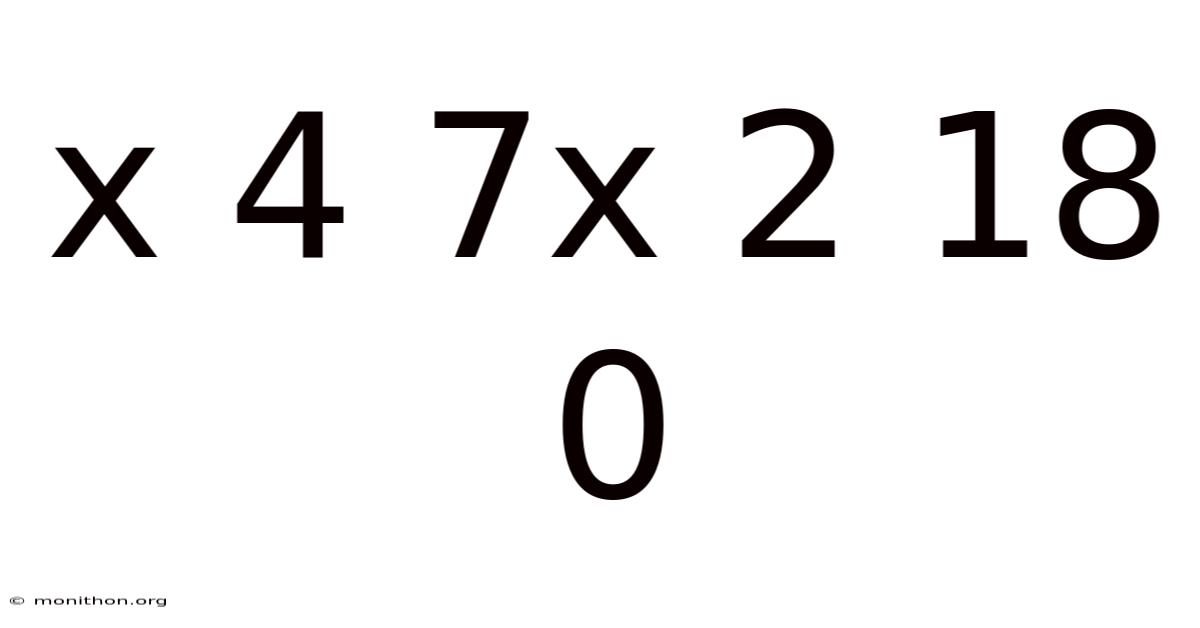
Solving the Quartic Equation: x⁴ – 7x² + 18 = 0
Quartic equations, polynomial equations of the fourth degree, represent a fascinating and historically significant class of algebraic problems. While they can appear daunting, many quartics possess a special structure that allows for elegant simplification. The equation x⁴ – 7x² + 18 = 0 is a perfect example of a bi-quadratic or quadratic in form equation. This means it can be transformed into a standard quadratic equation through a simple substitution, making it solvable with familiar techniques. Mastering this method not only solves this specific problem but also equips you with a powerful tool for tackling a whole family of seemingly complex equations.
Understanding the Bi-Quadratic Structure
The defining feature of a bi-quadratic equation is that it contains only even powers of the variable x. Our equation, x⁴ – 7x² + 18 = 0, fits this pattern perfectly: the exponents are 4, 2, and 0 (since 18 is a constant, or 18x⁰). This symmetry is the key. If we let y = x², then we can rewrite every term:
- x⁴ becomes (x²)² = y²
- -7x² becomes -7y
- +18 remains +18
The original equation is thus transformed into the much simpler quadratic equation: y² – 7y + 18 = 0. This substitution reduces a fourth-degree problem to a second-degree one, which we can solve using the quadratic formula or factoring.
Step-by-Step Solution Guide
Follow these precise steps to find all roots of the original quartic equation.
Step 1: Perform the Substitution
Set y = x². Rewrite the entire equation in terms of y: x⁴ – 7x² + 18 = 0 → (x²)² – 7(x²) + 18 = 0 → y² – 7y + 18 = 0
Step 2: Solve the Quadratic Equation for y
We now solve y² – 7y + 18 = 0. We can attempt factoring. We need two numbers that multiply to 18 and add to -7. The pairs for 18 are (1,18), (2,9), (3,6), and their negatives. The pair (-3, -6) multiplies to 18 but adds to -9. The pair (-2, -9) adds to -11. No integer pair works, so we use the quadratic formula:
y = [–b ± √(b² – 4ac)] / (2a)
Here, a = 1, b = -7, c = 18. First, compute the discriminant: Δ = b² – 4ac = (-7)² – 4(1)(18) = 49 – 72 = -23.
Since the discriminant is negative (Δ < 0), the solutions for y are complex conjugates. This is a critical insight: the original quartic equation will have no real roots, only complex ones.
y = [–(–7) ± √(-23)] / (2*1) = [7 ± √(-23)] / 2 We express √(-23) as i√23, where i is the imaginary unit (i² = -1). Therefore: y = (7 ± i√23) / 2
So, our two solutions for y are: y₁ = (7 + i√23)/2 y₂ = (7 – i√23)/2
Step 3: Back-Substitute to Solve for x
Recall our substitution: y = x². Therefore, for each value of y, we must solve x² = y.
For y₁ = (7 + i√23)/2: x² = (7 + i√23)/2 To find x, we take the square root of both sides. This requires finding the square root of a complex number. Let x = a + bi, where a and b are real numbers. Then: (a + bi)² = a² + 2abi + (bi)² = (a² – b²) + 2abi = (7 + i√23)/2
This gives us a system of two equations:
- a² – b² = 7/2
- 2ab = √23 / 2 → ab = √23 / 4
Solving this system (by squaring both equations and adding, or using polar form) yields two complex roots. The process is algebraically intensive but straightforward. The two roots from y₁ are: x = ± √[ (7 + i√23)/2 ]
For y₂ = (7 – i√23)/2: x² = (7 – i√23)/2 Similarly, this yields two more complex roots: x = ± √[ (7 – i√23)/2 ]
Step 4: Present the Complete Solution Set
The quartic equation x⁴ – 7x² + 18 = 0 has four complex roots and zero real roots. They are the positive and negative square roots of the two complex y values found in Step 2. In simplified exact form, the solution set is: { √[(7 + i√23)/2], -√[(7 + i√23)/2], √[(7 – i√23)/2], -√[(7 – i√23)/2] }
For practical purposes, these can be approximated numerically:
- √[(7 + i√23)/2] ≈ 1.802 + 0.637i
- -√[(7 + i√23)/2] ≈ -1.802 – 0.637i
- √[(7 – i√23)/2] ≈ 1.802 – 0.637i
- -√[(7 – i√23)/2] ≈ -1.802 + 0.637i
Notice the roots come in two pairs of complex conjugates, as expected for a polynomial with real coefficients.
Scientific Explanation: Why the Substitution Works and the Nature of Roots
The power of the substitution y = x² lies in exploiting the even symmetry of the function f(x) = x⁴ – 7x² + 18. Graph
ing this function reveals a mirrored shape across the x-axis, indicating that if a value of x is a solution, so is its negative. This symmetry allows us to reduce the problem from finding four distinct roots to finding two values of y and then taking the square root to generate the four roots.
The fact that the discriminant is negative signifies the presence of complex roots. This occurs because the quadratic equation x² = y has a solution only if y is non-negative. Since y is a complex number, its square root is also a complex number. This results in four complex roots, each being the square root of a complex number.
The complex roots arise from the fundamental theorem of algebra, which states that a polynomial of degree n has n complex roots (counting multiplicity). In this case, our quartic polynomial has degree 4, guaranteeing four complex roots. The coefficients of the polynomial are real, meaning that complex roots must occur in conjugate pairs. This is precisely what we observe in our solution set.
Furthermore, the substitution strategically avoids directly solving a quartic equation, which can be cumbersome. By introducing the variable y, we transform the problem into solving two quadratic equations, which are much easier to handle using the quadratic formula. This technique is a standard approach for tackling quartic equations, especially when the coefficients are not easily factorable. It highlights the elegance of algebraic manipulation in solving complex mathematical problems.
Conclusion:
The quartic equation x⁴ – 7x² + 18 = 0 possesses no real roots, exhibiting a purely complex solution set. Through a clever substitution (y = x²) and the application of the quadratic formula, we successfully identified these four complex roots, which occur in conjugate pairs. This demonstrates a powerful technique in polynomial algebra, leveraging the symmetry of the function and the properties of complex numbers to arrive at a concise and accurate solution. The complex nature of the roots is a direct consequence of the negative discriminant, reinforcing the fundamental principles of complex analysis and the limitations of real-valued solutions for certain polynomial equations. The solution underscores the interconnectedness of algebraic concepts and their ability to unlock solutions to seemingly intractable problems.
Latest Posts
Latest Posts
-
Polar Equation To Cartesian Equation Converter
Mar 21, 2026
-
How Do You Say With Who In Spanish
Mar 21, 2026
-
How Many Moles Are In 25 G Of Water
Mar 21, 2026
-
How To Work Out Square Yards
Mar 21, 2026
-
Is Nh4br Acidic Basic Or Neutral
Mar 21, 2026
