X 4 X 2 X 2

monithon
Mar 18, 2026 · 8 min read
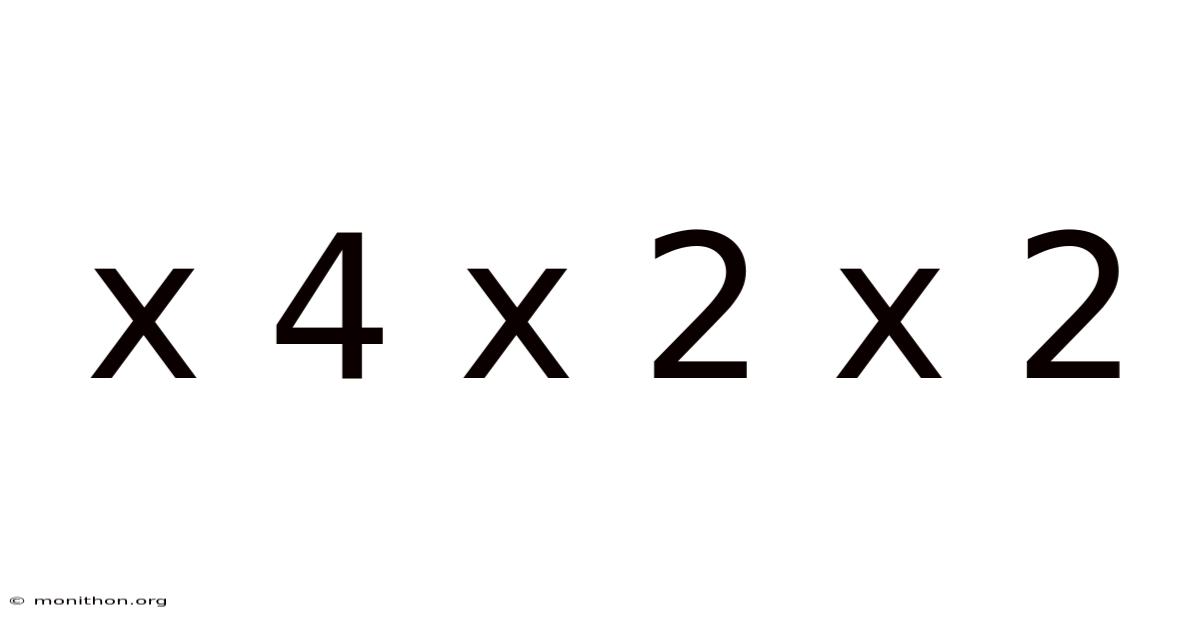
Table of Contents
x 4 x2 x 2: A Deep Dive into Multiplying Powers of the Same Base
When you encounter the notation x 4 x 2 x 2 in algebra, it may initially look like a random string of symbols. In reality, it represents a compact way of expressing the product of three separate powers of the same variable. This article unpacks the meaning behind the expression, walks you through a systematic simplification process, explains the underlying scientific principles, and answers the most frequently asked questions. By the end, you will not only know how to reduce x 4 x 2 x 2 to its simplest form, but you will also appreciate why those exponent rules work the way they do.
Understanding the Building Blocks
Before tackling the full expression, it helps to break down each component. In algebraic notation, a caret (^) or superscript indicates an exponent, which tells us how many times a base is multiplied by itself. For example, x⁴ means x multiplied by itself four times:
x·x·x·x.
Similarly, x² stands for x·x, and another x² repeats the same operation. When these terms are placed side by side without any explicit multiplication sign, mathematicians traditionally interpret the juxtaposition as multiplication. Therefore, x 4 x 2 x 2 actually reads as x⁴·x²·x².
Step‑by‑Step Simplification
The simplification process relies on a single, powerful rule: when multiplying powers with the same base, you add the exponents. This rule can be expressed as:
xᵃ·xᵇ = x⁽ᵃ⁺ᵇ⁾
Applying this rule to x⁴·x²·x² involves the following steps:
- Identify the common base – All three terms share the base x.
- List the exponents – You have 4, 2, and 2.
- Add the exponents together – 4 + 2 + 2 equals 8.
- Write the result – The product simplifies to x⁸.
In symbolic form, the entire operation looks like this:
x⁴·x²·x² = x⁽⁴⁺²⁺²⁾ = x⁸
This concise progression illustrates why the expression collapses into a single power of x with an exponent of 8.
Scientific Explanation of Exponent Rules
The addition of exponents during multiplication is not an arbitrary shortcut; it stems from the fundamental definition of exponents. Consider the expression x⁴·x². Expanding each term reveals:
x⁴ = x·x·x·x
x² = x·x
When you multiply these two expanded forms together, you line up all the factors:
x·x·x·x·x·x
Counting the total number of x factors gives you six, which corresponds to x⁶. Notice that 4 + 2 = 6, confirming the rule. Extending this logic to three factors—x⁴·x²·x²—means you are simply stacking all the individual factors and then counting them, leading to the sum of the exponents.
This principle holds for any real or complex base, provided the base is non‑zero when dealing with fractional or negative exponents. It is a cornerstone of algebraic manipulation and appears frequently in calculus, physics, and computer science.
Common Mistakes and How to Avoid ThemEven though the rule is straightforward, learners often stumble in a few typical ways:
- Misreading juxtaposition as concatenation – Some students interpret “x 4 x 2 x 2” as a single number, such as 422, rather than as a product of powers. Emphasize that spaces or lack of symbols still imply multiplication.
- Subtracting exponents instead of adding – This error occurs when the expression involves division (e.g., x⁴ ÷ x²). Remember: division subtracts exponents, while multiplication adds them.
- Forgetting to include all terms – In longer chains like x³·x⁵·x²·x⁴, it’s easy to overlook a factor. Using a checklist or writing each exponent on a separate line can prevent omissions.
- Applying the rule to different bases – The exponent‑addition rule only works when the bases are identical. For example, x³·y² cannot be simplified by adding exponents.
By keeping these pitfalls in mind, you can navigate more complex algebraic expressions with confidence.
Practical Applications
The ability to simplify x 4 x 2 x 2 and similar expressions is more than an academic exercise. Here are some real‑world contexts where this skill proves valuable:
- Physics – When dealing with formulas for intensity or power, exponents often represent repeated multiplicative effects. Simplifying them can reveal scaling laws.
- Computer Science – Algorithm analysis frequently uses Big‑O notation, where exponent growth determines time complexity. Recognizing that x⁴·x²·x² = x⁸ helps predict performance for large inputs.
- Finance – Compound interest calculations involve repeated multiplication of growth factors; consolidating exponents can simplify long‑term projections.
- Engineering – In signal processing, powers of a variable may represent frequency responses; simplifying them aids in system design.
Frequently Asked Questions (FAQ)
Q1: Does the rule work if the exponents are negative or fractional?
A: Yes. The same principle applies: *x⁻ᵃ·x⁻ᵇ = x
⁻ᵃ⁻ᵇ* and xᵃ/² · xᵃ/³ = xᵃ/²⁺ᵃ/³. However, remember that the base x must be non-zero to avoid undefined results with fractional or negative exponents.
Q2: What if I have a power raised to another power, like (x²)³?
A: This involves the power of a power rule, which states that (xᵃ)ᵇ = xᵃᵇ. You multiply the exponents in this case, not add them.
Q3: Can I apply this rule to more than just ‘x’?
A: Absolutely! The rule applies to any variable or expression that serves as the base, such as aⁿ·aᵐ = aⁿ⁺ᵐ or (2y)³·(2y)² = (2y)⁵. The key is that the base remains consistent.
Q4: How does this relate to logarithms? A: Logarithms are, in essence, the inverse operation of exponentiation. The rule for adding exponents corresponds to the logarithmic identity log(a*b) = log(a) + log(b). Understanding both concepts strengthens your overall algebraic foundation.
In conclusion, mastering the simplification of expressions like x⁴·x²·x² – which simplifies to x⁸ – is a fundamental skill in algebra with far-reaching implications. It’s not merely about following a rule, but about understanding the underlying principles of exponentiation and its connection to various fields. By recognizing common errors, practicing consistently, and appreciating its practical applications, you can confidently manipulate exponential expressions and unlock a deeper understanding of mathematical concepts. This seemingly simple rule forms a building block for more advanced mathematical endeavors, empowering you to tackle complex problems across a wide spectrum of disciplines.
Beyond the basic rule of adding exponents, it’s helpful to visualize why the operation works. Imagine each factor xⁿ as a stack of n identical blocks labeled x. When you multiply x⁴·x²·x², you are essentially concatenating four blocks, then two more, then another two. The total stack contains 4 + 2 + 2 = 8 blocks, which is why the product collapses to a single power x⁸. This concrete picture reinforces the abstract rule and makes it easier to spot mistakes, such as accidentally multiplying the exponents instead of adding them.
Common Pitfalls and How to Avoid Them
- Confusing the power‑of‑a‑power rule – Remember that (xᵃ)ᵇ means you multiply the exponents (giving xᵃᵇ), whereas xᵃ·xᵇ means you add them. A quick mental check: if the expression contains parentheses around the base, you’re likely dealing with multiplication of exponents; if the bases are simply written side‑by‑side, you add.
- Overlooking coefficient multiplication – When coefficients are present, they must be multiplied separately. For example, (3x²)·(4x³) = 12x⁵. Forgetting to handle the coefficients leads to an incorrect numeric factor.
- Assuming the rule applies to different bases – The addition‑of‑exponents trick only works when the bases are identical. x²·y³ cannot be combined into a single power because x and y are distinct.
- Neglecting domain restrictions – As noted in the FAQ, the base must be non‑zero when dealing with zero or negative exponents. Attempting to simplify 0⁻² is undefined, so always verify that the base avoids zero in such cases.
Extending the Idea
- Multiple variables: The same principle extends to expressions like a³b²·a⁵b⁴ = a⁸b⁶. Treat each variable independently, adding its exponents while leaving the others untouched.
- Scientific notation: When multiplying numbers in scientific notation, you multiply the mantissas and add the exponents of ten: (2·10³)·(5·10⁴) = (2·5)·10³⁺⁴ = 10·10⁷ = 1·10⁸. This is a direct application of the exponent‑addition rule in a practical context.
- Logarithmic transformations: Because logarithms turn multiplication into addition, the rule log(xᵃ) + log(xᵇ) = log(xᵃ⁺ᵇ) mirrors the exponent rule. Fluency with one often speeds up work with the other.
Quick Practice Set
Try simplifying the following without a calculator:
1. 7x⁵·2x³ 2. (5y⁻²)·(3y⁴)
3. (2a³b)·(4a²b⁵)
4. (½z⁷)·(8z⁻³)
Answers:
1. 14x⁸
2. 15y²
3. 8a⁵b⁶ 4. 4z⁴
Working through these reinforces the habit of separating coefficients from variables and applying the addition rule correctly.
Wrapping up, the ability to collapse repeated multiplication of like bases into a single exponent is more than a mechanical shortcut; it reveals
a fundamental relationship within the structure of exponents. It's a powerful simplification that underpins much of algebra and calculus. By understanding the underlying principle and diligently avoiding common pitfalls, students can gain confidence in manipulating exponential expressions. This skill isn't confined to simple calculations; it's a building block for tackling more complex mathematical concepts. Mastering the addition rule for exponents provides a crucial foundation for algebraic manipulation, scientific modeling, and even advanced topics like logarithms and differential equations. It’s a testament to the elegant and interconnected nature of mathematical ideas, demonstrating how a seemingly simple rule unlocks a deeper understanding of exponential growth and decay, phenomena prevalent throughout the natural and social sciences. Ultimately, fluency in this area empowers individuals to approach mathematical problems with greater efficiency and a stronger grasp of underlying principles.
Latest Posts
Latest Posts
-
If Two Angles Are Congruent Then They Are Vertical
Mar 18, 2026
-
How Many Quarts Is 15 Liters
Mar 18, 2026
-
Find The Measure Of The Missing Angle
Mar 18, 2026
-
The School That Stefan Goes To Is Selling Tickets
Mar 18, 2026
-
What Are Themes In Of Mice And Men
Mar 18, 2026
Related Post
Thank you for visiting our website which covers about X 4 X 2 X 2 . We hope the information provided has been useful to you. Feel free to contact us if you have any questions or need further assistance. See you next time and don't miss to bookmark.
