Y Varies Jointly As X And Z

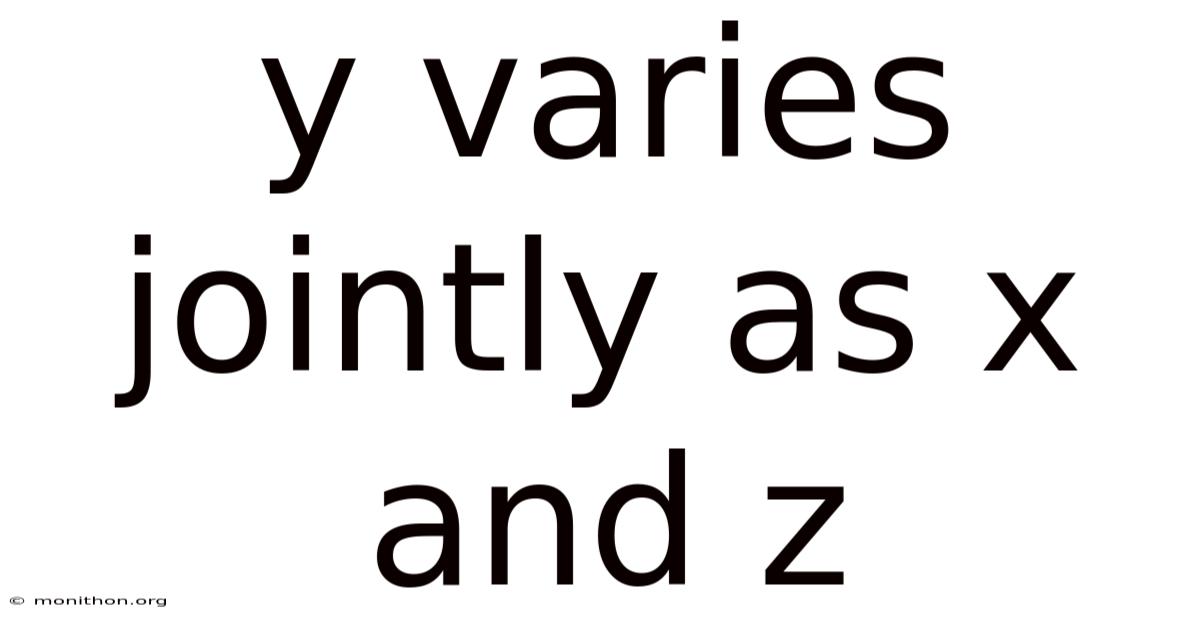
Understanding Joint Variation: When y Varies Jointly as x and z
Imagine you’re baking a large cake and need to scale a recipe. The total amount of flour, sugar, and eggs you need doesn’t just depend on one ingredient; it depends on the product of all three quantities you’re adjusting. This everyday scaling problem is a perfect real-world glimpse into a powerful algebraic relationship known as joint variation. In mathematics, when we say “y varies jointly as x and z,” we are describing a specific and very useful proportional relationship where the variable y is directly proportional to the product of x and z. This means if either x or z increases, y increases proportionally, provided the other remains constant, and vice versa. The formal equation capturing this is y = k · x · z, where k is the constant of variation, a fixed number that defines the precise nature of the relationship for that specific scenario.
This concept is foundational in algebra and appears repeatedly in physics, engineering, economics, and the natural sciences. Mastering it allows you to model complex interactions where an outcome is driven by multiple factors simultaneously. Unlike simple direct variation (y = kx) where one variable controls another, joint variation reveals how combined forces or quantities create an effect. This article will break down the mechanics, provide a clear problem-solving framework, explore diverse applications, and solidify your understanding so you can confidently identify and work with joint variation in any context.
The Core Definition and Formula
At its heart, joint variation describes a dependency. The statement “y varies jointly as x and z” translates directly into the equation: y = k · x · z
Here’s what each component means:
- y: The dependent variable. This is the quantity that changes based on x and z.
- x and z: The independent variables. These are the quantities that jointly influence y.
- k: The constant of variation or constant of proportionality. This is the most critical piece. It is a fixed, non-zero number that remains the same for all corresponding values of x, y, and z in a given relationship. Its value is determined from a single set of known data points.
Key Insight: The relationship is multiplicative. y is proportional to the entire product (x · z). If you double x while keeping z constant, y doubles. If you double z while keeping x constant, y also doubles. If you double both x and z, y becomes four times larger (2 · 2 = 4). This multiplicative nature is what distinguishes it from other variation types.
How It Differs from Direct and Inverse Variation
To fully grasp joint variation, it helps to contrast it with its close relatives:
- Direct Variation (y varies directly as x):
y = kx. y changes in direct proportion to a single variable x. - Inverse Variation (y varies inversely as x):
y = k/x. y changes in inverse proportion to a single variable x. - Joint Variation (y varies jointly as x and z):
y = k · x · z. y changes in direct proportion to the product of two (or more) variables.
You can also have combined variation, which mixes these types. For example, “y varies jointly as x and z and inversely as w” translates to y = (k · x · z) / w. The core principle remains: identify all proportional relationships and combine them multiplicatively.
Finding the Constant of Variation (k)
The constant k is the linchpin of the equation. Without it, the formula y = kxz is just a template. Finding k is always the first computational step when solving problems.
The Process:
- Identify the three variables (y, x, z) from the problem statement.
- Write the general joint variation equation:
y = k · x · z. - Substitute a given set of known values for y, x, and z into the equation.
- Solve for k. This will give you a specific number.
- Rewrite the specific equation for your scenario by plugging this k value back in:
y = (your k) · x · z. - Use this specific equation to solve for any unknown variable.
Example: Suppose a physical law states that the force of attraction (F) between two objects varies jointly with their masses (m₁ and m₂). If F = 100 Newtons when m₁ = 5 kg and m₂ = 2 kg, find the equation and then calculate
Latest Posts
Latest Posts
-
Scientific Questions That Cannot Be Answered
Mar 19, 2026
-
How To Work Out The Radius From The Circumference
Mar 19, 2026
-
What Is The Functions Minimum Or Maximum Value
Mar 19, 2026
-
Do Commas Go Inside Or Outside Of Quotes
Mar 19, 2026
-
Is 3 The Same As 30
Mar 19, 2026
